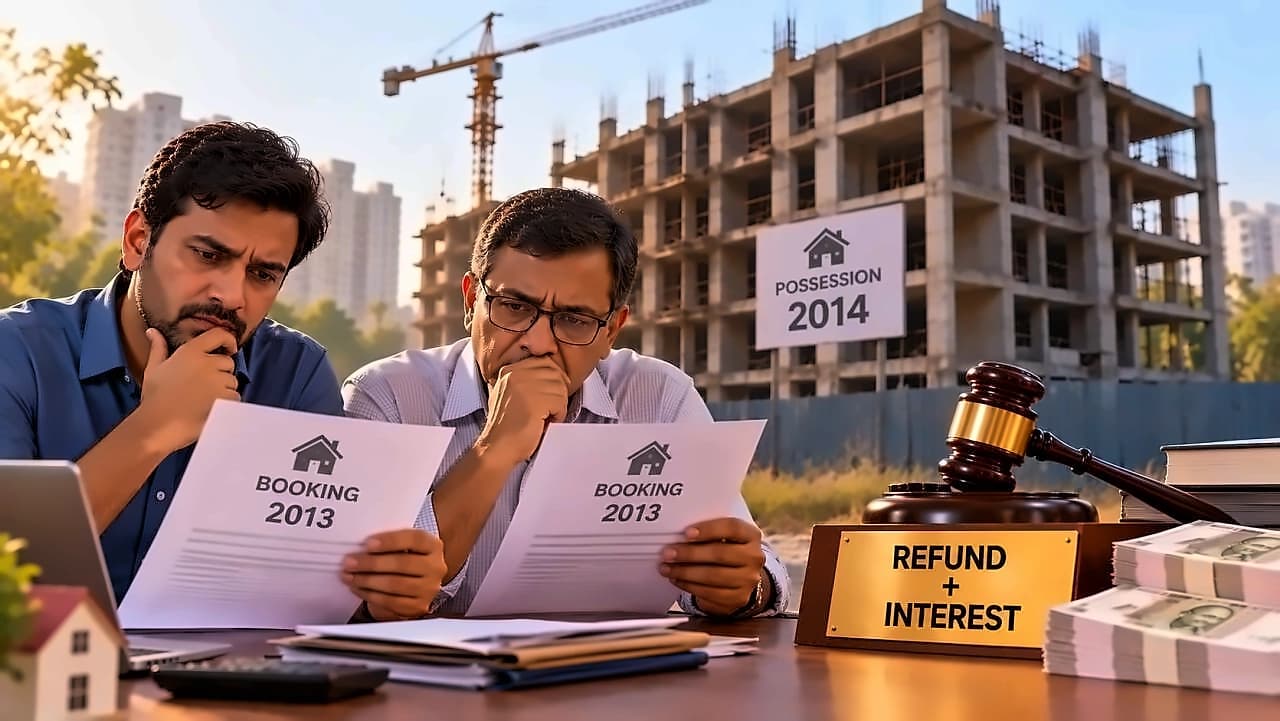
A recent Maharashtra Real Estate Regulatory Authority (MahaRERA) order has highlighted critical risks for homebuyers when relying on promises of future approvals. According to reports from Business Standard and Mint, the case involved the project Swami Krupaa, where buyers had booked flats on the sixth and seventh floors while the Commencement Certificate (CC) permitted construction only up to the fifth floor. MahaRERA eventually ordered the developer to refund the amounts established as having been paid towards the flats, along with interest, demonstrating the regulatory authority's stance on unauthorized floor bookings. The ruling serves as an important reminder that an allotment letter or RERA registration number does not automatically mean that the particular flat you are buying has been approved for construction.
The order records that the CC dated October 22, 2010 permitted construction only up to the fifth floor, while buyers had allotment letters for Flats 603 and 703 on the sixth and seventh floors respectively. As reported by Business Standard and Mint, the buyers' case was that they had booked these flats based on representations that approvals for the higher floors would subsequently be obtained. The order also records that architect certificates from 2017 and 2019 did not show progress on the upper floors, while no later approvals or relevant architect certificates were produced on record. The buyers said they booked the flats after being told that the necessary approvals for the additional floors would be secured subsequently.
According to Shashank Agarwal, founder of law firm Legum Solis, this discrepancy represents precisely the kind of issue a buyer should identify before committing money. As reported by Business Standard, booking a flat on a floor beyond the level covered by the CC creates a clear regulatory risk if the promised additional approval has not actually been obtained. Khushi Parmar, advocate at D.M. Harish & Co. LLP, noted that the documentary record was decisive in the MahaRERA proceedings, with evidence concerning payments, the project's incomplete status, the lapsed registration, and the absence of further approvals collectively supporting the buyers' case. For new homebuyers, this underscores why verbal assurances from a developer's sales team should not be taken as evidence that a required approval has been obtained.
Madhura Samant, founder of Elarra Law Offices, emphasizes that buyers should independently verify the Commencement Certificate, sanctioned plans, floor-wise approvals, MahaRERA registration and the project's status before committing funds. According to Business Standard and Mint, buyers should ask the developer to show the approval covering the exact floor and unit they are buying, and obtain the approval document rather than relying on a sales representative's assurance. The MahaRERA case also highlights the importance of maintaining a clean payment record, with experts recommending that buyers use banking channels wherever possible and preserve receipts for every instalment. Approval-related due diligence is only one part of the process, with buyers also needing to verify the stated possession or completion date to ensure it remains current.
Before paying a booking amount, buyers should verify the Commencement Certificate to determine which floors it actually permits, check whether the exact flat and floor match the approved sanctioned plan, verify subsequent approvals if additional floors are claimed to have been approved, and examine the project's RERA registration including progress filings and disclosures. As reported by Business Standard and Mint, buyers should ensure the promoter executes the required agreement for sale with unit details matching approvals, maintain a clean payment trail using banking channels with contemporaneous acknowledgements, and avoid unrecorded cash payments. The MahaRERA case ultimately directed the developer to refund amounts paid with interest and awarded ₹20,000 costs to each complainant. For new homebuyers, this case demonstrates the importance of seven key checks before paying for a flat: the Commencement Certificate, sanctioned plans, subsequent approvals, RERA records, agreement for sale, payment trail, and written promises.