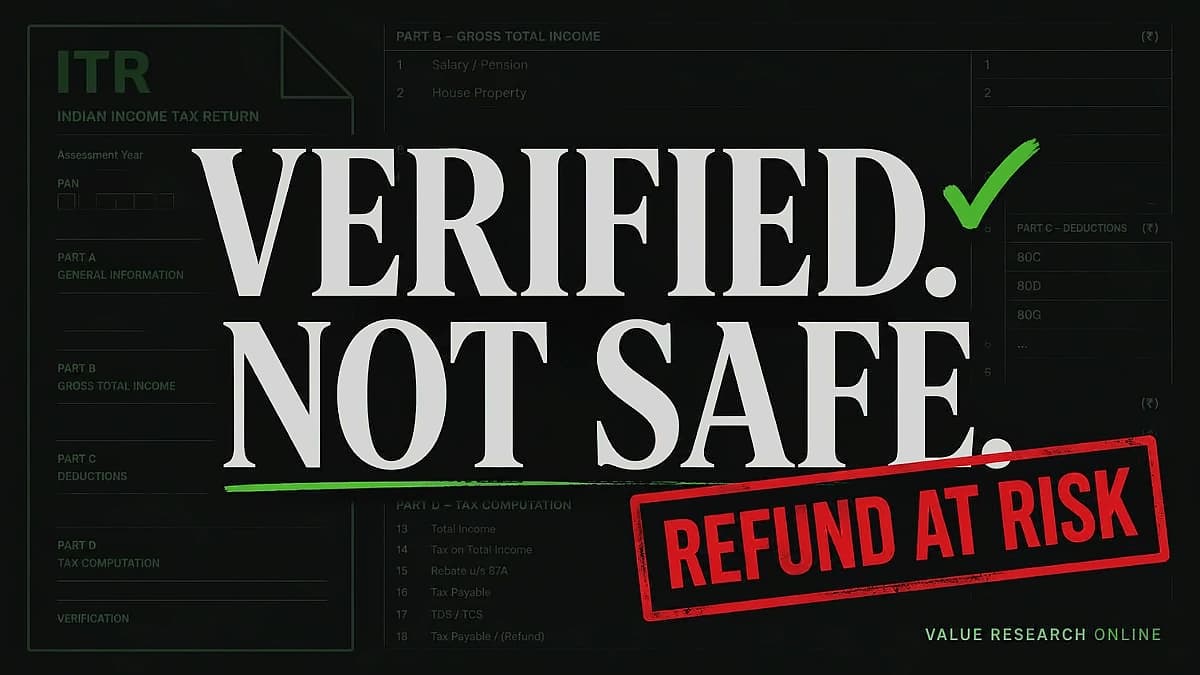
The Income Tax Department has set a strict 30-day deadline for ITR verification, with the deadline approaching on July 31, 2026. According to reports from Mint and Business Standard, taxpayers who have not yet filed or completed e-verification must act quickly to avoid their returns being treated as invalid. Filing income tax returns is only one part of the tax compliance process—it is considered complete only after successful verification within this 30-day window. As Savetaxs advises, your return will not be treated valid until it is e-verified, and completing the verification within the prescribed time limit using Aadhaar OTP, net banking, or other approved methods is essential. This year, unlike previous years, the Income Tax Department has already released utilities for ITR-1, ITR-2, ITR-3, ITR-4 and ITR-5, allowing taxpayers to start filing well in advance. With over 3 crore ITRs already filed as of July 23, 2026, the compliance momentum is strong, but experts caution that missing the deadline can have serious consequences. As per the Income Tax Department, an Income Tax Return must be verified after filing for it to be considered valid, and if the return is not verified within the prescribed timeline, it is treated as invalid under the Income-tax Act.

Since August 1, 2022, the IT Department has required taxpayers to complete verification within the 30-day window, replacing the earlier 120-day period. As reported by Mint and Business Standard, the IT Department begins processing returns only after verification is completed. E-verification remains the most preferred option because it is seamless, quick, and hassle-free, eliminating the need to send physical documents. Successful completion provides taxpayers with a transaction ID and on-screen confirmation, along with a confirmation email to their registered email address. According to Savetaxs, this verification process is crucial as it validates the income tax return and enables the tax department to begin processing it effectively. If taxpayers miss the deadline, they can submit a condonation request explaining the reason for the delay, but the return will only be considered valid if the Income Tax Department approves the request. The e-filing portal allows taxpayers to verify their returns online through multiple methods, eliminating the need to send a signed physical ITR-V to the Centralised Processing Centre (CPC) in most cases.
The IT Department offers multiple online verification options to suit different taxpayer preferences. According to Business Standard, the Aadhaar OTP method is the fastest and most commonly used, requiring an OTP sent to the mobile number linked with Aadhaar that must be entered on the e-filing portal. The Bank Account EVC method uses an Electronic Verification Code generated through a pre-validated bank account, while the Demat Account EVC method is available for investors with pre-validated Demat accounts. The Net Banking method allows taxpayers to log in through authorized bank portals, and the Digital Signature Certificate (DSC) method is mandatory for businesses, professionals, and taxpayers using DSC for secure digital authentication. As Savetaxs notes, taxpayers must ensure they provide correct pre-validated bank account details to avoid income tax refund delays or rejections. Additionally, the department allows verification through an EVC generated via designated bank ATMs and EVC through ATM (offline method) for enhanced convenience. Taxpayers using net banking can directly access the Income Tax e-filing portal through their bank's internet banking facility and complete the verification process without entering a separate OTP.
Taxpayers who do not wish to or are not eligible for e-verification can complete physical verification by printing the ITR-V acknowledgement form, signing it as per instructions, and sending it to the Centralised Processing Centre (CPC), Bengaluru, within 30 days of filing. As reported by Mint and Business Standard, completing e-verification within 30 days of filing and completing all steps enables quick disbursal of refunds. The verification process validates the income tax return and enables the tax department to begin processing it effectively. According to Savetaxs, completing the physical verification is important as it helps avoid mismatches or potential issues during the verification process. Before starting the e-verification process, taxpayers should ensure they have their PAN and acknowledgement number of the filed return, access to the registered mobile number, PAN linked with Aadhaar for Aadhaar OTP, PAN linked with the bank account, net banking activated if using that option, and a pre-validated and EVC-enabled bank or demat account if opting for EVC. Taxpayers should also ensure that basic prerequisites are in place before attempting e-verification, including linking PAN with Aadhaar, pre-validating a bank account, keeping the registered mobile number active and having the ITR acknowledgement number readily available.
Tax experts strongly advise against waiting for potential deadline extensions this year, citing the improved filing infrastructure and strong compliance momentum. CA Chandni Anandan from ClearTax emphasizes that with the July 31 deadline approaching, taxpayers should not wait till the last minute, especially now that over 3 crore returns have already been filed. CA Anshul Bhargava notes that the fact that 15 lakh-plus ITRs were filed in a single day and they've already crossed 3 crore shows taxpayers are getting serious about compliance. Experts recommend gathering all necessary documents including Form 16, interest certificates, and proof of income before filing, and reconciling income and TDS details with the Annual Information Statement (AIS) and Form 26AS to avoid mismatches. Jignesh Shah from Bhuta Shah & Co LLP warns that waiting for extensions can expose taxpayers to late filing fees, interest on unpaid tax liabilities, and delayed refunds, while Himank Singla advises taxpayers to avoid relying on social media speculation and file early to identify and rectify errors before the due date. With the ITR filing season in full swing, taxpayers should remember that submitting the return is only the first step. Completing e-verification within the prescribed timeline ensures that the return is treated as valid, refunds are processed without avoidable delays and compliance requirements are fully met.