The Gujarat High Court has established that a power of attorney holder cannot gift an owner's property to his own family members when the document does not authorise such a transfer. According to the court's judgment dated 15 July 2026 in Purshotam Ranchhodbhai Pankhania & Ors. v. Harihar Ambalal Patel & Ors., the court held that a power of attorney executed by a principal comes to an end on the principal's death. The ruling was delivered by a division bench comprising Justice Ilesh J. Vora and Justice R. T. Vachhani. The court emphasised that "a Power of Attorney is strictly construed; acts beyond the expressly or necessarily implied authority are void and do not bind the principal."
The case involved Purshotam Ranchhodbhai Pankhania, who was living in London with his wife, and their property in Vadodara's Sayajigunj area measuring approximately 3,200 square feet. The property was purchased through a registered sale deed dated 16 September 1999 with consideration paid by cheque. The couple had given powers of attorney to their acquaintance, Harihar Ambalal Patel, to deal with their affairs and property in India. Pankhania's wife died in London on 21 July 2010, but the POA documents remained with Patel. As per the court's analysis, "the POAs did not authorise the attorney to make a gift of Pankhania property in Vadodara."
On 5 January 2011, around six months after Pankhania's wife's death, Patel executed a registered gift deed transferring the property in favour of his own son and daughter-in-law. According to Patel's defence, he claimed Pankhania had taken around £78,000 from him for starting a business and had not repaid the money. Patel alleged that Pankhania had suggested the property transfer as an adjustment against the alleged debt, making the gift deed a legitimate transaction rather than unauthorised. However, the court noted that "Patel had no knowledge about Pankhania's wife's death, signed a gift deed on January 5, 2011 and gave Pankhania's Sayajigunj property to his own son and daughter-in-law."
The High Court examined the legal authority contained in the powers of attorney rather than treating the alleged financial dealings as sufficient authority to transfer the property. The court relied on Section 201 of the Indian Contract Act, 1872, which states that agency is terminated by the death of the principal. The bench rejected Patel's plea that he was unaware of Pankhania's wife's death and held that he could not rely on the POA to execute transactions after the death of the principal. The court examined both POAs and found they authorised the attorney to "buy, sell, exchange, mortgage, manage property, settle accounts, compromise claims, etc. – all acts involving consideration." However, "there was no clause authorising a gift (transfer without consideration)."
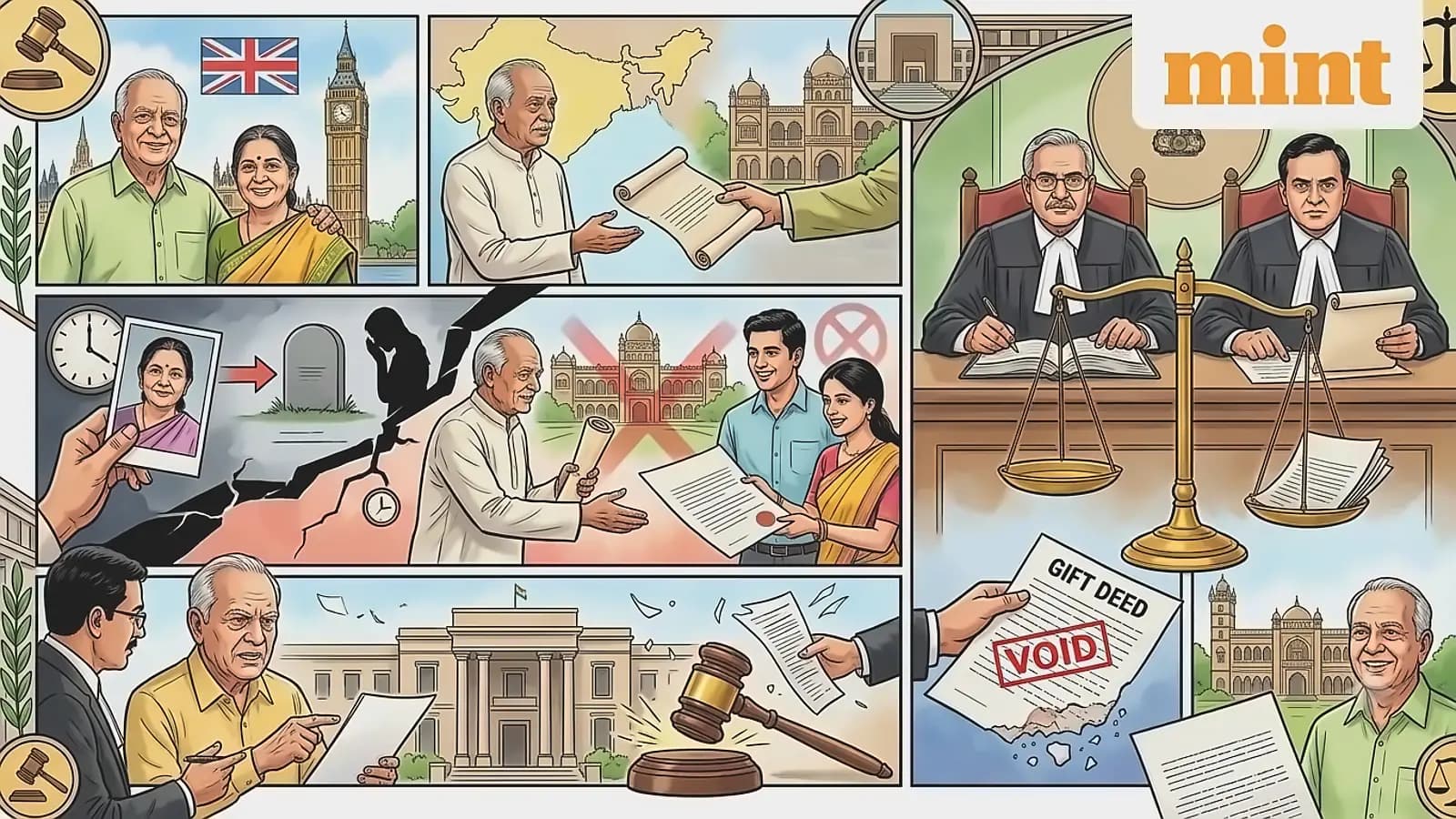
The court emphasised that a power of attorney must be construed strictly, with an attorney exercising only those powers expressly granted or necessarily implied. The existence of powers relating to dealing with or managing property could not be stretched to include the power to make gratuitous transfers. The court held that the gift was made in favour of Patel's own family members, which fell outside the authority granted under the POA. Since Patel's authority had ended, his alleged financial claims could not substitute for the required POA authority, and any independent financial claims between the parties could not provide valid power to gift Pankhania's property. The court also distinguished previous judgments on construction of deeds, stating they were "inapplicable on the facts."