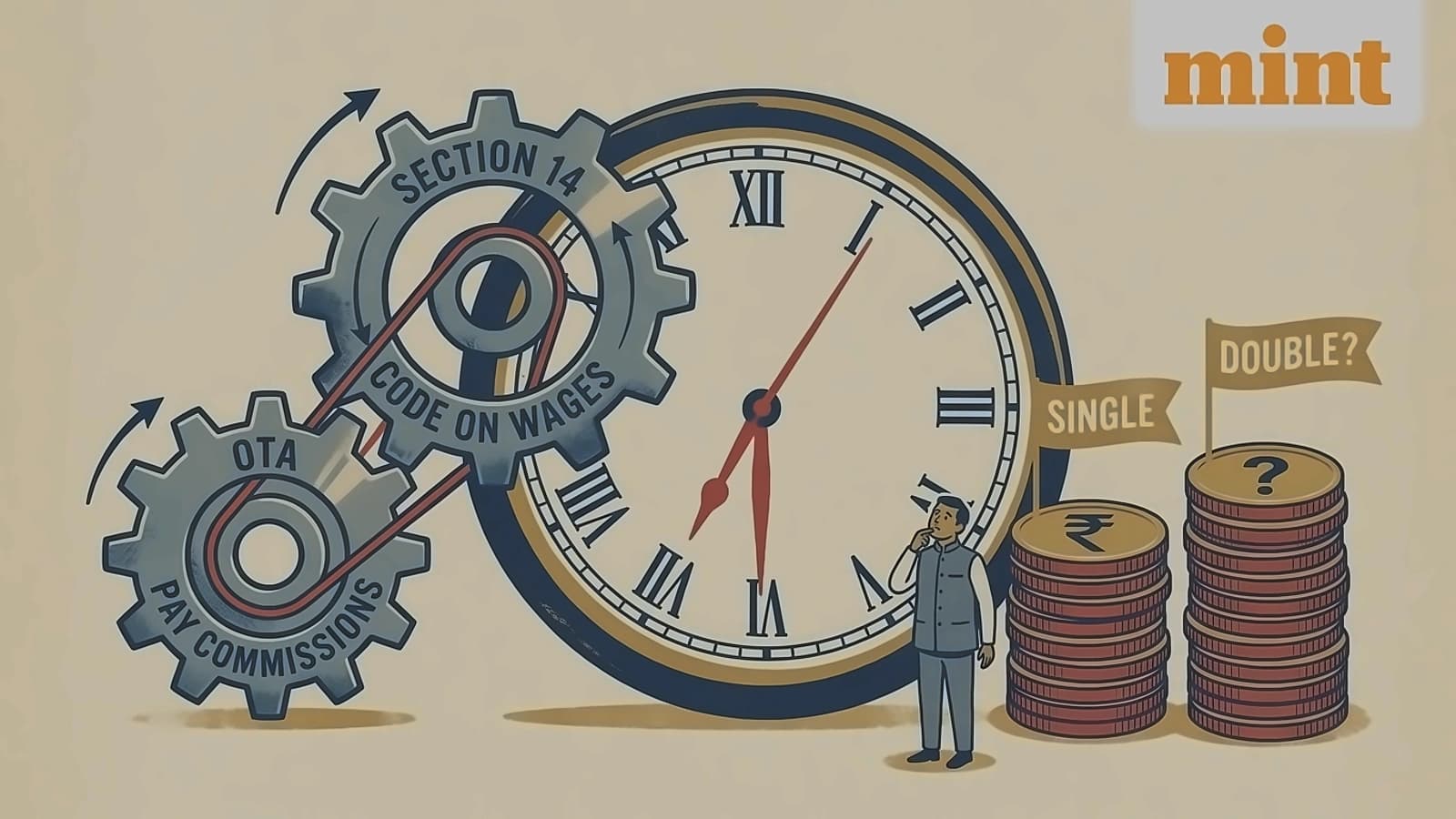
The Department of Personnel and Training (DoPT) has clarified that the Code on Wages, 2019 does not automatically revise overtime allowance (OTA) for Central government employees. According to reports from Mint and Financial Express, this clarification came during the Lok Sabha session on 5 August 2026, when the government was specifically asked about OTA revisions after the wage code implementation. The DoPT stated that OTA for eligible non-gazetted Central government employees continues to be governed by recommendations of respective Pay Commissions and applicable government orders. The latest clarification makes clear that employees should not interpret Section 14 as an automatic revision of Central Government OTA rates or as a blanket extension of overtime benefits to categories that are currently excluded.
Under Section 14 of the Code on Wages, employees working beyond normal working hours are entitled to overtime at a rate of at least twice the normal rate of wages, subject to the conditions and coverage of the law. As reported by Mint and Financial Express, the Labour Ministry's compliance handbook identifies working hours and overtime as provisions covered under this section. However, this does not mean every Central government employee working extra hours automatically gets double-rate OTA entitlement. The Code establishes a statutory overtime benchmark of at least twice the normal rate where its overtime provisions apply, but this does not automatically replace the existing Central Government OTA framework.
The Centre's response indicates that overtime for eligible Central government employees remains linked to separate rules governing their service. According to Financial Express reports, the government stated that hourly OTA rates applicable to eligible employees were prescribed through an Office Memorandum issued on 19 March 1991. This 1991 order establishes the framework for overtime payments and provides for compensatory leave in circumstances where overtime work is performed. The latest clarification confirms that these rates have not been revised, based on decisions taken by the Department of Expenditure on recommendations of successive Pay Commissions. The 7th Pay Commission-related decision in 2018 had also discontinued OTA for several categories, retaining it only for Operational and Industrial employees covered by statutory provisions.
For eligible non-gazetted employees, the new wage code has not changed their existing OTA entitlement by itself. As reported by Mint and Financial Express, employees must still fall within a category covered by applicable government rules to claim the allowance. The government's response specifically does not announce any extension of OTA benefits to gazetted Central government employees who are currently outside the benefit category. The existing Central Government framework continues to determine who is eligible for OTA and at what rate, with the Code on Wages providing a separate provision for overtime payment. The key distinction is that the existing OTA framework does not provide a general overtime allowance to all Central Government employees simply because they work beyond their regular hours.
The existing government framework shows that OTA is not simply payment for every extra hour worked, with the 1991 instructions stating overtime should generally be avoided through proper work organization. According to Financial Express reports, any change in existing rates or extension of benefits to currently excluded categories, including gazetted employees, would require separate government decisions. The implementation of the Code on Wages from November 21, 2025, does not automatically mean that all Central Government employees working beyond normal hours will start receiving overtime at double their regular rate. The government has retained the existing category-based approach, under which only eligible employees receive OTA. The hourly OTA rates for eligible Central Government employees have not been revised since they were prescribed in March 1991, even though basic pay, allowances and other components of government employees' compensation have changed over the years.