Financial advisors, fund managers, and sell-side equity researchers consistently recommend stock investments throughout market cycles, with 'Buy' ratings on majority of stocks they cover according to reports from NDTV Profit. As noted by finance writer Vivek Kaul, these 'OPM wallahs' (people who manage other people's money) earn earnings linked to assets under management (AUM), portfolio performance, or number of investors they bring into schemes. Mutual fund distributors also earn higher trail commissions on equity-oriented schemes than on debt schemes, creating a default recommendation structure that prioritizes market participation over risk awareness. Recent market events demonstrate this pattern, with markets correcting meaningfully following 'Liberation Day' tariff announcements and the Iran war onset in March 2026, yet fully recovering within weeks despite continued negative headlines.
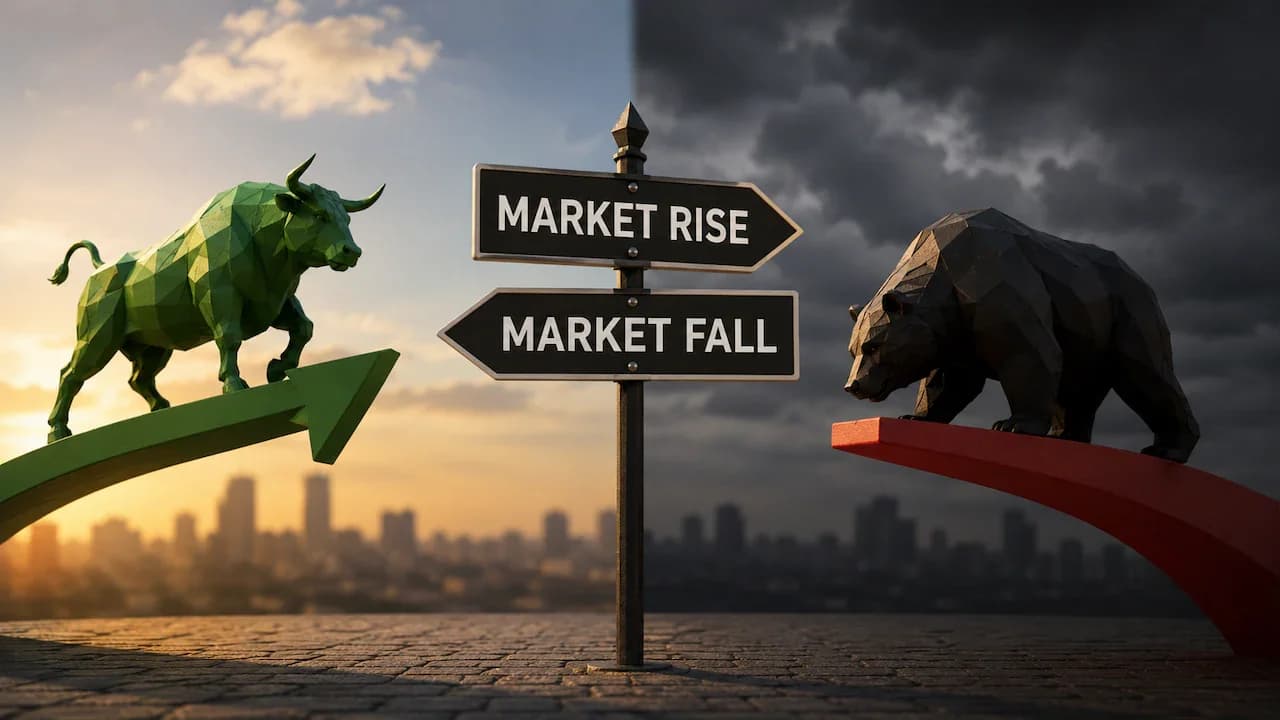
Investor psychology plays a crucial role in maintaining market optimism, with recently delivered strong returns over the last four to five years leading investors to assume 20% annual returns are normal rather than exceptional as reported by NDTV Profit. This is reinforced by denialism - our tendency to avoid information we don't like, causing high valuations, slowing earnings, and market cycles to slowly disappear from conversations. Bull markets amplify this effect, with almost every portfolio making money leading investors to believe their strategies are working effectively. However, recent events show that markets tend to respond before headlines improve, meaning investors who react emotionally risk missing recovery opportunities. As J.P. Morgan Asset Management data reveals, the S&P 500's average intra-year decline was 14.2% from 1980 through 2025, yet annual returns remained positive in 35 of those 46 years.
India's retail investor base has experienced dramatic growth, with unique investors on NSE increasing from 3.1 crore in March 2020 to 11.3 crore by March 2025 and 13.1 crore by May 2026 according to NDTV Profit data. More than half of new investors are under 30 every year, with the proportion rising from 235 out of every 1,000 investors under 30 in March 2020 to 381 by May 2026. This demographic shift has created expectations of 20-30% normal returns, leading many investors to stop investing during market corrections. As Hartford Funds research demonstrates, missing just the 10 best days would have reduced a $10,000 S&P 500 investment to about $85,000 over the past 20 years, highlighting the cost of emotional decision-making during market volatility.
Recent market data reveals a broadening market participation that contradicts bubble concerns, with emerging markets leading gains at 24% through June while the S&P 500 managed only 10% returns. US small caps delivered 23% gains and large-cap value stocks achieved 15% returns, significantly outperforming the tech-heavy Magnificent 7 stocks which declined 3% despite being the most hyped segment. This stronger market breadth is generally viewed as a healthier environment as the market becomes less reliant on fewer stocks or sectors, with the loudest, most hyped parts of the market actually becoming the worst performers. The SpaceX IPO example demonstrates this pattern, pricing at $135 per share and opening up 19% on its first day, but falling 33% from its high of $225 within just two weeks, while quieter segments like emerging markets and small caps continued their steady climb.
SEBI's Investor Survey 2025 found that 97% of respondents struggled to understand risk and uncertainty before investing, with 93% becoming inactive because of poor portfolio performance afterwards according to NDTV Profit. Nearly 45% admitted they had expected quick riches, highlighting the gap between return expectations and understanding of market cycles, valuations, and diversification. This survey underscores the need for financial advisors and finfluencers to address these fundamental issues more frequently and at appropriate times throughout market cycles. The challenge is that the average investor has historically underperformed the S&P 500 by about 6% over the long term due to emotional responses to headlines and gut feelings, causing buying after runups and selling after declines that materially reduce long-term returns.