Shiv Sena (UBT) Legislature Party leader Aditya Thackeray has formally written to Prime Minister Narendra Modi, urging the Centre to reconsider the mandatory use of ethanol-blended fuel. According to NDTV Profit, Thackeray stated that the Union government's push for ethanol-blended fuel has impacted consumers across the country and created a ripple effect on the broader economy. In his letter, Thackeray emphasized that the ethanol issue should not be made into an issue of tussle of the Union Government forcing it on Indian citizens to support a particular interest group, and a choice should be made available at affordable rates. This development comes as C-Voter survey revealed that more than half of NDA supporters do not want the ethanol-blended petrol, with 52.5% of NDA supporters saying they do not want E20 petrol and only 18.1% voicing support.
The government has released fact sheets addressing common concerns about E20 fuel, with Union Minister Nitin Gadkari defending the programme while acknowledging that motorists who prefer 100% petrol can buy it but will have to pay more than for ethanol-blended fuel. According to Business Standard, the government argues that E20 petrol is no longer cheaper because ethanol itself has become a costlier input, citing sharp increases in procurement prices. Ethanol made from C-heavy molasses increased from ₹46.66 per litre in ESY 2021-22 to ₹57.97 in ESY 2024-25, while maize-based ethanol rose from ₹52.92 to ₹71.86 per litre over the same period. However, the same NITI Aayog report that recommended E20 transition also suggested considering tax incentives for E10 and E20 fuels to compensate consumers for lower fuel efficiency, yet the government's fact sheets do not disclose corresponding refinery or depot costs, blending expenses, or tax incidence on each component of E20 fuel.
The Supreme Court hearing on petitions challenging the E20 policy has intensified the controversy, with Attorney General R Venkataramani referring to E20 as an 'experiment' during proceedings. According to The Times of India, the remark quickly went viral, fuelling fresh criticism and renewed focus on the 2021 NITI Aayog roadmap that recommended a phased transition. The government later clarified that Venkataramani had used the term only in the context of ethanol supply volumes and not the E20 policy itself, with the Attorney General telling Reuters that his comments had been misunderstood. Congress leader Priyank Kharge has accused the Centre of treating motorists as 'guinea pigs', claiming the government was conducting 'an experiment on 3.6 crore Indians' while 'mileage is plummeting' and 'engines are getting bust'. NCP (SP) MLA Rohit Pawar has questioned the policy, alleging that 'pushing ethanol blending beyond 20% in older vehicles will cause technical damage' and demanding that the Centre 'Roll back E20. First, prove. Then, deploy.'
Chennai-based entrepreneur Sachin George has documented widespread complaints from vehicle owners following the mandatory E20 petrol rollout from April 1, 2026. According to his findings, vehicles purchased before 2023 are experiencing significant issues including reduced mileage, increased repair costs, and mechanical failures. George's personal vehicles - two Honda Activas, two motorcycles, and a Maruti Ciaz - all show reduced fuel efficiency after the E20 transition. His motorcycles, which previously delivered 35 kmpl, now give only 20-23 kmpl, while the Activas that earlier delivered 35-40 kmpl in city conditions now return only 28-30 kmpl. Government-backed studies by the Automotive Research Association of India (ARAI), Indian Oil and SIAM estimate that fuel efficiency may decline by around 3-4%, while fuel consumption could increase by up to 6% in some vehicles. However, GEMA President C K Jain conceded that there is a 3-5% drop in mileage, but emphasized that this should be viewed as a gain for reducing pollution and saving foreign exchange rather than a loss for taxpayers. At Delhi's price of ₹102.12 per litre, a car delivering 20 kilometres per litre has a fuel cost of about ₹5.11 per kilometre. If mileage declines by 3-5%, the cost increases to approximately ₹5.26-5.37 per kilometre, assuming the pump price remains unchanged, requiring the fuel to be priced about 3-5% lower to offset the mileage loss entirely.
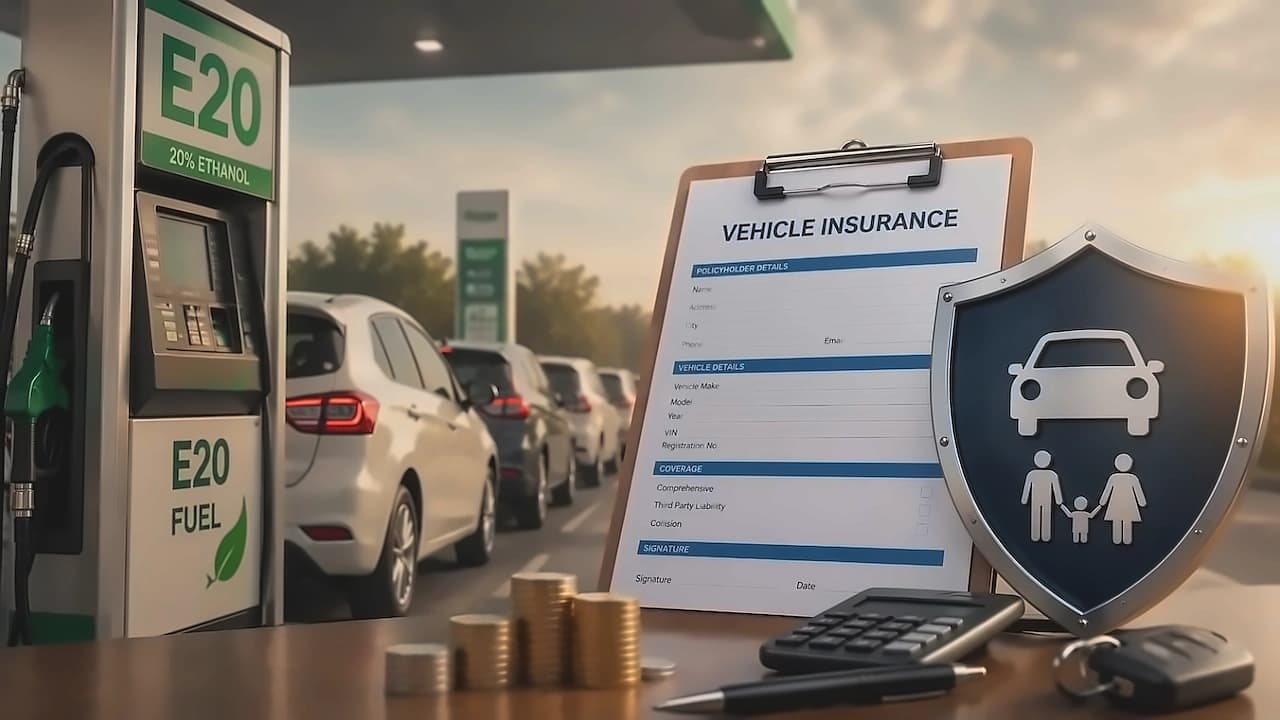
According to GEMA, India has sufficient ethanol manufacturing capacity at 1,800 crore litres, while current consumption remains around 1,200 crore litres only, indicating significant excess capacity. The E20 programme production capacity has expanded nearly fivefold from 421 crore litres in 2014 to about 2,000 crore litres in 2026. This expansion has reduced crude oil imports and saved valuable foreign exchange, while also lowering greenhouse gas emissions and strengthening farmers' incomes through new market opportunities. GEMA's Jain emphasized that India should aim for maximum self-reliance with 85% ethanol blending, targeting 25-30% blending of crude oil replacement, noting that 100% replacement is not possible but achievable through alternative energy sources. The government dismissed viral claims that ethanol production consumes 10,000 litres of water for every litre produced, stating that modern ethanol plants use only 3-5 litres of processed water per litre of ethanol and operate using Zero Liquid Discharge (ZLD) systems.
Despite the government's explanation of E20 pricing, consumers still lack a transparent price build-up, cost-per-km comparison and retail tax concession for the blended fuel. According to Business Standard, the publicly available Indian Oil price build-up for Delhi shows a price charged to dealers of ₹81.08 per litre, excluding VAT, with dealer commission of ₹4.45 and VAT of ₹16.59, taking the retail price to ₹102.12 per litre. The Petroleum Planning and Analysis Cell (PPAC) lists only the consolidated retail price build-up for 'petrol' rather than separate calculations for E20 and unblended petrol. E20 avoids the additional basic excise duty of ₹2 per litre on unblended petrol, giving it an explicit tax advantage over unblended petrol, while state taxes add another layer with Delhi currently levying VAT of 19.40% on petrol. The NITI Aayog roadmap had anticipated this problem, recommending price incentives through tax relief at the retail level to support the transition and compensate consumers for reduced fuel efficiency, yet the government's fact sheets do not disclose the corresponding refinery or depot cost of petrol, blending expenses, or tax incidence on each component of E20.