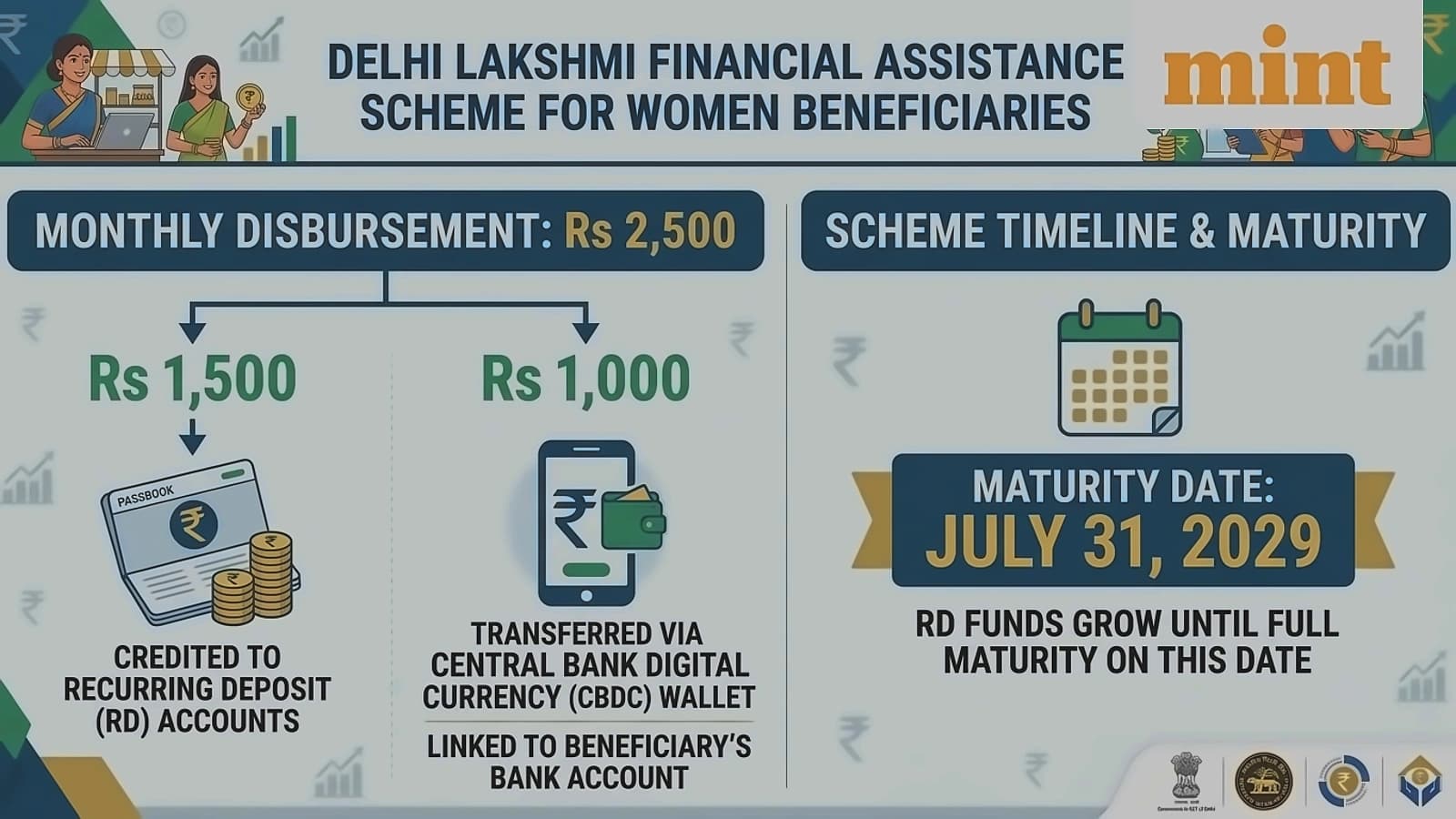
The Delhi state government has established a maturity date of 31 July 2029 for the recurring deposit component under the Delhi Lakshmi Yojana, according to reports from PTI. The scheme document reveals that the Council of Ministers has been empowered to review and change the maturity period after two years of the scheme's launch. This timeline aligns strategically with the next Lok Sabha polls scheduled for 2029, providing political context for the scheme's structure.
The Delhi Lakshmi Yojana, launched on 26 August 2026, provides eligible women beneficiaries with ₹2,500 monthly through a structured approach. As reported by PTI, ₹1,500 is credited to a recurring deposit account with a lock-in period until 31 July 2029, while ₹1,000 is transferred through a Central Bank Digital Currency (CBDC) wallet linked to the beneficiary's bank account. Beneficiaries can alternatively choose to receive the entire ₹2,500 monthly in their recurring deposit account. The CBDC wallet comes with spending restrictions and cannot be used for items on the scheme's negative list, which includes alcoholic beverages, tobacco products, narcotic drugs, lottery tickets, gambling, and betting.
The scheme targets women between 21-60 years of age who are the eldest female member of their family, with only one woman per household eligible for benefits. According to the scheme document, applicants must have annual family income not exceeding ₹2.5 lakh and resided in Delhi for at least 10 years. The applicant, her husband, or parents must be registered voters in Delhi, while income-tax payers, GST filers, and government employees are excluded. Additionally, families consuming more than 2,400 units of electricity annually and those owning four-wheelers are not eligible. Applicants without Aadhaar can register using alternative documents including PAN card, ration card, voter identity card, passport, or driving license.
The enrollment process is being conducted by the Women and Child Development Department, which facilitates Aadhaar enrollment for beneficiaries who have not obtained the identity number. As reported by PTI, beneficiaries can seek Aadhaar enrollment while completing registration, with iris or face authentication and Aadhaar-based OTP available for cases where biometric quality fails. When these methods prove unsuccessful, benefits may be provided against a verified physical Aadhaar letter carrying a QR code. The scheme aims to support up to 17 lakh beneficiaries across the national capital, with about 4,000 beneficiaries receiving sanction letters on 26 August and first monthly disbursements scheduled from 1 September.