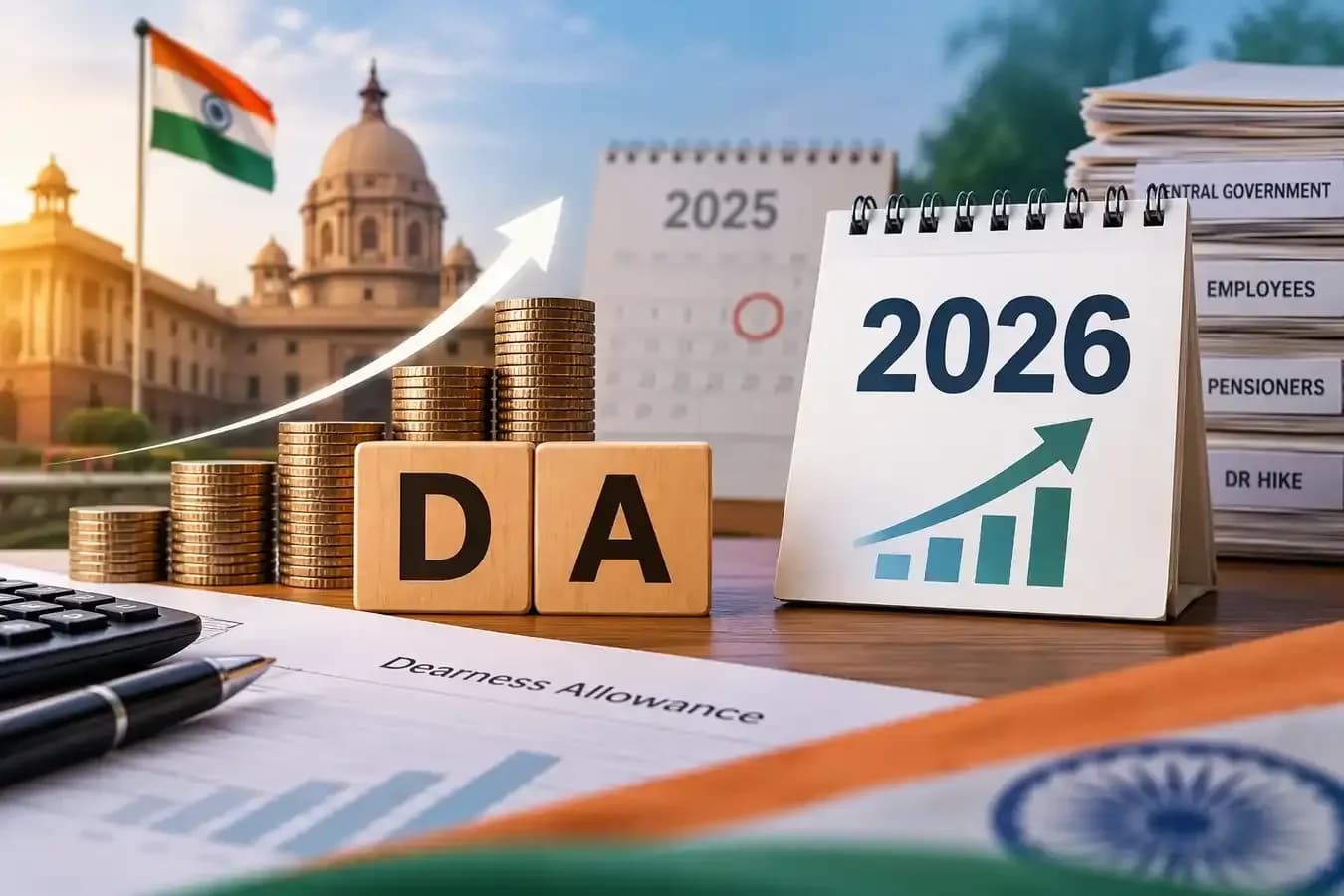
Central government employees and pensioners are awaiting the next Dearness Allowance (DA) hike announcement for July 2026, though officially this remains pending as the June data from the Labour Bureau's AICPI for Industrial Workers (AICPI-IW) is yet to be released. The last DA hike was announced in April 2026, when the Finance Ministry increased DA from 58% to 60% of basic salary, effective from 1 January 2026. According to reports from Mint, AICPI-IW trends indicate that a 3-4% DA hike could be likely, with the index showing progression from 149.1 in March 2026 to 150.8 in May 2026, with an estimated 151.7 for June 2026. The Centre usually updates DA biannually using data from the All-India Consumer Price Index (AICPI), with new announcements made in March and October, and rollouts in January and July.
The latest government data shows retail inflation in June 2026 rose to 4.38%, while food inflation climbed to 5.32%, as reported by Mint. The final DA hike calculation will depend on the June 2026 AICPI-IW data and government approval. DA hikes are calculated based on the AICPI's 12-month average using the method prescribed by the 7th Pay Commission, with the formula being DA percentage = [(Average of AICPI (Base Year 2001 = 100) for the last 12 months – 261.42) / 261.42] x 100 for central government employees. Notably, Dearness Relief (DR) for pensioners is calculated similarly, with the component known as DA in salary being called DR in pension benefits.
Even if no DA hike is announced in July 2026, central government employees and pensioners could still see a second increase sometime in the second half of the year during the festive season, according to Mint reports. Last year, Labour Minister Ashwini Vaishnaw in October announced that the Union Cabinet cleared a 3% DA increasing the component to 53% of basic pay. The previous year in 2024, the Centre announced an increase ahead of the Diwali festive season, with Diwali this year in November, so beneficiaries could expect a 'Diwali gift' sometime in October or November 2026. Recent state-level developments show West Bengal hiked DA and DR for state government employees by 20% with effect from October, taking components to 38% of basic salary. The Indian Banks' Association (IBA) also announced revised DA and DR for workmen and officer employees across levels for the months of May, June and July 2026, hiking basic salaries between ₹48,000 to ₹1,17,000 and DA from ₹435 to ₹1,050.
Several state governments are actively considering DA hikes for their employees. Kerala is reportedly considering a 2% DA hike for state government employees to be disbursed in their August salaries, ahead of Onam festivities, with estimates pegging the additional expenditure at around ₹60 crore. Punjab government on 30 May said it will consider payment of pending DA and DR dues to state government employees for the period between 1 July 2021 to 31 March 2024, with a sub-committee discussing payment of arrears for employees and pensioners based on revised salary and pension benefits for the period between 1 January 2016 to 30 June 2021. Himachal Pradesh is reviewing DA and pending arrears for state employees and pensioners, with the state also announcing it will pay employees their full salary including DA and HRA when availing study leave. West Bengal expressed satisfaction with the 20% hike announced in the state budget last month, with teachers' organisations expecting another hike to clear the remaining 22% by December. Maharashtra greenlit payment of ₹800 crore DA arrears under the 5th, 6th and 7th CPCs for November and December 2025, and January 2026, and 2% DR hike for retired All India Services officers.
Approximately 50 lakh central government employees and around 65 lakh retired central government pensioners, including defence and railway personnel and retirees, will benefit from an increase in DA and Dearness Relief (DR) components, as reported by Mint. There are 18 levels of employees, and the individual hikes will depend on the employee's or pensioner's level, as basic pay differs from level to level. The 7th CPC stipulated that DA be merged with basic salary if it exceeds 50%, with the component now at 60% of basic pay and potentially rising further if another hike is announced. Notably, in India, DA and DR are only provided by the central government for its employees and retirees, with the private sector not offering the same for employees or pensioners. Recent state-level developments show West Bengal hiked DA and DR for state government employees by 20% with effect from October, taking components to 38% of basic salary. Various state governments have also increased salaries to close gaps with the central government, with Arunachal Pradesh, Assam, Odisha, Tamil Nadu and Uttar Pradesh each approving 2% hikes, while Bihar implemented 2% hike for staff under the 7th pay commission, 5% hike for employees under 6th CPC and 9% for staff under 5th CPC.
Reports suggest that another DA hike announcement could come this year amid inflationary pressures and as employees and pensioners seek relief against steadily rising living expenses, according to Mint. The 8th Pay Commission is expected to submit its final recommendations around 18 months after its constitution, which means the earliest announcement is February or April 2027. Based on past trends, once the pay commission's recommendations are made, the rollout takes another two to three years to complete, meaning hikes announced in 2027 may only be fully implemented by 2029 or 2030. Various employee groups have made detailed submissions to the commission, with the National Council — Joint Consultative Machinery (NC-JCM), Maharashtra Old Pension Organisation and All India Defence Employees Federation (AIDEF) demanding comprehensive pension restructuring and improvements. The demands include increasing minimum pension to 67% of the Last Pay Drawn, revising fitment factors, expanding family pension benefits, and introducing progressive age-based pension enhancement up to 100% of the LPD for pensioners aged 90 years and above.