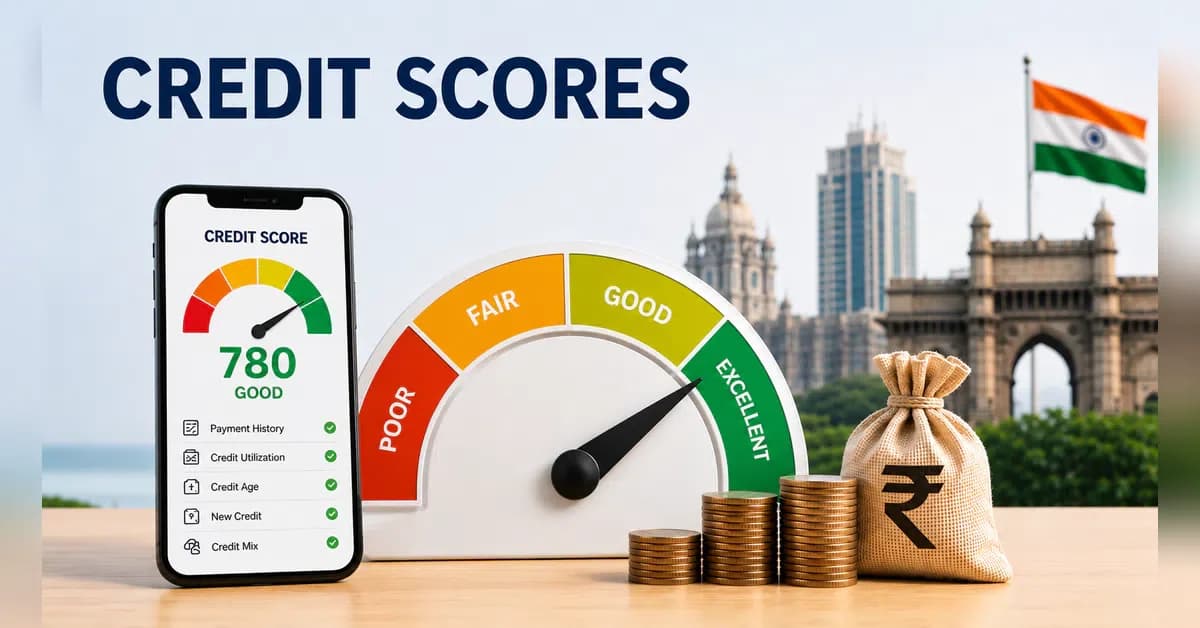
A salary hike provides real room to fix credit scores that have dropped below 600 due to limited financial capacity. When earning ₹10,000 to ₹30,000 monthly, even a ₹5,000 EMI consumes 20-50% of salary, leaving little room for emergencies. A salary increase from ₹22,000 to ₹28,000 provides ₹6,000 extra that can clear small overdue balances, set up autopay systems, and build emergency buffers. The key is channelling extra income into credit recovery before lifestyle spending absorbs it. As reported by Hero FinCorp, missing one EMI reduces the score by 50-70 points and affects future borrowing ability, making timely payment automation crucial for recovery.
Credit scores in India range from 300 to 900 and serve as a three-digit indicator of credit risk to lenders based on past behavior. According to reports from Mint, these scores are calculated by four prominent credit bureaus regulated by the Reserve Bank of India (RBI) - CIBIL, CRIF High Mark, Equifax, and Experian. While each CIC has their own scoring model, the overall credit health should remain consistent regardless of which bureau is chosen. The scores are not fixed and can be improved gradually over six months to a year through responsible financial habits. As per Hero FinCorp, a 725+ CIBIL score is considered a magic number by lenders, indicating consistent repayment behavior and financial stability.
Credit bureaus evaluate several key factors when calculating scores. Timely bill payments demonstrate repayment history and credit discipline, while the weight of current credit bills compared to overall eligibility indicates fiscal strength through assessments of investments, personal assets, and savings. The number of active credit lines and repayment time for each, along with the type of credit lines (credit cards, home loans, personal loans, secured or unsecured loans), are crucial metrics. Additionally, credit activity including recent applications and active concurrent loans examines loan purposes and potential repayment conditions. According to Hero FinCorp, missing one EMI will reduce the score by 50-70 points and affects future borrowing ability. The debt-to-income ratio (DTI) is also critical, with lenders increasing interest rates or reducing eligibility if more than 40-50% of income is spent on EMIs.
When implementing a salary hike strategy for credit recovery, the approach should focus on automation and buffer building. If your salary increases by ₹5,000, allocate ₹2,000 toward your smallest outstanding balance and ₹2,000 into a payment buffer in savings. Call your lender and request EMI date shifts to within 3-5 days after salary credit to prevent 80% of accidental late payments. Set up bank autopay for every active EMI and minimum credit card dues. For high-interest credit card debt at 36-42% interest, consider a Gold Loan at 10-12% interest to convert revolving debt into structured payments. This strategy can lift scores by 40-70 points in 4 months while replacing unpredictable debt with fixed monthly obligations.
The interest rate on a 3 lakh personal loan in India ranges from 10% to 24% per annum, varying with factors such as lender policies, credit score, and income stability. At 11% interest, a 3 lakh loan for 3 years brings EMI of about ₹9,800, while at 18% rate, the EMI increases to around ₹10,800. This difference may seem small, but the total interest varies by ₹25,000 to ₹40,000 over the loan tenure. Borrowers with a 725+ CIBIL score can save between ₹20,000 and ₹45,000 compared to those with lower scores, as reported by Hero FinCorp. The employment type plays a vital role, with salaried individuals with fixed monthly income considered lower risk, while self-employed may face greater scrutiny due to income differences.
As reported by iDiva, a CIBIL score of 700 or higher is usually deemed satisfactory, though most creditors prefer even higher scores for easier processing and more favorable terms. The classification system shows 650-699 as good (moderately likely), 700-749 as very good (likely), 750-900 as outstanding (very likely), and 900 as maximum (most reliable). For loan applications, a satisfactory score of 650-700 is acceptable, while better scores enable faster approval, with premium cards requiring 750 or more. Different products may have slightly different expectations, making an ideal CIBIL score of 750+ adequate for most financial requirements. Even with excellent scores, lenders assess other factors including employment type, income stability, and repayment history before final approval. A satisfactory score of 680 is the minimum for most credit products, while 700+ scores unlock better terms and faster approvals.