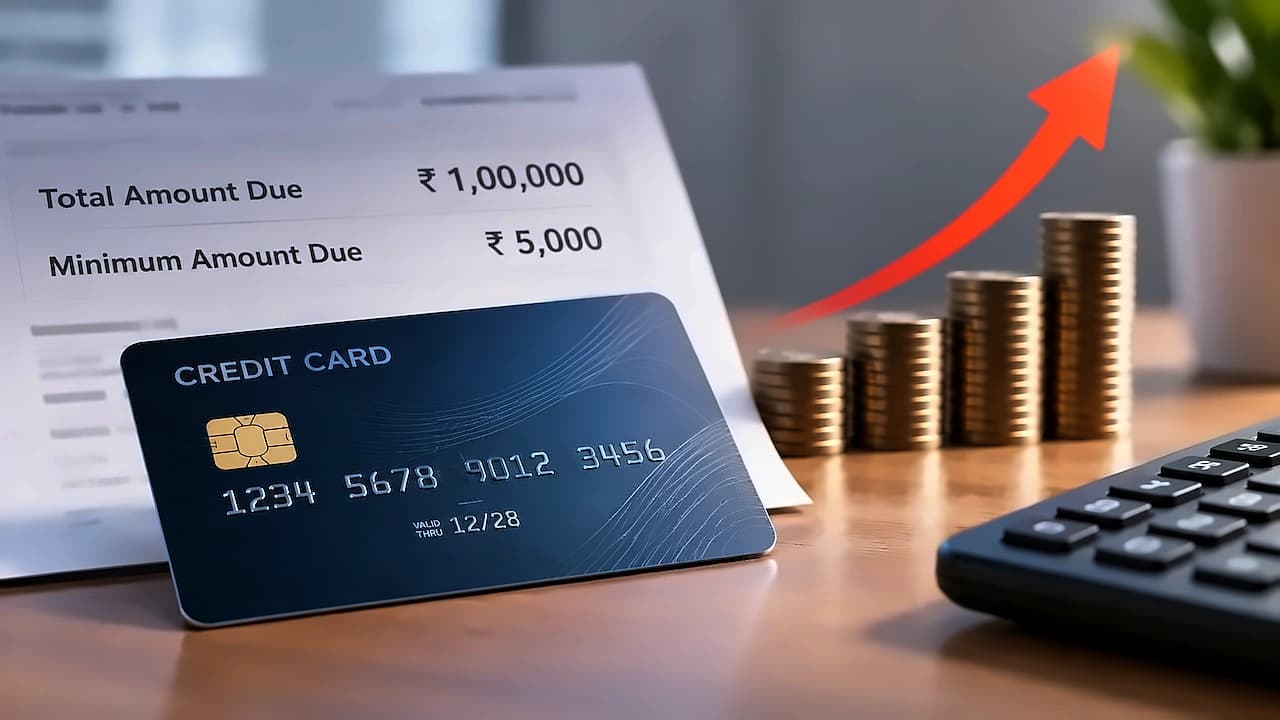
Recent data from FREED demonstrates the devastating impact of minimum payment cycles on credit card debt. After 12 months of consistent minimum payments, a borrower with a ₹48,000 to ₹50,000 balance has reduced their debt by only ₹10,000 to ₹12,000. The borrower paid ₹36,000 in minimum dues over those 12 months, yet still owes the same amount they started with. Most critically, ₹24,000 to ₹25,000 of the total paid went to interest, not principal reduction. This represents almost two-thirds of total payments going to interest charges, highlighting the trap mechanism where interest compounds faster than payments can reduce the principal balance.

The minimum payment trap operates through a fundamental mathematical disadvantage where interest charges consume most of each payment. At 3.5% monthly interest (equivalent to 42% annually), a ₹60,000 credit card balance accrues ₹2,100 in interest every month. If the minimum due is ₹3,000, only ₹900 actually reduces the principal. The remaining ₹59,100 balance accrues another ₹2,069 in interest the following month. This cycle repeats indefinitely, creating a debt that persists despite consistent payments. The minimum due amount is strategically set low enough to feel manageable but high enough that most payments go to interest rather than principal reduction. Doubling the minimum payment every month reduces the repayment timeline dramatically, while paying five times the minimum can clear most balances within 12 to 18 months.
Credit card debt traps form through recognizable patterns that create a cycle of accumulation and minimum payments. The most common pattern is gradual balance accumulation: starting small from emergencies or overspending, growing slightly each month due to only minimum payments, and compounding over 6 to 18 months into amounts that feel impossible to address. The second pattern involves balance transfer dependency: moving balances to new cards offering 0% promotional rates, using the promotional period for progress, then finding balances haven't been cleared when rates reset to 40% and starting the minimum payment cycle again. The third pattern is festive season spikes: significant credit card spending during Diwali or other festive periods, carried forward because bills are too large to clear in one go, then minimum-paid month after month while interest compounds. In all three cases, the trap mechanism remains the same: minimum payments keep accounts technically current while interest ensures balances barely move.
For balances that can be cleared within 12 to 24 months through disciplined repayment, self-directed strategies work effectively. The most important first step is stopping new charges immediately by removing credit cards from all spending contexts and switching to debit cards or UPI. For balances above ₹3 to 5 lakh or where aggressive payments produce negligible progress, professional debt consolidation or resolution through companies like FREED becomes appropriate. FREED's Debt Consolidation Programme combines all credit card balances into one lower monthly payment at reduced effective interest rates, while their Debt Resolution Programme negotiates settlements with banks, typically accepting 40% to 70% of total outstanding including accumulated interest. Personal loan consolidation at 12% to 20% interest can save 20 to 28 percentage points in annual interest rates, with savings of ₹40,000 to ₹56,000 on a ₹2 lakh outstanding in the first year alone.