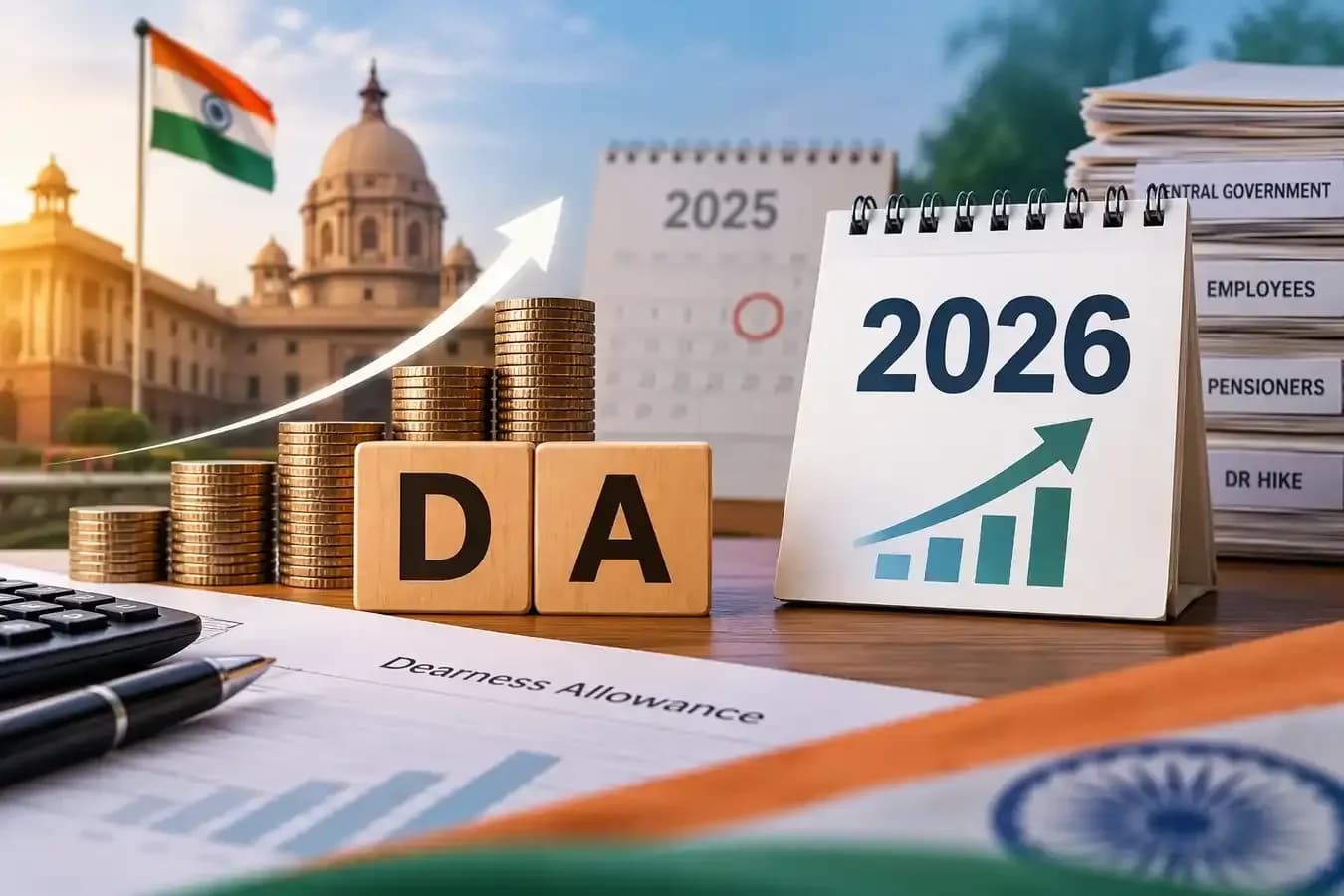
The June 2026 Consumer Price Index for Industrial Workers (CPI-IW) data has completed the calculation for the July 2026 Dearness Allowance revision under the 7th Central Pay Commission. According to reports from Financial Express, the Labour Bureau released the June 2026 CPI-IW on July 31, standing at 151.9, up from 150.8 in May. Since June is the last month considered for the July DA revision, the inflation data required for the calculation is now complete. The DA works out to about 63.75% of basic pay, indicating a payable rate of 63%, subject to approval by the Union Cabinet. The calculation effectively settles the debate over whether the July 2026 DA increase would be 3% or 4%, as the CPI-IW reached 63.75% but is rounded down to 63% after dropping the decimal portion. Latest AICPI-IW data shows a notable rise of 0.8 points in a single month, strengthening expectations of another DA increase from 1 July 2026.
If approved, the DA will rise by 3 percentage points, increasing the allowance from 60% to 63% of basic pay. As reported by Financial Express, for an employee with a basic pay of ₹18,000, the increase would translate into an additional ₹540 a month (₹10,800 to ₹11,340). Those drawing a basic pay of ₹35,400 could see an increase of about ₹1,062 per month (₹21,240 to ₹22,302), while employees with a basic pay of ₹56,100 may receive roughly ₹1,683 more every month (₹33,660 to ₹35,343). Since the revised rate will be effective from 1 July 2026, employees and pensioners are also expected to receive arrears once the revised DA is approved and notified. The July 2026 revision is unlikely to be the final DA hike under the 7th Pay Commission, as the Union government has constituted the 8th Pay Commission but it is yet to submit its recommendations. Current projections indicate that employees may receive a 3% to 4% increase in DA, providing welcome relief against rising prices.
The final DA and Dearness Relief (DR) rates will become official only after the Union Cabinet approves the proposal and the Department of Expenditure issues the notification. According to Financial Express, in previous years, the government has typically announced the July DA revision around September or October, often ahead of Diwali. The Union Cabinet is expected to approve the July 2026 DA hike in September or October, following the usual practice of announcing after the Labour Bureau releases the June CPI-IW data. Employees and pensioners will receive the revised amount along with arrears from July once the Cabinet approves the revision. With the 8th Pay Commission expected to submit its report only in 2027 and its recommendations likely to come into effect towards the end of 2027 or early 2028, employees could still receive at least two more DA hikes before the new pay structure replaces the existing one.
Under the 7th Central Pay Commission, the revision is linked to the 12-month average of the Consumer Price Index for Industrial Workers (CPI-IW) published by the Labour Bureau. As reported by Financial Express, the formula was recommended by the 7th Central Pay Commission and has been followed since 2016. When a new Pay Commission is eventually implemented, accumulated DA is not paid separately but merged with the existing basic pay to create a revised pay matrix, and future DA calculations begin afresh under the new pay structure. This happened when the 7th Pay Commission replaced the 6th Pay Commission, where central government employees were receiving 125% DA under the 6th Pay Commission before the 7th Pay Commission came into force on January 1, 2016. The accumulated DA was merged into basic pay, a new pay matrix was introduced, DA was reset to 0% and future DA increases started again from zero under the new pay structure. The DA calculation formula under the 7th CPC is DA(%)=(12-Month Average AICPI-IW-261.42)/261.42×100.
Based on the latest AICPI-IW trend, DA increases appear almost certain with a minimum increase of around 3% looking achievable. Should inflation continue to rise in the coming months, the increase could potentially reach 4 percentage points. Experts estimate that if the AICPI-IW remains stable during May and June 2026, DA is expected to increase by at least 3 percentage points. Should inflation continue to rise, the increase could potentially reach 4 percentage points. The DA revision also benefits pensioners through Dearness Relief (DR), with pensioners receiving proportionately larger increases. For example, pensioners with a basic pension of ₹25,000 would see their DR increase from ₹15,000 to ₹15,750, providing additional relief to offset rising cost of living and inflation. The expected July 2026 DA increase is separate from the ongoing work of the 8th Central Pay Commission, as DA revisions continue under existing government rules until a new pay structure is approved.