The **Karnataka High Court has upheld amendments to the Employees' Pension Scheme, 1995 (EPS-95), rejecting a challenge by retired employees who argued that changes introduced in 2007 and 2008 had reduced their monthly pension benefits. A division bench comprising Chief Justice Vibhu Bakhru and Justice C.M. Poonacha delivered the judgment on October 14, 2026, in Employees Provident Fund Organisation and Another vs Mr Subbannachary and Others. The ruling is significant for pensioners covered by the Employees' Provident Fund Organisation (EPFO), particularly those whose retirement benefits were calculated under the disputed provisions.
The National Confederation of Pensioners' Associations (NCPA) has escalated its opposition to EPFO's January 18, 2025 circular by writing to President Droupadi Murmu seeking intervention in the EPS-95 higher-pension issue. According to Mint, the association, which represents over 1 million pensioners from public sector undertakings and exempted provident fund establishments, submitted a memorandum dated October 23, 2026, urging the President to direct EPFO to withdraw the controversial circular. The NCPA alleges that the circular 'weaponises a technicality regarding the historical language of internal trust rules of exempted establishments', transforming past legal compliance into a bureaucratic trap to mass-reject legitimate higher pension applications.
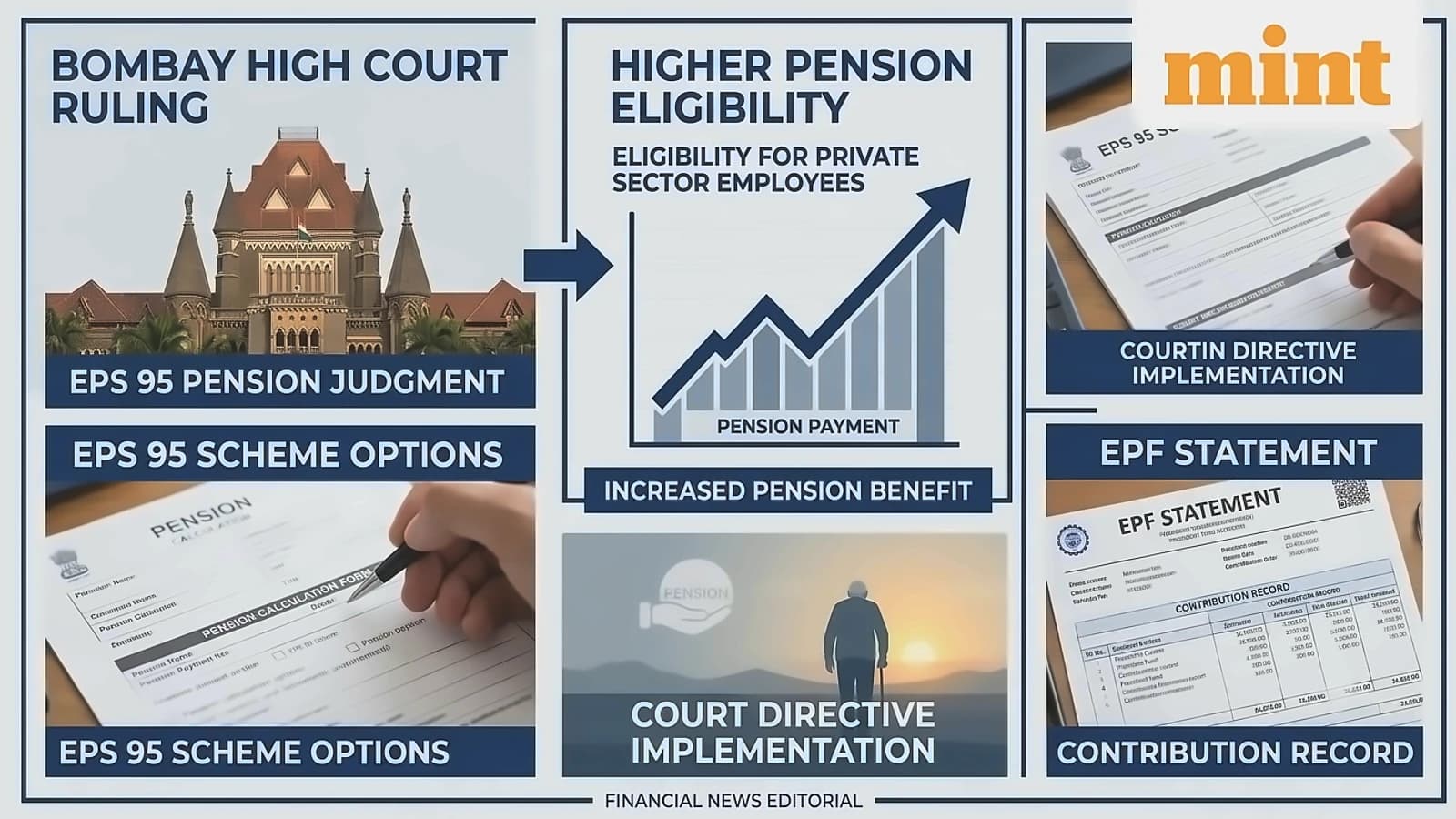
The Bombay High Court has ruled that EPFO cannot reject eligible private sector employees' EPS 95 higher-pension applications solely because their employer's PF trust rules cap contributions. According to reports from Mint, Justice Sandeep V. Marne set aside EPFO orders rejecting applications filed by over 40 private-sector employees of establishments including Abbott India, Tata Communications, Raymond Steel and BEST Undertaking. The court directed EPFO to process and allow the petitioners' joint options within eight weeks. As reported by Legal Service India, the employees won the case on October 19, 2026, establishing a significant precedent for higher pension rights.
The ruling clarifies that eligible employees who contributed to their PF on actual salaries above the statutory ceiling can seek a higher pension by opting to calculate pension contributions on higher wages, subject to the scheme's conditions. As reported by Mint, this joint option allows employees and employers to seek pension based on higher wages instead of being restricted to the statutory ceiling. For example, if an employee's salary was ₹40,000 a month and PF contributions were made on that actual salary, the employee may seek a higher pension based on higher wages, subject to eligibility and required contributions. According to Legal Service India, the court emphasized that a joint option cannot be rejected on the ground that the PF Trust rules either envisage a cap/ceiling or employer's contribution. The court specifically ruled that 'the common issue of law which is involved in these Petitions is whether private trust rules of a provident fund trust of an exempted establishment under the Employees' Provided Fund and Miscellaneous Provisions Act, 1952 (EPF Act) can govern the contribution to the Employees' Pension Fund of employers or restrict the exercise of Joint Option under paragraph 11(3) /11 (4) of Employees' Pension Scheme,1995 (EPS, 1995)'.
According to Mint reports, some employers had their own PF trusts because their establishments were exempted from the usual EPF arrangement. The trusts' internal rules restricted contributions to the statutory wage ceiling or did not expressly provide for higher pension contributions. EPFO relied on these rules to reject the employees' joint-option applications, citing missing documents or questions about contributions on eligible salary components. The NCPA cites the Madras High Court Division Bench ruling of July 9, 2026, which held that 'internal trust rules are merely administrative arrangements for Provident Fund and cannot override parent legislation (under EPS-95) enacted by Parliament'. As reported by Legal Service India, EPFO had also relied on its head office circular dated January 18, 2025, which required higher-pension eligibility in cases involving exempted PF trust establishments to be determined with reference to the applicable PF trust rules.
As reported by Mint, the court set aside the EPFO orders and directed authorities to process and allow petitioners' joint options for higher pension within eight weeks. The ruling clarifies that an employer's PF trust rules, by themselves, cannot be used to deny an otherwise eligible employee access to the statutory higher-pension option. According to Legal Service India, the court ruled that EPFO has to accept their joint declaration for a higher EPS pension and then decide the application on its merits, subject to the terms and conditions specified. However, the judgment does not automatically entitle every EPFO member to a higher pension - employees must still meet applicable eligibility conditions, required contributions and other relevant requirements. The statutory wage ceiling limit was revised to ₹15,000 in 2014 and again revised to ₹25,000 in 2026. Importantly, as clarified by the court, the ruling does not make higher pensions available to all EPFO members automatically - employees still need to satisfy the eligibility criteria and contribution requirements under EPS-95.
The NCPA has requested three key interventions from the President: immediately withdraw the January 18, 2025 circular, halt adversarial litigation and ensure uniformity, and waive punitive interest while expediting claims. According to Mint, the association cited a parliamentary disclosure of August 10, 2026, showing that more than 1,49,806 higher pension orders have been issued. The NCPA alleges that pensioners within the same PSUs, including SAIL, HAL, BHEL, IOCL, HMT, BEL and ITI, are being treated differently depending on their units and geographical postings. The association pointed to the Supreme Court's judgments in R.C. Gupta (2016) and Employees' Provident Fund Organisation vs. Sunil Kumar B. (2022), arguing that the legal framework for higher pension under EPS-95 is already settled. The NCPA also referred to a Ministry of Labour and Employment communication of May 31, 2023, which attributed confusion over higher pension claims to 'EPFO's own mismanagement'.