Specialised Investment Funds (SIFs) require a ₹10 lakh minimum investment, but this threshold is calculated at the Asset Management Company (AMC) level rather than per strategy. According to Nitin Agrawal, CEO of Mutual Funds by InCred Money, investors can split their investment across multiple SIF strategies offered by the same AMC, with the combined value counting toward meeting the threshold. The ₹10 lakh check applies across all SIF strategies of a given AMC, not to each strategy separately, as reported by Mint.
SIF strategies are broadly divided into equity-oriented, debt-oriented, and hybrid strategies depending on asset type and approach. Equity-oriented strategies include Equity Long-Short Fund, Equity Ex-Top 100 Long-Short Fund, and Sector Rotation Long-Short Fund. Debt-oriented strategies comprise Debt Long-Short Fund and Sectoral Debt Long-Short Fund. Hybrid strategies encompass Active Asset Allocator Long-Short Fund and Hybrid Long-Short Fund, as detailed in the report.
Sebi tracks eligibility at the individual investor level (PAN) for each AMC separately, with the ₹10 lakh threshold calculated across all SIF strategies of a given AMC. Sougata Basu, Founder of CashRich, explained that each folio and holding mode tagged to one PAN gets added up across investment strategies under that SIF. Using an example, if an AMC offers Hybrid Long-Short and Equity Long-Short strategies, an investor can invest ₹6 lakh in one and ₹4 lakh in the other, meeting the combined ₹10 lakh threshold. However, ₹5 lakh invested in SIF of AMC A and ₹5 lakh in SIF of AMC B would not qualify, as the threshold is calculated separately for each AMC, according to Mint reports.
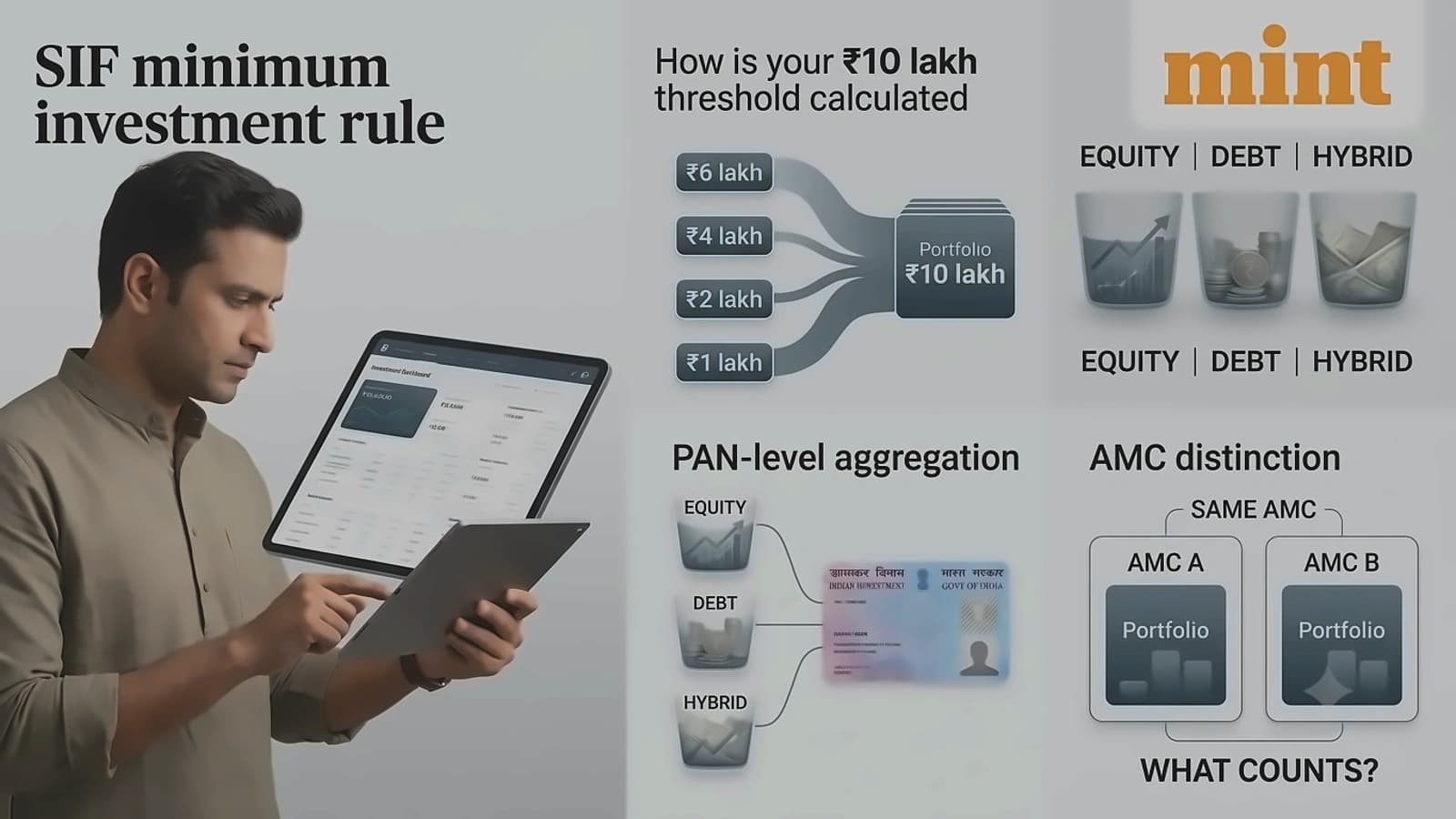
Regular mutual fund investments with the same AMC are excluded from the ₹10 lakh SIF threshold, even if the investor holds crores in regular schemes. As reported by Mint, someone with ₹50 lakh in regular schemes and ₹8 lakh in SIF strategies does not meet the threshold. Sebi-accredited investors are exempt from the minimum investment requirement, along with mandatory investments made by AMCs on behalf of designated employees under the 'skin-in-the-game' requirement, according to Agrawal's explanation.
All three investment methods - SIP, SWP, and STP - are permitted in SIFs, subject to one binding condition: the aggregate SIF investment at the PAN level must stay at or above ₹10 lakh through these transactions. Once the threshold is met, these facilities work broadly similarly to regular mutual funds, as noted by Agrawal. The report clarifies that after a passive breach due to market movements or NAV decline, partial redemption is not allowed - the investor must redeem the entire remaining investment, while active breaches due to investor actions result in frozen units requiring restoration within 30 calendar days.