Short Duration Mutual Funds represent a strategic investment category for risk-averse investors seeking stable returns over shorter investment horizons. According to reports from Goodreturns, these funds invest in fixed income instruments including bonds, government securities, and money market instruments with a Macaulay duration of 1 to 3 years as mandated by SEBI. The funds are designed for investors who want to park money for 1 to 3 years without the volatility of equity markets, offering a middle ground in the debt fund universe that is safer than long-duration bond funds while providing better returns than liquid or ultra-short funds. In contrast to common notions that mutual funds are only for long-term investors, these funds offer a wide range of options for risk-averse investors to park their money for shorter periods without worrying about market volatility.
Short-duration mutual funds offer several compelling advantages for investors. As reported by Goodreturns, the funds benefit from lower interest rate risk due to their capped portfolio duration, making NAVs far less sensitive to RBI rate changes compared to long-duration bond funds. In the current RBI rate-easing environment (2025-26), these funds benefit from bond price appreciation on top of interest income, often beating Fixed Deposit returns on a post-tax basis. The funds also provide high fluidity with no lock-in period, allowing redemption at any time with proceeds credited within 1-2 business days. Additionally, gains are taxed as per income slab if held under 3 years, with long-term capital gains treatment available for investments beyond 3 years, which is more tax-efficient than FD interest for investors in the 30% tax bracket. These funds occupy a rare sweet spot as stable, liquid, tax-smart investment options in a country where fixed deposits are losing their shine due to inflation concerns.
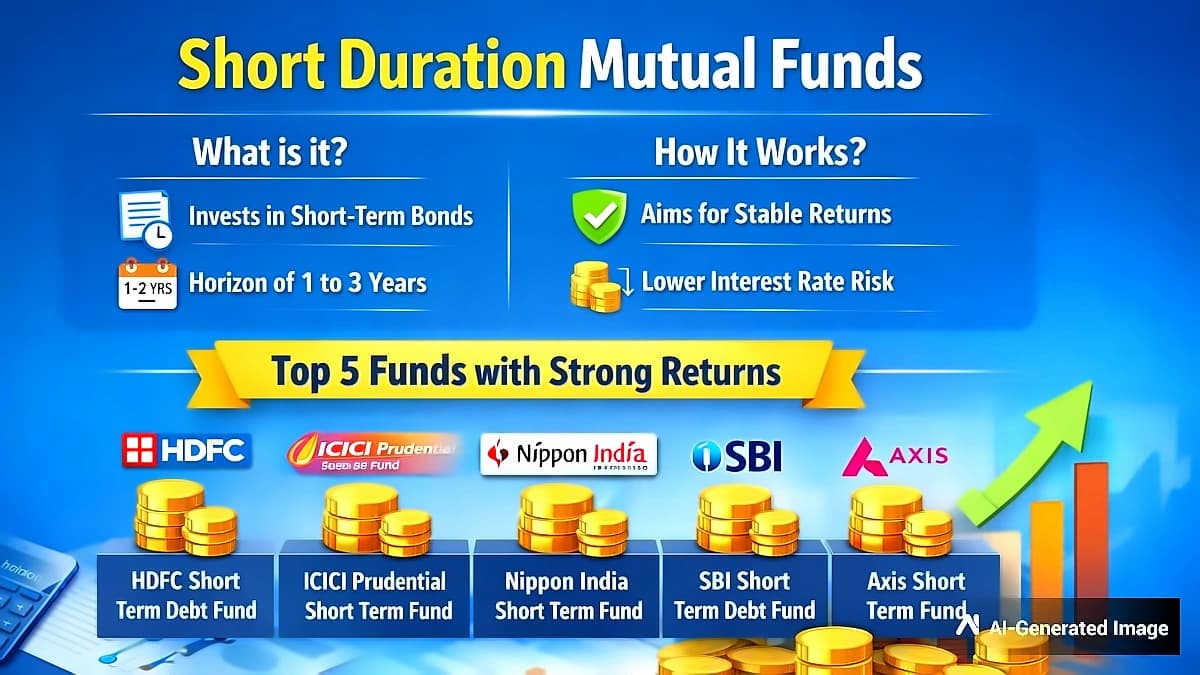
According to AMFI data reported by Goodreturns, the ICICI Prudential Short Term Fund leads the performance charts with a 1-year return of 4.63% and 3-year return of 7.01%, significantly outperforming its benchmark of 3.87% and 6.56% respectively. The fund has a daily AUM of ₹21,389.30 crore and carries a Moderate riskometer rating. Other top performers include the Axis Short Duration Fund with a 1-year return of 4.37% and 3-year return of 6.87%, the HDFC Short Term Debt Fund with 4.14% and 6.97% returns respectively, and the Bandhan Short Duration Fund with 4.00% and 6.74% returns. The Nippon India Short Duration Fund rounds out the top performers with a 3-year return of 6.77%. The latest data shows the Sundaram Short Duration Fund has also emerged as a strong performer with a 3-year return of 3.95%.
Recent developments in the mutual fund space include the launch of target maturity funds by SBI Mutual Fund, India's largest mutual fund house. According to Mint, SBI recently launched two funds: the SBI CRISIL-IBX 10:90 Gilt + SDL Index – Dec 2029 Fund and the SBI Nifty G-Sec Jul 2031 Index Fund, both featuring fixed maturity dates. These passive debt index funds hold a defined basket of bonds until every security in the portfolio matures, with the fund name carrying the maturity date. As per Mint, these are passive schemes where the fund manager does not actively pick bonds but tracks a preset index, buying and holding constituents until maturity. The held-to-maturity structure means interim bond yield movements do not affect final returns, as investors stay put until the fund closes.
Market experts suggest strategic approaches to maximize returns from short-duration funds. Joydeep Sen, a corporate trainer and author, notes that when yields are relatively high, investors can buy these funds and hold them until maturity, essentially locking into the yield available at the time of investment. According to Mint, Vikram Dalal from Synergee Capital Services recommends that target maturity funds are suitable for investors who can match their investment horizon with the fund's maturity date, though early exits may not fetch the fund's indicative yield at launch. A strategic approach involves laddering investments across funds with different maturity dates - one maturing in 2027, another in 2029, and a third in 2031, allowing reinvestment at prevailing rates as each tranche matures. Each fund combination carries different yield and credit profiles, with pure G-Sec funds offering highest sovereign safety while SDL and PSU bond funds typically offer marginally higher yields.