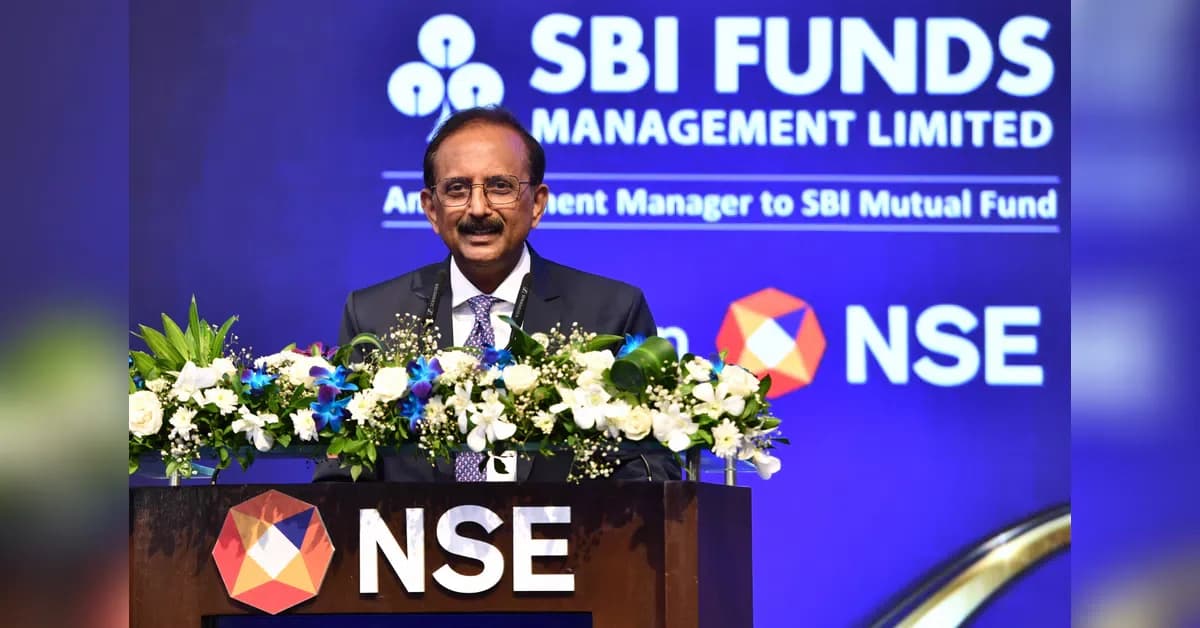
State Bank of India (SBI) Chairman C S Setty announced on Tuesday that the bank does not plan to dilute any further stake in its asset management subsidiary, SBI Funds Management, following its stock market debut. According to reports from Business Standard, Setty stated that any future decision regarding stake dilution would be guided by public shareholding requirements, with the same approach applying to joint venture partner Amundi. As reported by The Economic Times, Setty clarified that "the whole dilution process will depend on the holding norms of the Securities and Exchange Board of India. This is true for Amundi also. So, we don't intend to look for any further dilution." Speaking on the occasion, Setty emphasized that "The listing of SBI Funds Management marks a defining milestone in the Company's journey and reflects the trust that millions of investors have placed in us over the years. We are deeply grateful for the overwhelming confidence shown by investors across all categories." Following the listing, only two large subsidiaries of SBI remain unlisted — SBI General Insurance and SBI Pension Funds. As per The Financial Express, Setty indicated that "We will certainly look for opportunities to list the other subsidiaries as they evolve and mature and reach a stage where listing makes sense."
The asset management company made a subdued debut on the bourses, listing at ₹613.30 on the National Stock Exchange (NSE), representing a premium of 7% over its issue price of ₹574. As reported by The Economic Times, the stock ended the day at ₹609.75. The ₹9,812.91 crore initial public offering (IPO) was subscribed 41.66 times, led by strong institutional demand. According to The Economic Times, the SBI Funds Management IPO was a completely offer-for-sale (OFS), with SBI selling around a 6.3% stake (128.3 million shares) in the company and its partner Amundi offloading around 3.7%. The IPO received an overwhelming response with subscription of ~42 times, reflecting deep confidence in SBI Funds' business model, governance standards, investment capabilities and long-term growth prospects. The ₹9,812.91 crore IPO was initially set at ₹11,693 crore, but was later slashed because of the pre-IPO placement of approximately ₹1,880 crore. The SBI Funds Management shares were quoted at ₹610 per share on the BSE, recording an increase of 6.27% over the issue price, bringing the company's market cap to about ₹1,24,919 crore on the NSE and ₹1,24,246.48 crore on the BSE.
The IPO witnessed exceptional institutional participation with Qualified Institutional Buyers (QIBs) having subscription of 140.11 times, with bids for 4,33,32,71,956 shares against only 3,09,28,731 shares reserved. As reported by The Economic Times, Non-Institutional Investors (NII) had a subscription of 22.51 times, while retail investor participation was 3.60 times. Prior to the listing, the company managed to raise ₹2,663 crore by issuing anchor shares to prominent institutions including HDFC Mutual Fund, ICICI Prudential Mutual Fund, LIC, GIC, Nippon India Mutual Fund, Abu Dhabi Investment Authority, Capital World Investors, HDFC Life Insurance, Goldman Sachs Asset Management, and Fidelity Management. The lot-wise profit made by investors that got allotted in the IPO was ₹15,945.80 at the NSE listing price of ₹613.30 per share, with 26 shares making up one lot. The value creation through SBI's investment strategy is evident, with SBI's investment in 18 subsidiaries valued at ₹6,000 crore currently valued at ₹4 lakh crore, demonstrating the bank's successful value creation approach across its subsidiary portfolio.
Following the listing, SBI's holding in the asset manager stands at 55.46 per cent, while France-based asset manager Amundi owns 32.56 per cent. According to The Economic Times, SBI diluted around 6.3 per cent of its stake in the asset management company, while its joint venture partner, global asset manager Amundi, sold nearly 3.7 per cent of its holding through the offer. As reported by The Economic Times, post-listing, SBI will still hold 55.46%, and Amundi will have a 32.56% stake. The strong participation from domestic and international institutional investors, retail investors, shareholders of State Bank of India and employees of SBI and SBI Funds underscores the confidence of the investment community in both SBI Funds and India's long-term economic growth story. Amundi's role in the listing process was significant, with Deputy CEO Nicolas Calcoen noting that "We brought our experience of being listed in the public markets. We also played a role in bringing international investors into the company during the roadshows."
SBI Funds Management manages the country's largest mutual fund with quarterly average assets under management of ₹12.51 lakh crore as of March 31, 2026, with a market share of 15.3%. According to The Economic Times, Debasish Mishra, MD and CEO of SBI Funds Management, highlighted the massive growth potential, stating that "India has a population of 1.4 billion, but only 10 million are in investment portfolios. We have a lot of way to go around towns and cities to bring another 100 million in 5 years' time to this whole investment world." The company is making major investments in alternative investment funds (AIFs) as it looks to scale up its overall business, officials said, with plans to expand the basket of exchange-traded funds (ETFs) and passive funds. As per The Financial Express, Oliver Marie, Head of Amundi International Partner Network and Joint Venture Division, noted that "If we look at mutual fund assets as a percentage of GDP, the figure is 18% in India, compared with more than 80% in France and more than 120% in the US." The company is valued at 38.12 times earnings based on the IPO price, with the listing seeing the value jump up to about 40.72 times P/E against the listed peers' average of 41.64 times P/E. The SBI Funds IPO garnered bids worth 2.97 trillion rupees ($30.7 billion), with the focus now shifting to strengthening leadership in B30 locations and expanding retail investment reach across India.