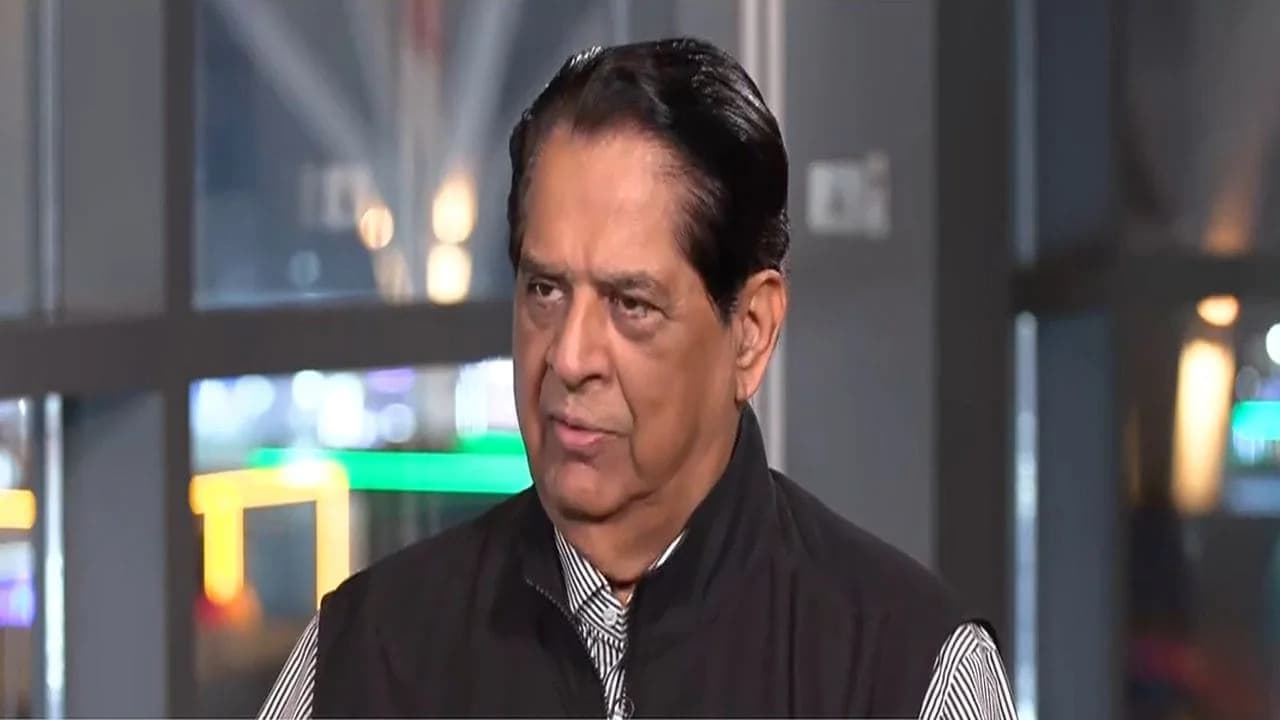
The Indian mutual fund industry is positioned for substantial expansion over the next five years, with assets under management (AUM) expected to more than double, according to K V Kamath, Chairman of Jio Financial Services. Speaking at a Jio BlackRock event 'Investing for a new era', Kamath noted that the entry of Jio Financial Services in partnership with BlackRock comes at an opportune moment for the Indian market. The projection follows the industry's remarkable growth trajectory, with AUM surging from ₹12.75 lakh crore in December 2015 to ₹80.23 lakh crore as of December 31, 2025, representing a more than six-fold increase over the past decade. This expansion is driven by India's ambition to ascend to the rank of the world's third-largest economy by 2030, with projections reaching a $7.3 trillion GDP, necessitating commensurate growth in capital markets. BlackRock's Chairman and Chief Executive Larry Fink has reinforced this optimism, estimating that India's GDP will expand 8-10% annually over the next decade, calling the next few years the "era of India." Kamath emphasized that "my experience in banking shows that if you are growing at 20 per cent, financial services typically grows at 15 per cent, so we should simply compound at 15 per cent and we'll have a doubling of the assets."
The industry has demonstrated exceptional momentum in recent years, with AUM nearly tripling in the past five years alone from ₹31.02 lakh crore in December 2020. According to the Association of Mutual Funds in India (AMFI), the number of folios has expanded significantly, reaching 26.13 crore as of December 31, 2025. Retail participation remains robust, with over 20 crore folios under equity, hybrid, and solution-oriented schemes, indicating strong investor confidence in mutual fund products. The mutual fund AUM as a proportion of bank deposits has risen from 19.7% in March 2020 to an estimated 30.0% by March 2025, reflecting a fundamental shift from traditional savings towards market-linked instruments. Jio BlackRock has achieved remarkable traction, signing up 1 million investors within just seven months of launch, with about a fourth of these investors being new to mutual funds. The company's parent Jio Financial Services has also attracted 2 crore users since its launch, demonstrating the growing appeal of digital financial services.
Open-ended equity funds have emerged as major contributors to AUM growth, with assets quadrupling over five years from ₹9 lakh crore in November 2020 to about ₹36 lakh crore in November 2025. Year-on-year, equity fund AUM rose more than 17%, driven by flexi-cap funds which recorded the fastest growth of over 25% to ₹5.45 lakh crore. Multi-cap and large-and-mid-cap funds also witnessed robust inflows, reflecting investor preference for diversified equity strategies amid changing market conditions. The accelerated adoption of digital financial transactions, spurred by the COVID-19 pandemic, has fostered greater investor comfort with technology-driven financial products. BlackRock's Chairman Larry Fink specifically urged Indians to invest in capital markets rather than bank deposits, citing the US experience where capital market investors benefited more through compounding compared to bank account savers.
The strategic collaboration between Jio Financial Services and BlackRock, formalized with the establishment of JioBlackRock Mutual Fund in May 2025, is positioned to be a significant catalyst for market expansion. This joint venture uniquely combines BlackRock's extensive global investment expertise and technological capabilities with Jio Financial Services' vast digital reach and established brand presence across India. The partnership has already seen ₹229.50 crore invested into their joint ventures by December 2025 to bolster operational capabilities. JioBlackRock has launched its first New Fund Offers and an investment advice platform, signaling a proactive approach to capturing market share. Despite intense competition from established players like SBI Mutual Fund, HDFC AMC, and ICICI Prudential AMC, who collectively hold over 41% of the market share, the Jio-BlackRock venture's focus on technology and global best practices positions it to capture a significant segment of this expanding market. Reliance Industries' Chairman Mukesh Ambani emphasized the opportunity to "convince" Indian savers about capital markets and channel savings from traditional investments like ₹60 billion in gold and ₹15 billion in silver into mutual funds. BlackRock's Chief Operating Officer Rob Goldstein highlighted that "there are very few places in the world where that would even be a thing, that would even be an aspiration," noting that the Indian mutual fund industry needed to be bigger than it is today if India aspired to be the third largest economy in the world.
Industry analysts, including ICRA Analytics, project that the sector could surpass ₹300 lakh crore in AUM by 2035, driven by rising systematic investment plan (SIP) adoption and deeper penetration beyond top cities. The asset management market is projected for robust growth, with total assets expected to reach $5.82 trillion by 2031, driven by formalization of savings and digital digitization. The industry's continued growth hinges on deepening engagement, particularly in Tier-2 and Tier-3 cities, and maintaining investor confidence through transparency and innovation. The market's expansion is intrinsically linked to India's economic goals, where the mutual fund industry serves as a fundamental pillar supporting the nation's trajectory towards becoming the world's third-largest economy. BlackRock's Larry Fink emphasized that "in the era of India, we need to get more people investing alongside the growth of the country," highlighting the critical role of mutual funds in India's economic transformation. Goldstein noted that the state of the Indian financial services sector now is similar to what it was in US or UK 20-30 years ago, adding that while they were buying good schemes, "they are paying high prices, they are paying high distribution costs and they're sort of collecting funds as opposed to having the opportunity to really understand what am I investing for, what is my outcome that I aspire to, and how do you actually build a portfolio with the right building blocks to achieve that outcome."