TCS reported that client decision-making slowed further during Q1FY27 despite maintaining a strong deal pipeline, indicating that macroeconomic uncertainty is delaying the conversion of signed contracts into revenue rather than weakening demand for technology services. CEO and Managing Director K Krithivasan said those headwinds had become more pronounced even as the company continued to report healthy deal wins and expressed confidence in its long-term demand outlook. "Q1FY27 reflects continued growth momentum and the strength of our strategic positioning, despite geopolitical and macro-economic headwinds. We delivered a strong order book of $9.5 billion, including a marquee AI-led transformation deal with SKF, while continuing to add clients across key revenue bands and scaling our AI business to a $2.6 billion annualised revenue run rate," Krithivasan said during TCS's Q1 FY27 earnings call. He added that global businesses had been disrupted by conflicts, economic uncertainty, and supply chain issues, leading to project deferrals and slower decision-making that resulted in "less than expected revenue conversion." The comments mark a shift from the company's previous earnings call, when it first highlighted delays in client decisions and project starts. Despite the near-term pressure, Krithivasan reiterated confidence in the company's longer-term outlook, stating "As customers accelerate investments in AI, modernisation, cybersecurity, sovereign cloud and platform simplification, our strong deal conversion, improving client mining and expanding ecosystem partnerships position TCS well to translate opportunity into sustained growth."
TCS delivered exceptional AI performance in Q1FY27, with annualised artificial intelligence revenue reaching $2.6 billion, up 13.6% sequentially from approximately $2.3 billion three months earlier, demonstrating strong momentum in the AI transformation market. The increase implies that TCS added approximately $300 million in annualised AI revenue run rate during the quarter, highlighting AI as one of the company's fastest-growing businesses. While AI remains a relatively small share of TCS's overall revenue base, it is emerging as an increasingly important driver of large transformation deals. Total contract value (TCV) for the quarter came to $9.5 billion, with AI as the central pitch in nearly every headline win. The standout deal was an $800 million contract with SKF, the Swedish industrial group, structured around building an "enterprise nervous system" - a self-learning operational backbone tying together SKF's data, processes, and platforms. CEO and Managing Director K Krithivasan noted that customer demand for AI, modernisation, and platform simplification was translating into "strong deal conversion" and "expanding ecosystem partnerships." Most of the increase came from financial institutions, which offset losses in business from retail firms, as the company gets a third of its revenue from banks. As Aarthi Subramanian, Executive Director, President and Chief Operating Officer, noted, "AI is being brought into execution much earlier than before. Whether it's in ops (IT operations) or in transformation, AI is part of the day-one proposition and execution, so that brings a certain acceleration to the transformation and also to the execution."
TCS COO Aarthi Subramanian addressed the growing debate around token cost versus human cost in AI deployments, arguing that the choice is a false dichotomy. Speaking after the company's June quarter results, Subramanian said the growing debate around token cost versus human cost in AI deployments is a false choice, arguing that enterprises are not trading one for the other as artificial intelligence adoption scales. "That whole token cost of AI is a top conversation with customers," she said, adding that governing this cost has become a priority for enterprises and technology partners alike. Subramanian pushed back on the framing that rising AI costs come at the expense of human capital, saying the two were not competing for the same budget. "I don't think this is a zero some game on token cost plus tech human cost," she said, arguing that as clients extract more value from AI, overall technology spending will rise rather than shrink. She noted that the choice of AI model is increasingly being dictated by the nature of the workload rather than made on an ad hoc basis, a shift she compared to disciplines such as FinOps that emerged during the cloud computing wave. TCS and the wider industry are now building similar governance frameworks, sometimes described as AI Ops, to manage cost and control as adoption scales. Subramanian also flagged that the rise of AI coding assistants had not diminished the importance of core technical skills within delivery teams, noting that strong engineering fundamentals remain essential even as automation tools speed up development work.
TCS reported consolidated net profit of ₹13,349 crore for Q1FY27, declining 2.7% from ₹13,718 crore in the preceding quarter, primarily due to one-time legal settlement costs. However, revenue showed resilience with a 2.2% sequential increase to ₹72,275 crore from ₹70,698 crore, demonstrating the company's ability to maintain growth momentum despite challenging market conditions. Operating profit, measured by earnings before interest and tax (EBIT), declined 3.1% from the previous quarter to ₹17,317 crore from ₹17,870 crore, while EBIT margin narrowed 130 basis points to 24% from 25.3% in the March quarter. The margin compression was attributed to wage hikes that impacted margins by 170 basis points, reflecting the company's continued investment in talent retention and upskilling initiatives. TCS reported constant-currency revenue growth of 0.4% quarter-on-quarter and 3.2% year-on-year during the June quarter. The company's workforce stood at 593,798 at the end of the June quarter, with last-12-month attrition in its IT services business at 13.6%. TCS shares closed 0.52% lower at ₹2,047.75 on Thursday, with the stock trading between ₹2,016 and ₹2,065 during the session, while the broader BSE Sensex ended 0.31% higher at 76,741.82.
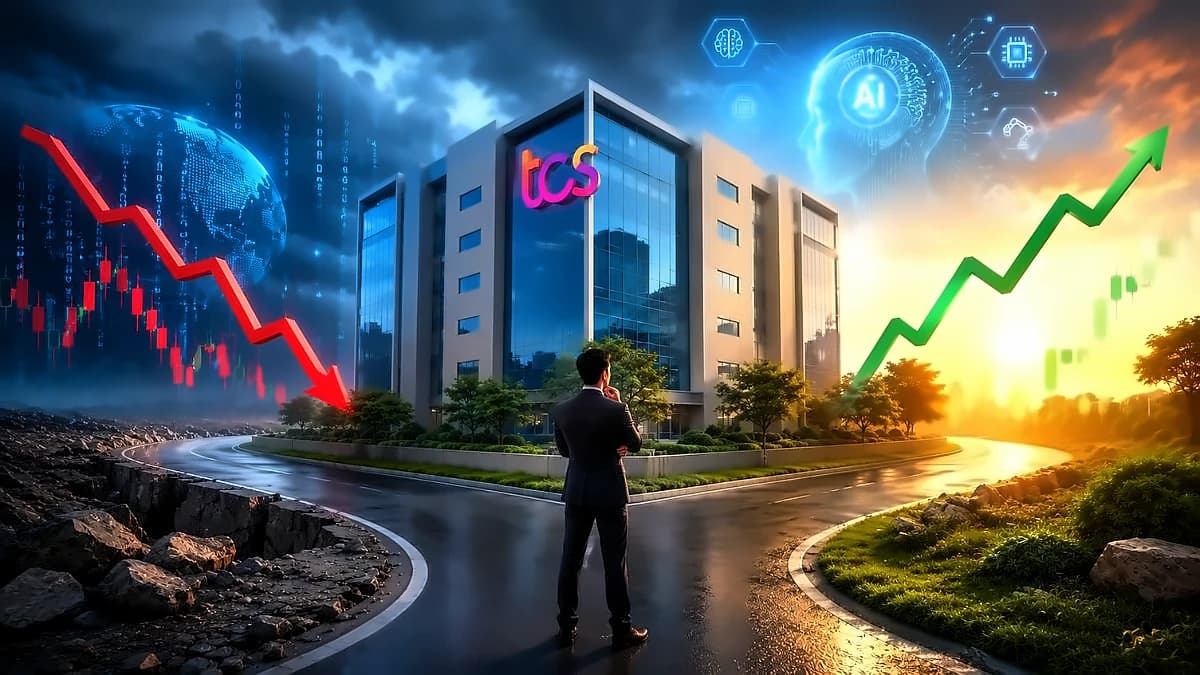
Banking, financial services and insurance, which contributed 32.1% of revenue, grew 1.6% sequentially and 2.4% from a year earlier, demonstrating resilience in the company's core banking vertical. Technology and Services, accounting for 8.5% of revenue, rose 1.7% quarter-on-quarter and 3.5% year-on-year, showing steady growth momentum. Regional Markets and Others was the fastest-growing business segment, posting 4% sequential growth and 9% year-on-year growth, contributing 13.3% of total revenue. Energy, Resources and Utilities recorded 6.9% year-on-year growth despite a 0.7% sequential decline, while Life Sciences and Healthcare, along with Manufacturing, posted year-on-year growth of 3.5% and 2.9%, respectively. However, Consumer Business was the weakest-performing segment, with revenue falling 4% quarter-on-quarter and 1.2% year-on-year, accounting for 15% of total revenue. Communication and Media remained largely unchanged, reporting 0.3% sequential growth and 1.4% year-on-year growth.
TCS onboarded 14,000 campus graduates during the April-June quarter of FY27, as it sharpened its focus on AI-native talent amid changing enterprise technology demands. The fresher intake comes alongside a net addition of 9,279 employees during the quarter, taking TCS's total headcount to 593,798. Chief HR Officer Sudeep Kunnumal said during the company's post-earnings conference call that "Our campus hiring continues to focus on digital and AI-native talent, supported by a reimagined initial learning programme and a stronger AI-centric curriculum." The company is investing in experiential, project-based learning to improve deployment readiness while gradually moving towards a more skills-centric employee pyramid. Alongside campus hiring, lateral recruitment is now focused on domain specialists and AI-native talent, with most experienced hires already possessing next-generation skills. CEO K Krithivasan had earlier told PTI that TCS has already made 25,000 campus offers for FY27 and will scale hiring further depending on demand conditions. Responding to concerns about AI impact on employment, K Krithivasan said the company does not expect a significant decline in knowledge-worker employment, instead expecting roles to evolve towards areas such as prompt engineering, model training, testing and AI lifecycle management.
TCS has declared an interim dividend of ₹12 per equity share of ₹1 each for Q1FY27, demonstrating confidence in its financial performance despite challenging market conditions. The company has fixed the record date for the dividend on July 15, 2026, while the payment date is July 31, 2026, providing shareholders with clarity on dividend eligibility and processing timelines. To be eligible for the dividend, investors must ensure they hold TCS shares in their Demat accounts as of July 15, 2026, as any fresh buying after this date will not be eligible for the reward. This dividend declaration comes alongside the company's strong quarterly results, reflecting management's commitment to returning value to shareholders while maintaining growth investments. This comes after TCS paid a dividend of ₹31 in May, interim dividend of ₹11 and special dividend of ₹46 in January this year, taking the company's dividend payout so far this year to ₹100 per share. TCS has declared 95 dividends since October, 2004 and maintains a dividend yield of more than 5% at current market prices, with the stock offering a strong dividend yield of 5.4% at current levels. However, TCS's shares have plummeted 36% since the start of the year, reflecting broader challenges in the IT sector and investor apprehension about future growth prospects. The company's shares closed 0.52% down at ₹2,047.75 on Thursday, having fallen to a six-year low last week.