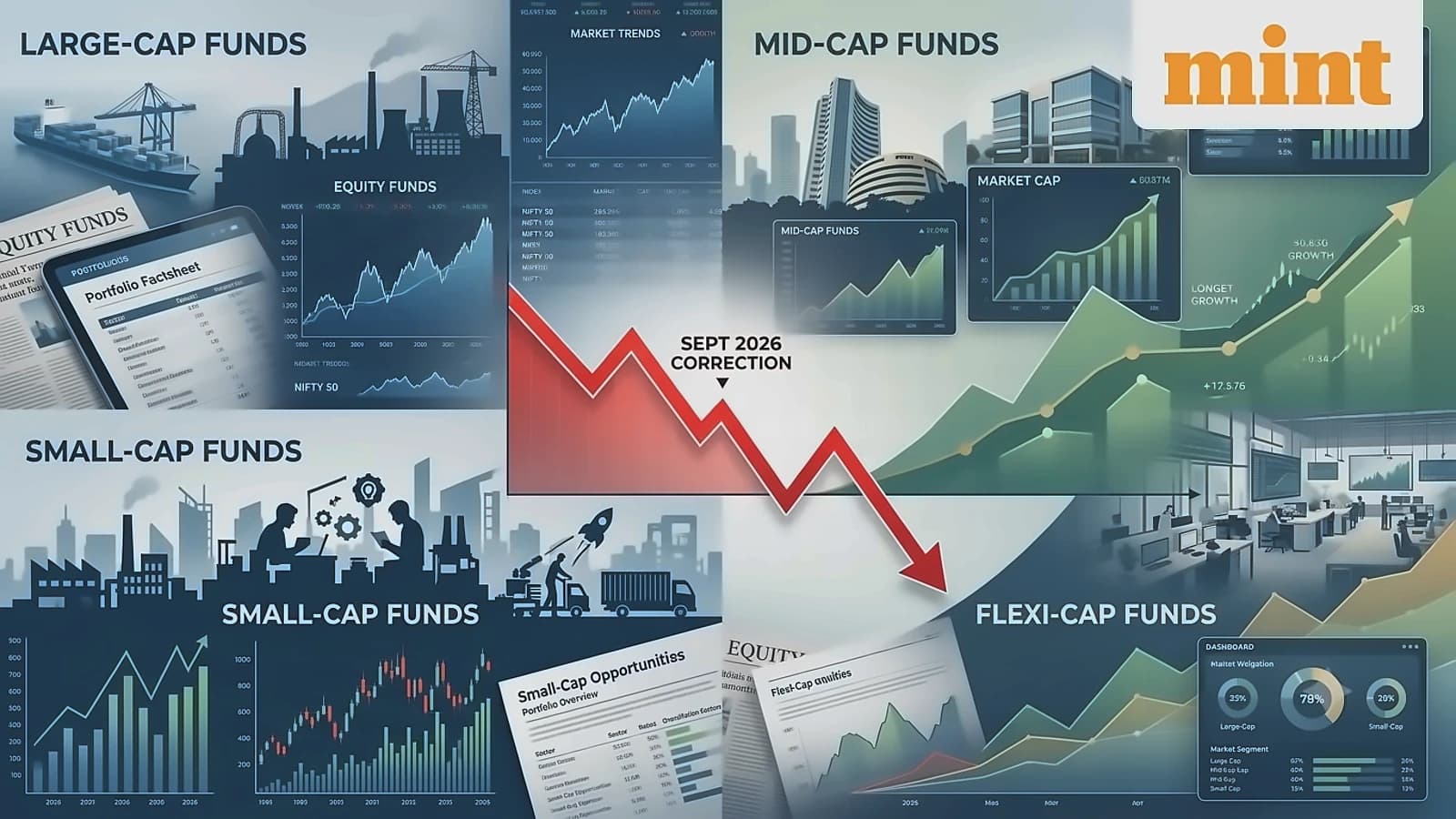
India's stock market is witnessing a quiet but significant shift as large-cap stocks lose ground amid changing capital flows and investor sentiment. According to The Economic Times, the combined market capitalisation share of mid- and smallcaps reached a record 43.7% in September, while the share of the top 100 companies fell to a low of 56.3%. This transformation is most evident in recent performance, with the Nifty50 rising just 1.3% in the first half of FY27, while the Nifty Smallcap 250 gained 24.6%. As per Shriram AMC's Prateek Nigudkar, "The defining feature of the quarter was the sharp divergence between largecaps and the broader market."
Smallcap stocks faced significant pressure on Thursday, with the Nifty Smallcap 100 index falling 0.86% to 19,218 as of 10:04 AM, contrasting sharply with the 1% rally in the Nifty 50. According to Business Standard, the decline was driven by sharp falls in IDBI Bank, HFCL, MTAR Technologies, Netweb Technologies, Mangalore Refinery and Petrochemicals (MRPL) and Chennai Petroleum Corporation (CPCL). HFCL, Sterlite Technologies and MTAR Technologies were locked at 5% lower circuits with only sellers at these counters. Despite recent pressure, the Nifty Smallcap 100 has corrected 5% from its 52-week high of 20,187.80 touched on September 4, 2026, but still outperformed the market with 8.5% gains in CY26 against a 12.5% fall in the benchmark index.
The performance divergence has been shaped significantly by direction of capital flows rather than straightforward fundamentals. Foreign investors, who typically own larger shares of India's biggest companies, have been selling largecaps as global bond yields rose, the rupee weakened and oil prices climbed. Meanwhile, domestic institutions, supported by steady systematic investment plan inflows, have directed more money towards mid- and smallcap stocks. According to Shriram AMC's Nigudkar, "Largecaps, owned heavily by foreign investors, have borne the brunt of global risk-off selling, while smaller companies, owned mostly by domestic investors, have been cushioned by steady SIP inflows." The ongoing rotation is supported by around ₹2.8 lakh crore flowing into small and midcap mutual funds since 2024, with midcaps' earnings generally outperforming Nifty 50 companies over previous quarters.
Investors have rotated funds towards mid- and small caps from heavyweights, with sectors showing high growth opportunities from the government's policy thrust attracting significant flows. As per Mirae Asset Sharekhan's Saurabh Prasad, "The beneficiaries are companies that are part of high-growth sectors, such as defence, capital goods, renewable energy, and pharmaceuticals." Kotak Neo's Shrikant Chouhan identified defence and aerospace, capital goods, electronic manufacturing services, and renewable energy as key sectors seeing investor interest. The pharmaceutical sector and healthcare are the only ones that have delivered double-digit returns in 2026 as of October 9, with Capital Goods (+9.2%), Metals (+7.5%), Media (+7.5%) and Power (+7.4%) also moving into positive territory. By contrast, IT (-24.6%), FMCG (-19.1%) and Oil & Gas (-15.9%) have underperformed the Sensex (-15.0%).

India's smallcap universe has delivered exceptional returns, with market value growing 2.3 times since April 2023, significantly outpacing largecaps which increased 1.4 times during the same period. According to The Economic Times, smallcaps now trade at 32.5 times trailing earnings compared to 21 times for largecaps, creating a substantial valuation gap. However, Axis Mutual Fund warns that while headline indices have corrected, expectations embedded in parts of the broader market remain elevated. The fund house notes that the market is moving away from a phase driven by liquidity and broad-based re-rating towards one in which earnings delivery, business quality and the price paid for growth would determine returns. Motilal Oswal's data shows smallcaps traded at 23.2 times, still a 33% premium to their long-term average, while midcap valuations fell to 22.8 times, slightly below their 10-year average.