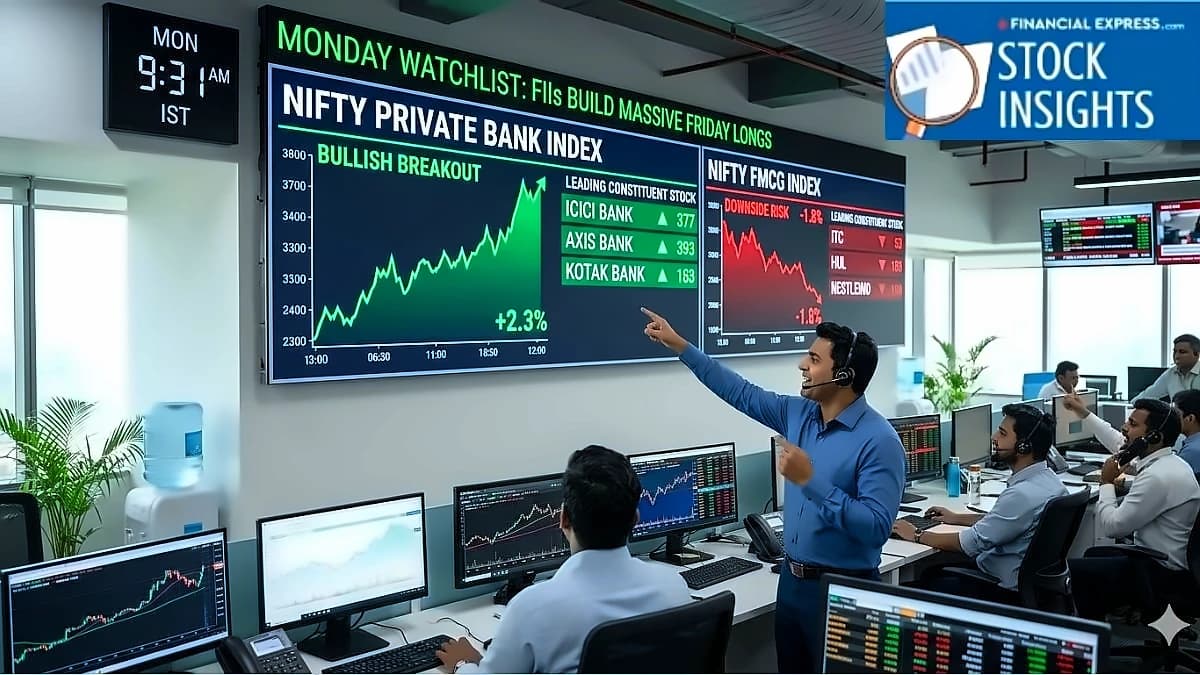
The Financial Services sector is showing early signs of recovery after a prolonged consolidation period. According to The Financial Express, the Nifty Financial Services Index has broken above a descending triangle pattern on the 4-hour chart, adding nearly 1.80% in a single session. The index found support around the 23,500 area in April 2026 and entered a prolonged consolidation phase, with sellers defending higher levels as prices tested support near the 24,500 area on repeated tests. The Relative Strength Index (RSI), which had been stuck under its own resistance zone for weeks, has now broken higher and is trading near 64, suggesting potential leadership traits in the sector.
The Nifty is positioned at a crucial technical juncture with resistance at 23,350-23,400 and support at 22,700-22,800. According to Dharmesh Shah, AVP Technical Analyst at ICICI Direct, speaking to ET Now, the index has been making a consistent lower-top, lower-bottom formation with no session closing above the previous session's high. A decisive close above 23,350-23,400 - a confluence zone where the falling trendline and 10-day exponential moving average converge - could trigger a short-covering rally. The RSI is sitting near oversold territory around 20, with even a minor positive trigger potentially igniting a short-covering move.
Bank Nifty is clearly outperforming with a target of 56,500, according to Shah's analysis. His top stock pick in the current volatile environment is Federal Bank, which has been outperforming for the past three to four weeks after staging a breakout from its multi-month consolidation range since September 2025. Shah expects the stock to head towards ₹340 with a stop loss placed at ₹295. The banking sector's strength comes as Bank Nifty's trend looks more promising going forward, with any move above 23,400 potentially creating a short covering rally. Axis Bank is also showing technical strength, with the stock testing resistance after a 20-day Exponential Moving Average crossed above the 50-day EMA, a bullish crossover signal that often appears in early trend changes.
Leading global brokerages have revised their Nifty and Sensex targets for FY27, reflecting mixed market sentiment amid geopolitical tensions and economic uncertainties. Citi has cut its 12-month Nifty target to 26,000 from 27,000 earlier, citing geopolitical risks, AI concerns, and El Niño conditions. Morgan Stanley projects a base-case Sensex target of 89,000 by June 2027, implying an upside of roughly 19% from current levels, built on strong domestic demand and capex cycle. Goldman Sachs has lowered its 12-month Nifty target to 25,900 from 29,300 earlier, while Antique Stock Broking revised its Nifty target to 27,000 for March 2027. India's economic growth is expected to moderate to 6.6% in FY27 from the robust 7.7% growth achieved in FY26, according to BMI, a Fitch group company.

Brokerages are showing preference for domestic cyclical sectors over defensive or globally sensitive stocks. Morgan Stanley and Antique Stock Broking are overweight on Industrials, citing India's infrastructure expansion, manufacturing push, and private capex recovery. Citi highlighted key overweight bets including financials, telecom, healthcare, utilities, and defence. Morgan Stanley has its largest overweight position in Consumer Discretionary, expecting stronger consumption growth driven by lower interest rates and improved income growth. However, Antique Stock Broking remains underweight on IT services due to weak discretionary spending globally and longer client decision-making cycles. The Financial Services sector contributes nearly 20% to the Nifty 50 and is one of the most influential segments of the Indian market, with a solid recovery potentially having meaningful impact on broader indices.
The biggest near-term risk remains geopolitical tension in West Asia, with higher crude oil prices potentially increasing inflation, pressuring India's trade balance, and reducing consumer spending power. Morgan Stanley's bear-case scenario assumes crude oil averaging above $120 per barrel. Other key concerns include monsoon uncertainty, global growth slowdown affecting IT services exports, and foreign institutional flows. According to Citi, any resolution of the West Asia situation and pause in FII outflows could result in market upsides. Corporate earnings for Q1FY27, especially in banking, industrials, and consumer discretionary sectors, will be crucial factors determining market direction in the coming months.