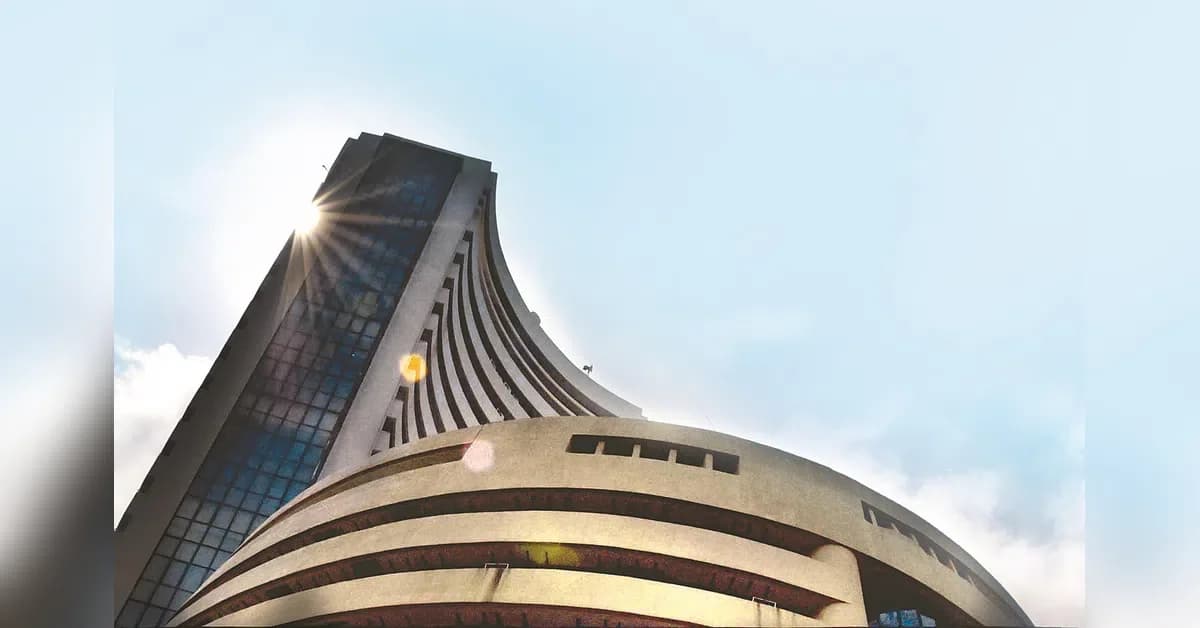
Indian equity markets rallied sharply on Monday with benchmark indices surging more than 1.4%, as investor sentiment improved significantly amid growing optimism over a potential peace agreement between Iran and the US. The NSE's Nifty 50 ended at 24,031.70, up 312.40 points or 1.3%, while the BSE's Sensex closed 1,073.61 points or 1.4% higher at 76,488.96. The gains were broad-based with over 66% of stocks trading on the NSE ending higher, with almost all sectoral indices gaining. These gains were led by banking, financial services, and automobile stocks, with other global markets also gaining ground, led by the Nikkei of Japan which rose 2.87%. The rally has been supported by improving sentiment, steady earnings, and hopes of easing geopolitical tensions in West Asia, with the drop in oil prices below $100 per barrel giving a boost to market confidence.
The rupee ended at 95.05 against the dollar on Monday, recording its best single-day gain since April 2, as it rose 53 paise from the previous closing level of 95.69. According to Ponmudi R, CEO of Enrich Money, the USD/INR pair is currently trading below the Rs 95 mark, retreating from the week's high near Rs 95.9 and helping the rupee end the week with a net appreciation. The REER is a mechanism to compare the weighted average value of a currency against a basket of global currencies, and the rupee's strength reflects improving global risk sentiment amid geopolitical developments. From a technical standpoint, the pair remains close to the lower boundary of its long-term ascending trendline, indicating a gradual easing in dollar strength. However, the weekly chart has formed a shooting star pattern, signalling rejection at higher levels with immediate resistance seen around Rs 95.2.
This week's market direction will be heavily influenced by several critical events, with the RBI's monetary policy announcement on Friday being the primary domestic catalyst. As per Ajit Mishra, SVP Research at Religare Broking Ltd, participants will closely monitor global developments surrounding the US–Iran situation and movement in cruide oil prices, which continue to remain critical for inflation expectations, currency stability, and foreign flows. The final HSBC Manufacturing PMI reading for May will be announced on Monday, followed by the Services PMI and Composite PMI data on Wednesday, providing important insights into demand trends, business activity, and growth resilience across sectors. Additionally, investors will monitor India's GDP growth data and foreign exchange reserves figures for further clarity on economic momentum and external sector stability. Last week, the BSE benchmark Sensex dropped 639.61 points, or 0.84%, and the NSE Nifty declined 171.55 points, or 0.72%.

Foreign institutional investors (FIIs) have persistently pulled out money from the Indian capital markets since the war began in late February, adding pressure on both the equity and forex markets. FIIs have withdrawn a hefty $53 billion from Indian equities since late 2024, putting pressure on several large-cap stocks even as domestic institutional investors emerge as the market's primary support, according to Jefferies. Foreign portfolio investors (FPIs) emerged as heavy sellers on Friday, pulling out a net ₹20,637 crore in a single session, marking one of the sharpest single-day selloffs in recent years. The sustained selling has taken a toll on market performance, with MSCI India falling around 8% between September 2024 and May 2026, underperforming the MSCI Emerging Markets index by 67 percentage points in dollar terms. However, experts are cautiously optimistic regarding a deal between the US and Iran, with hopes that foreign outflows would be reversed or at least curbed to an extent if a concrete agreement is announced.
From a technical standpoint, Nifty continues to trade below all its key moving averages, with these moving averages having flattened out, indicating the absence of a strong trend. The daily RSI remains in a sideways zone as per the RSI Range Shift framework, while the daily Stochastic oscillator is also moving within a narrow band. Adding to this, the trend strength indicator, Daily ADX, is placed at near 15 level and continues to decline, suggesting a lack of directional momentum in the index. While these indicators point towards a lack of trend, Friday's late sell-off has injected fresh uncertainty into the market setup. Markets are expected to remain highly sensitive to geopolitical and macroeconomic developments this week, with investor attention firmly focused on the evolving US–Iran negotiations, broader diplomatic developments in the Middle East and the trajectory of crude oil prices. Beyond geopolitics, investors are also expected to closely monitor rupee movement, institutional flow dynamics, global equity market trends and key macroeconomic indicators for further direction.