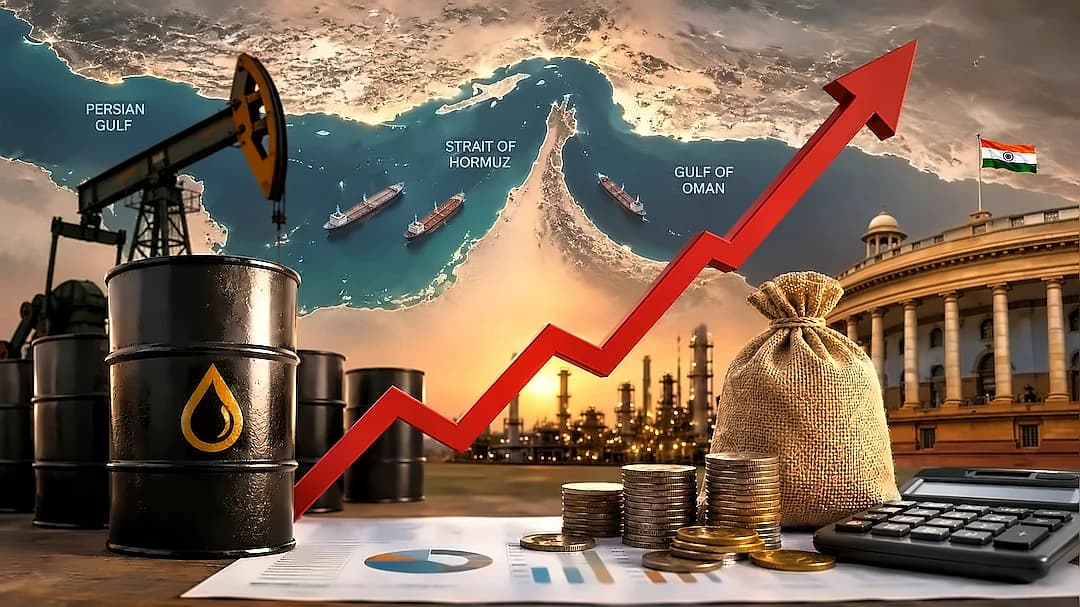
Prime Minister Narendra Modi's recent public appeals on energy conservation and consumption restraint have added a new layer of macro discussion for investors. According to The Economic Times, JPMorgan's Sanjay Mookim placed the development in the broader context of India's external vulnerability and fiscal strain due to elevated oil prices. "Oil shock is a direct hit to India's external balance," Mookim stated, emphasizing that the transmission mechanism is both direct and significant. He noted that policy nudges to reduce consumption are a response to an unusually prolonged disruption, with the war lasting much longer than originally imagined. At every $10 increase in oil prices, it increases our CAD by about $15 to $16 billion annualised. And oil prices are up far more than $10 now. The economy feels the impact of this in a very major way. The prices in most cases have not yet been passed on to consumers. The government or government companies are bearing a large part of the oil increase cost to the economy."
On whether equity markets had anticipated such explicit policy communication, Mookim pointed to a two-layered uncertainty framework. As reported by The Economic Times, he stressed that the more important variable is post-shock oil pricing, noting that even if oil prices were to stay in the $85–90 corridor, there would still be a significant drain from the Indian economy. He added that policy action—both fiscal and monetary—becomes more likely the longer the disruption continues, with the uncertainty still prevailing despite initial market expectations that the situation would be resolved quickly. "Everybody, at least in the equity markets, if you see how stocks have behaved since, has believed that this is over and we are going to be back and open the whole thing very soon, but the uncertainty still prevails."
According to The Economic Times, Mookim drew a distinction between short-lived Q4 impact and more visible Q1 stress. "Q4 earnings were impacted only for about three weeks in the quarter. So it is difficult to say that we expected much dent to numbers in Q4. In many cases companies have reported better than expectations nevertheless." However, he warned that Q1 FY27 could feel the pressure due to the impact of not just lack of energy and higher energy costs, but also tapering demand. He highlighted risks of demand deferral across consumption-linked sectors, noting that builders would likely avoid locking in high commodity prices for apartment construction. "If you are building, let us say, an apartment, would you want to lock in a high price of commodities now? You are likely to see demand issues also."
On sustained foreign investor underweighting in India, Mookim pointed to global allocation logic driven by growth differentials. As reported by The Economic Times, he noted that India is currently losing out on the relative growth argument, with questions on Indian growth numbers having to be downgraded while growth in other places like Korea, Taiwan, North Asia, tech and the US looks better. He emphasized that cheaper valuations alone are not sufficient to attract flows, stating that "the growth dynamic has to improve relatively." He also cautioned against extrapolating index strength into broad economic resilience, noting that "the largecaps will actually fare better. If you are looking for Nifty index outlook, I do not think that will get damaged much. It will be the broader market and economy which will feel a bigger impact."
On sectoral positioning, Mookim acknowledged the structural strength of the power theme but flagged valuation risk. According to The Economic Times, he noted that while the power theme makes sense due to AI requirements and grid evolution needs, "valuations are not cheap." He reiterated a broader preference for largecaps over midcaps in the current environment, cautioning against extrapolating index strength into broad economic resilience. In a weaker macro regime, he concluded that traditional defensive sectors—staples, healthcare, and IT—tend to outperform historically in India. "In a weaker environment, the three sectors that have tended to outperform always historically in India are staples, healthcare, and IT."