
India is actively building strategic resilience in emerging and critical sectors to protect its economy from global uncertainties, according to Economic Affairs Secretary Anuradha Thakur at the State Bank of India Banking and Economics conclave. As per Business Standard, Thakur emphasized that India has emerged as a stable economy that has the ability to withstand external headwinds, making it all the more important to develop strategic resilience. The government is taking proactive steps to build capacity in emerging and strategic sectors across the economy, with semiconductors identified as a key area where New Delhi is seeking to reduce vulnerability to external shocks.
Private-sector project announcements reached ₹13.1 lakh crore in Q1 FY27, more than 70% higher both year-on-year and sequentially, according to CMIE data. Power and electricity projects were the biggest driver, with new electricity project announcements rising 398% sequentially. Manufacturing announcements also increased 17.3% during the quarter. However, as noted by Business Standard, these project announcements are not actual spending - they represent planned investments that may take years to execute and could be delayed, scaled down or cancelled. The actual spending will depend on the next stages of the investment chain: announcements → actual spending → orders → revenues → profits → cash flows.
Multiple international agencies have turned more optimistic on India's economic outlook, with the Organisation for Economic Co-operation and Development, Asian Development Bank, S&P Global and Fitch Ratings lifting their growth forecasts for the financial year by 40 to 80 basis points. According to Business Standard, this upgrade cites solid domestic demand and investment, and a smaller-than-feared hit from the West Asia conflict and higher energy prices. Moody's Corp. raised its forecast for the fiscal year to 7% from 6% previously, while India's gross domestic product grew 7.8% in the three months ended June from a year earlier. Economists expect the RBI to also raise its 6.7% growth forecast for the fiscal year when policymakers meet early next month, with a majority predicting the first interest-rate hike since early 2023.
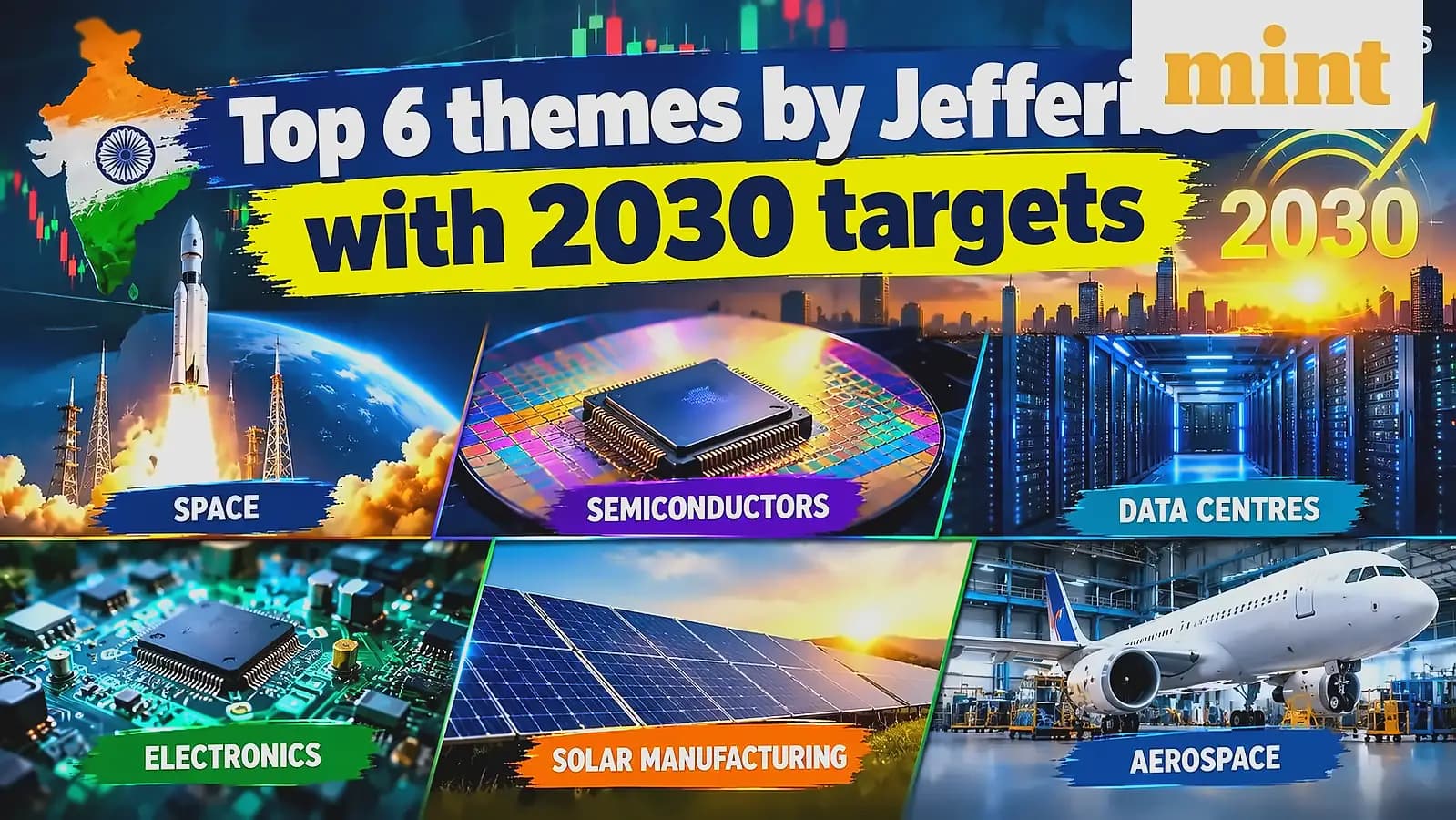
Brokerage firm Jefferies has identified six key themes driving India's emergent industries, according to their latest report. The firm emphasizes that large domestic opportunity is driving private participation across Space, Semiconductors, Electronics, Datacenters and Solar sectors. Government support is evident through policy measures including opening space to private sector, long tax holidays for data centers, and large incentive schemes for semiconductors, electronics and solar sectors. Lighthouse Canto's Laijawala identifies three major investment themes: AI infrastructure, renewable energy transition, and defense manufacturing and exports, each structurally difficult to postpone.
The next AI investment wave requires enormous physical infrastructure investment, with India's AI infrastructure investment potentially reaching $100-150 billion over the next five years. As reported by Business Standard, AI models run in data centres that need electricity, cooling systems, electrical equipment, cables, conductors, transformers and transmission infrastructure. The AI investment chain creates opportunities for companies that don't look like conventional technology companies - cable manufacturers, power-equipment makers or engineering companies could potentially benefit from rising data-centre investment. This represents a structural shift where AI demand drives electricity demand, power generation, transmission and construction requirements.
India's defense production reached a record ₹1.78 lakh crore in FY26, up 15.6% from ₹1.54 lakh crore a year earlier, with the private sector accounting for about 24% of production, or roughly ₹42,000 crore. Defense exports also reached a record ₹38,424 crore in FY26, up 62.66% from the previous year. Companies are expanding their defense presence - Solar Industries saw defense revenue grow 123% year-on-year and now accounts for over a quarter of its business, while Astra Microwave's order book effectively doubled on a single radar contract from HAL. Bharat Forge disclosed a fresh ₹11,196 crore defense order book, demonstrating the shift from importing equipment to manufacturing it domestically.
Manufacturing GVA accelerated to 9.2% from 8.3%, outpacing the headline growth rate and nudging the sector's share of output higher after years of stagnation. According to Business Standard, India's capital expenditure multiplier stands at 2.45x versus 0.98 for transfer payments and 0.99 for other revenue expenditure. Companies are reporting substantial order books - Larsen & Toubro reported FY26 order inflows of about ₹4.36 lakh crore with an order book of ₹7.40 lakh crore at March 2026 end, while Kalpataru Projects International reported an order book of ₹66,607 crore including ₹29,609 crore in transmission and distribution business. This evidence suggests the current capex story is moving beyond announcements into actual execution.

