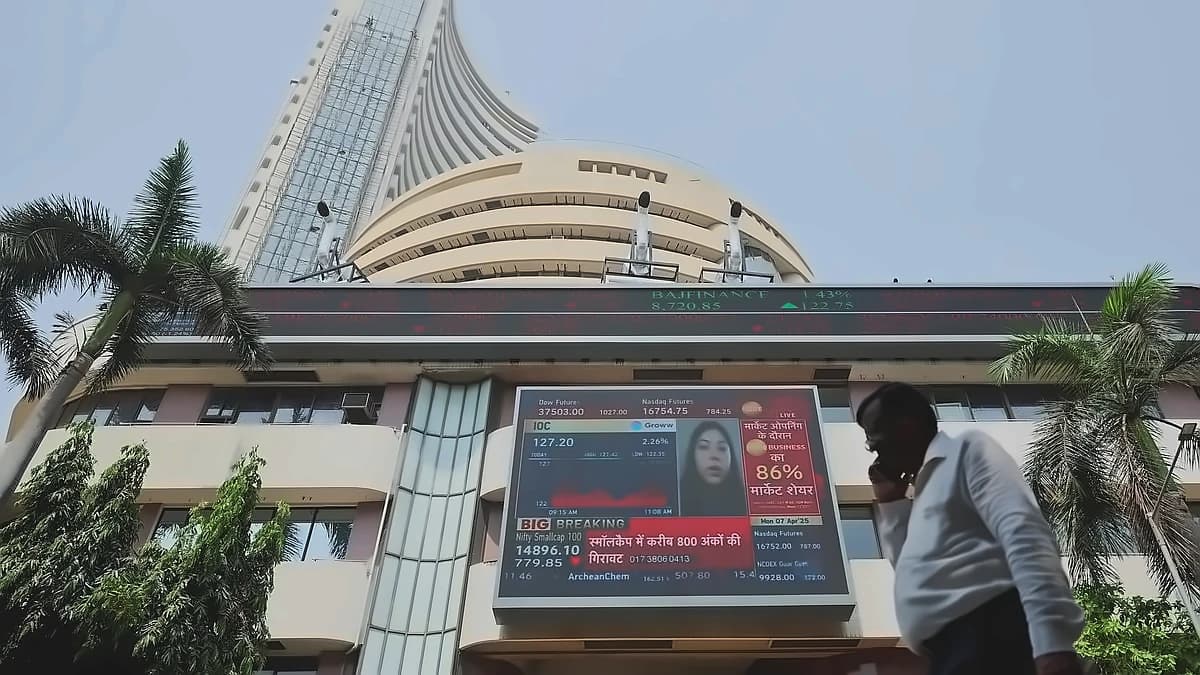
Indian markets staged a sharp rebound last week after a phase of weakness, with the BSE Sensex climbing 2,034.87 points (2.67%) and the NSE Nifty surging 616.15 points (2.59%). The rally was strong enough to lift valuations of almost the entire top tier of the market, with nine of India's top-10 most-valued companies adding ₹2.51 lakh crore in combined market capitalisation. According to CADialogue, this coordinated revival was particularly strong in financials, telecom, technology and index-leading conglomerates. Bajaj Finance emerged as the biggest wealth creator, with its valuation surging ₹80,345.97 crore to ₹7,10,817.51 crore, followed by Bharti Airtel's valuation soaring ₹44,959.5 crore to ₹12,30,005.63 crore and Tata Consultancy Services jumping ₹40,414.03 crore to ₹8,55,894.78 crore.

Bajaj Finance's standout performance was driven by strong quarterly results, with shares ending over 8% higher after the firm reported a 28% year-on-year rise in consolidated profit after tax for the June quarter of FY27. As reported by CADialogue, the company's valuation surge of ₹80,345.97 crore represents the biggest gain among the top-10 firms. The rally was particularly significant because Bajaj Finance sits at the intersection of consumer credit, financialisation and India's expanding formal lending ecosystem. The immediate trigger was the company's robust profit growth, which points to lending demand, asset-quality comfort and confidence in the company's operating engine, all closely watched indicators in India's financial sector.
The healthcare sector's financialization trend has emerged as a significant concern alongside the broader market rally. India has become a 'leading destination for capital,' accounting for 25-30% of total deal volume in the Asia-Pacific region, with private equity firms driving over 8,000 healthcare transactions worth an estimated $1 trillion globally over the past decade. According to Bain & Company, this represents a favorable 'risk-return profile' for investing in Indian healthcare, with the potential for strong returns despite relatively small incremental risk above higher-income markets. The healthcare financialization has been accompanied by rising investments from global and domestic PE in large and regional hospitals, making them integral to governance and ownership structures. However, this trend has raised questions about the sustainability of healthcare costs and accessibility for patients.
Indian markets have started the second half of 2026 on a challenging note, with the Nifty 50 currently trading at 19.3x one-year forward earnings, down from 24x in September 2024. According to Prashasta Seth, CEO of Prudent Investment Managers LLP, this represents a meaningful reversion to mean following an extended period of premium valuations. The markets are currently responding to three major uncertainties: geopolitical instability in West Asia creating crude oil volatility concerns, investor caution before the Q1FY27 earnings season, and El Nino's impact on monsoons. As reported by ETMarkets, Seth believes earnings growth is likely to be in mid-teens for the current financial year, though growth will be variable across sectors.
For fresh portfolio construction, Seth recommends an equal mix of 50% large caps and 50% small caps. Large caps, with proven business models and corporate governance, should form the core of portfolios during uncertain times when macro variables are major factors. The remaining portfolio should be predominantly small caps, which typically provide better value over midcap counterparts. According to the interview, large caps have seen significant underperformance over the last 22 months both in terms of time and absolute correction, making them attractive for stability and compounding potential.
The investment strategy is currently overweight on banking and financial services, with particular preference for microfinance institutions. Asset quality trends are improving, credit costs are expected to normalize, and loan growth remains healthy. Conversely, the portfolio remains underweight on IT sector with near-zero exposure due to cautious global enterprise spending and slower discretionary technology budgets. The strategy is positioned towards sectors benefiting from lower crude oil prices, with businesses linked to domestic consumption, financials, and manufacturing as key beneficiaries.
According to Seth's analysis, the financialisation of household savings stands out as one of the most powerful drivers of wealth creation over the next decade. Indian families are transferring savings from traditional assets like gold and property to financial assets including mutual funds, stocks, ETFs, and retirement products. The number of Demat accounts has reached 200 million, indicating rising retail participation in capital markets. Manufacturing's share of India's GDP still has significant room for growth, supported by government PLI schemes and the global 'China Plus One' strategy. Defence sector also presents opportunities given government focus on exports and self-reliance.
The single biggest risk for Indian equities over the next 12 months is a prolonged period of high crude oil prices, which could lead to inflationary impacts, widening current account deficit, and interest rate hikes. Seth warns that the biggest mistake retail investors make is playing momentum without considering valuations and business fundamentals. He emphasizes that successful investing involves building resilient portfolios focused on companies with sustainable earnings, reasonable return on capital, and effective capital allocation decisions, rather than chasing multibaggers through frequent trading. The latest rally confirms renewed confidence in Indian large caps, but retail investors should avoid chasing momentum blindly and should review concentration, valuation and existing mutual fund exposure before adding individual blue-chip stocks.