
India has responded to the 126% countervailing duty imposed by the United States on solar imports, with government sources telling CNBC-TV18 that the move is 'part of a usual quasi-judicial process'. As per CNBC-TV18, these CVD investigations are undertaken by all countries, including India, and represent standard trade enforcement procedures. Santosh Kumar Sarangi, secretary in the ministry of new and renewable energy (MNRE), confirmed to reporters on Thursday that the Centre is unlikely to intervene on behalf of Indian companies after the US imposed the 126% levy. According to Mint, Sarangi stated that manufacturers can take legal recourse and appeal at the appropriate forum, adding that "Once the CVD has been imposed, you will have to legally fight only. So, companies will have to challenge that in the appellate forum, but until then this will continue, this 126% which has been imposed... Indian government, of course, is not in the picture." The response comes after the US Department of Commerce announced preliminary duties of 125.87% on solar imports from India on February 24, 2026, following its determination that Indian manufacturers received unfair government subsidies that enabled them to undercut American producers.
India has emerged as a significant supplier to the US solar market, with solar imports valued at ₹6,370 crore ($792.6 million) in 2024, representing a substantial increase from 2022 levels. According to Upstox, PTI, and CNBC-TV18, US imports of Indian solar cells and modules surged from about 232 million watts in 2022 to over 2.29 billion watts in 2024, with shipment values jumping from nearly ₹67 crore to ₹6,370 crore. The growth reflects a broader reshuffling of supply chains after the US previously imposed steep duties on four Southeast Asian nations that once dominated imports. These three countries - India, Indonesia, and Laos - accounted for 57% of all US solar-module imports in the first half of 2025, as reported by Bloomberg. The newly announced duties could disrupt this balance as developers diversified away from earlier restricted markets. India exports around 3 gigawatts (GW) of solar modules annually, as reported by Mint, though these exports have already been impacted by high US tariffs and are largely focusing on the domestic market. As per The Times of India, between April 2023 and November 2025, India exported cells and modules worth roughly ₹34,000 crore to the US, with modules from India becoming at least 30% more expensive compared with US-made alternatives, potentially making them commercially unviable.
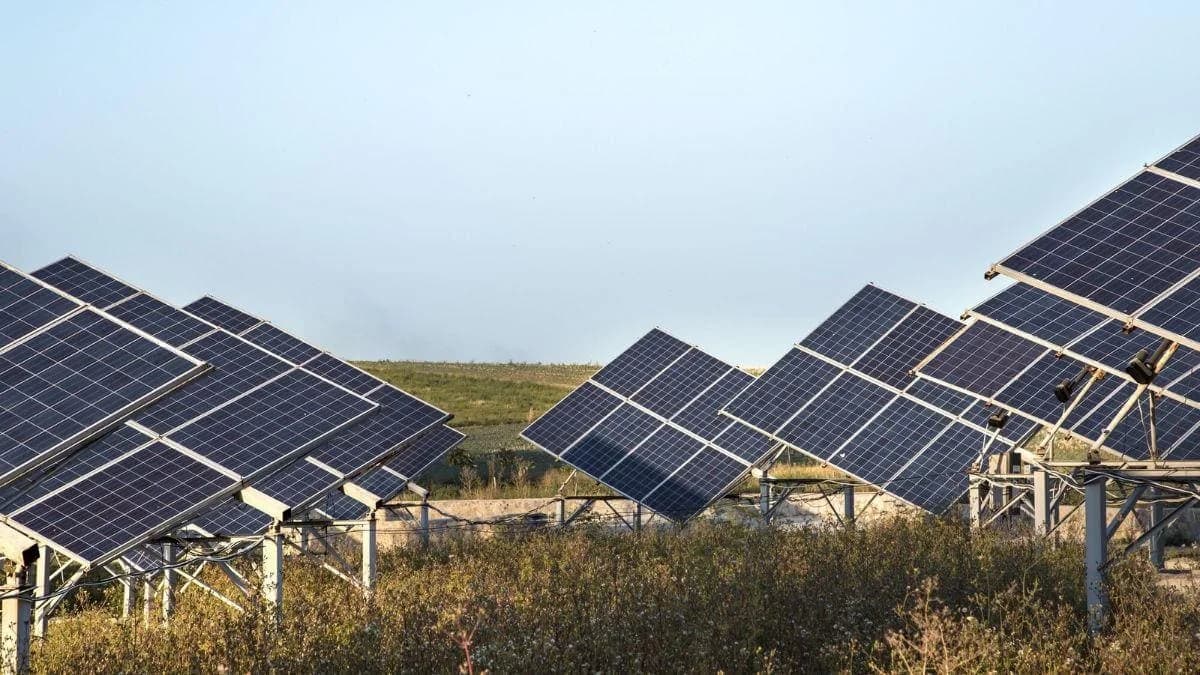
The steep provisional duty could now price Indian products out of the US market, adding pressure on manufacturers that have invested heavily in new factories under India's production-linked incentive (PLI) schemes. According to CNBC-TV18, shares of solar energy companies tumbled on February 25, 2026, with Waaree Energies falling 10% to ₹2,721 per share, Premier Energies hitting the lower circuit of 10% at ₹699.35 per share, and Vikram Solar dropping 5.72% to ₹174.79 per share. Reports suggest that Waaree Energies has nearly 29% export exposure, while Vikram Solar derives around 16% of its revenue from exports. However, industry experts suggest the impact on domestic Indian manufacturers may be limited, as exports already represent a small portion of total production. The move is particularly sensitive regarding India, as President Trump recently signed a bilateral trade deal intended to reduce economic friction between the two nations, creating additional complexity in the relationship. As per The Times of India, Abhishek Pareek, group head - finance at Waaree Energies, said the matter remains under review and the company does not expect a material impact on its ability to service its US order book, while the company is expanding local manufacturing in the US and diversifying its supply chain.
The tariff announcement comes at a challenging time for India's domestic solar manufacturing sector, which is already grappling with oversupply conditions. According to Mint, Ankit Jain, vice president & co-group head-corporate ratings at Icra Ltd, warned that countervailing duties and growing regulatory uncertainty in the US are likely to dampen export volumes from India. Jain noted that "the move will potentially exert pricing pressures on domestic original equipment manufacturers, and can impact the profitability of the solar module manufacturers." The ministry informed the Department of Financial Services and non-bank lenders including Power Finance Corp., REC Ltd and Indian Renewable Energy Dev Agency Ltd about the status of installed domestic manufacturing capacities, with over 140GW of solar module manufacturing capacity as of date and expected to increase to over 165GW by March 2027. Amid concerns about oversupply, the MNRE cautioned banks and non-banking financial companies against unregulated lending to solar module manufacturers in December.
The 126% tariff places India among a group of Asian exporters facing steep penalties, with initial duties ranging from 86% to 143% for Indonesia and 81% for Laos, as reported by CNBC-TV18. The final determination in the investigation is scheduled for July 6, 2026, unless the timeline is extended. In parallel, the Commerce Department is also conducting an antidumping duty probe into solar cells imported from India, Indonesia and Laos. The Trump administration's move follows federal determinations that foreign subsidies have allowed exporters to unfairly undercut American-made products, as the US seeks to shield domestic manufacturers from a flood of cheap imports. Earlier this month, the US and India struck a bilateral trade deal aimed at easing economic friction between the two countries, but these preliminary duties add complexity to that relationship, particularly in the fast-growing clean energy segment. As per The Times of India, Vietnam, Thailand, Malaysia and Cambodia already face heavy countervailing duties, adding to the regional impact of these trade measures.
The Department of Commerce is expected to issue its final determination on July 6, 2026, unless the timeline is extended. According to Upstox, the findings that have been issued are preliminary, and interested parties have the opportunity to comment on the preliminary determination and participate in a public hearing. As a result, the final rates could be higher or lower than the preliminary figures. The department is also conducting parallel antidumping investigations into solar cell imports from the three countries, while the US International Trade Commission is examining whether the imports have caused injury to the domestic industry. If both the Department of Commerce and the ITC deliver affirmative final rulings, the US will impose definitive duties on the imports. The move signals a tightening grip on the global solar supply chain and a potential shift in energy costs for American consumers, as these measures follow the US's broader protectionist trade agenda. Meanwhile, Indian solar equipment makers including Waaree Energies, Adani Solar, Reliance Industries Ltd, ReNew Energy Global plc, Brookfield and PTT backed Avaada Group are lining up ₹30,000 crore solar cell play for creating new 50GW capacity in the next financial year (FY27) to leverage localization norms.