
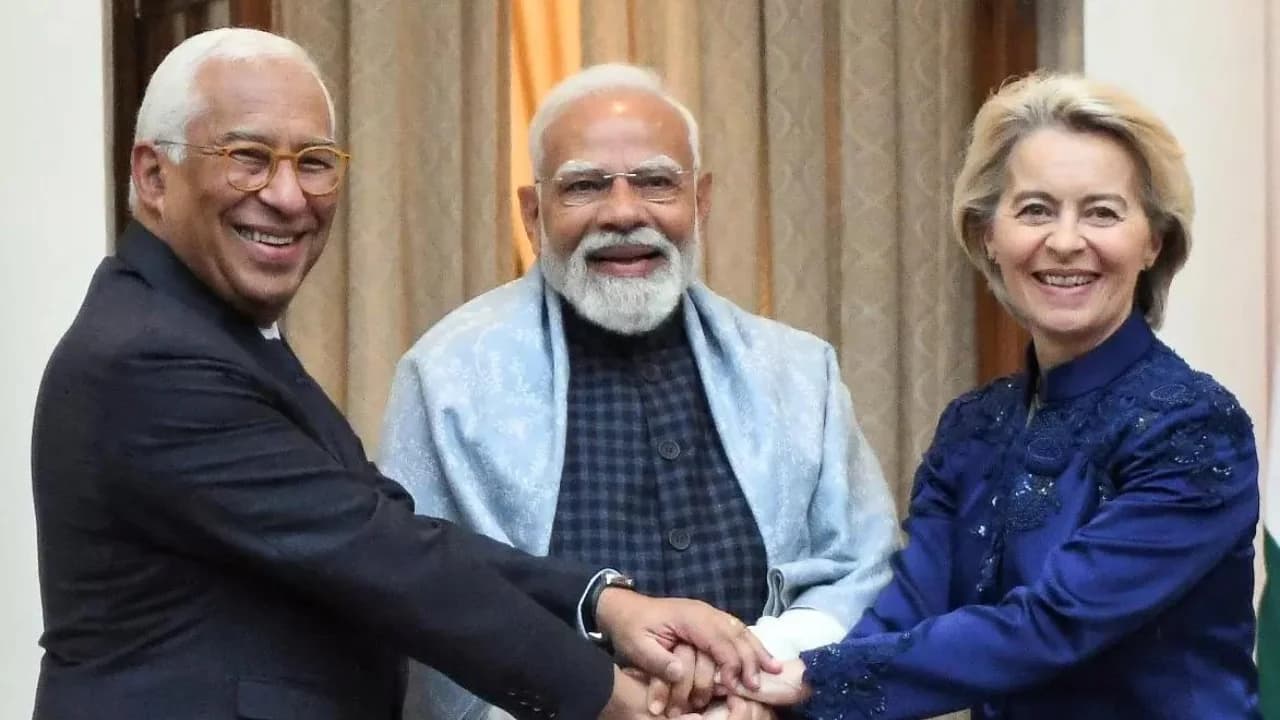
India and the European Union have finalized their landmark free trade agreement after nearly two decades of negotiations, with both sides agreeing to Most Favoured Nation (MFN) status once the deal takes effect. According to the draft agreement released by the Union commerce ministry on Friday, the move is embedded within the draft text of the agreement and will bind both sides to World Trade Organization (WTO) disciplines. This ensures they do not impose new import or export restrictions beyond agreed global rules. The development came after marathon meetings between European Commission President Ursula von der Leyen, European Council President Antonio Costa and Prime Minister Narendra Modi during their visit to New Delhi on January 27, when the two sides announced the end of negotiations for what has been dubbed the 'mother of all deals'. As per Reuters, the economic deal between India and EU opens up avenues for India and the EU to stabilise the international order.
The pact, concluded after nearly 20 years of negotiations that began in 2007 and were paused in 2013, is expected to take effect within a year following legal vetting and ratification by the European Parliament and India's authorities. As reported by NewsIndia, the agreement will progressively eliminate or reduce tariffs on 96.6% of traded goods by value. The deal will unite India (the world's fourth-largest economy) with the EU (the second-largest economic bloc), forming a market of around 2 billion people. Together, they represent 25% of global GDP and roughly one-third of global trade, worth about USD 11 trillion of USD 33 trillion. The European Union is India's largest trading partner, with bilateral goods trade standing at USD 135 billion in FY 2023-24. The deal, likely to be effective in a year after legislative ratification, is expected to double EU exports to India by 2032 and will lead to savings of 4 billion euros ($4.7 billion) in duties for European companies, according to the EU.
Under the agreement, India will ultimately remove duties on 96% of goods by trade value, with phased reductions over up to ten years. The EU, in turn, will open 99.5% of its market by trade value, with most tariff lines falling to zero immediately or within seven years. According to the draft agreement, the pact will allow 93% of Indian exports to enter the 27-nation bloc duty-free. The deal is expected to significantly expand commercial ties, with India potentially cutting import tariffs on EU cars to 40% from the current peak of 110%. Sources close to the talks indicate New Delhi has agreed to immediately lower duties on select EU cars priced above roughly ₹16.3 lakh ($17,739), with tariffs expected to drop further to 10% over time. Sensitive agricultural sectors including dairy, rice, sugar and beef have been excluded from the agreement, with agriculture-related items like soya, beef, sugar, rice and dairy left out of the purview of the trade deal, as confirmed by the draft text.
To facilitate smoother trade operations, New Delhi and Brussels will bring food safety and plant health rules in line with World Trade Organization standards and streamline certification and audit procedures. The text sets out plans for closer customs cooperation and quicker clearance of goods, with these commitments becoming binding after ratification. Both sides will start sharing annual import data one year after the deal takes effect to track agreement implementation and tariff benefits. They have also agreed to provide fair and accessible appeal processes for customs decisions related to imports, exports or goods in transit. The agreement is expected to transform India-EU relations qualitatively across multiple sectors, particularly as global commerce faces disruption from tariff-driven policies of the United States.
On digital trade, India and the EU committed to curbing unjustified barriers and promoting an open and secure online environment. The draft recognises privacy as a fundamental right while preserving both sides' authority over personal data protection and cross-border transfer rules. It also promotes paperless trade and legal recognition of electronic contracts, signatures and authentication. Separately, the EU will mobilise finance and investment to support India's efforts to cut greenhouse gas emissions under the proposed pact, as outlined in the draft text. The FTA is taking shape amid rising concerns over US trade measures that have impacted both India and the 27-nation bloc, prompting New Delhi and Brussels to deepen economic cooperation. Both sides have committed to deeper digital trade cooperation, recognising privacy as a fundamental right while retaining authority over personal data protection.