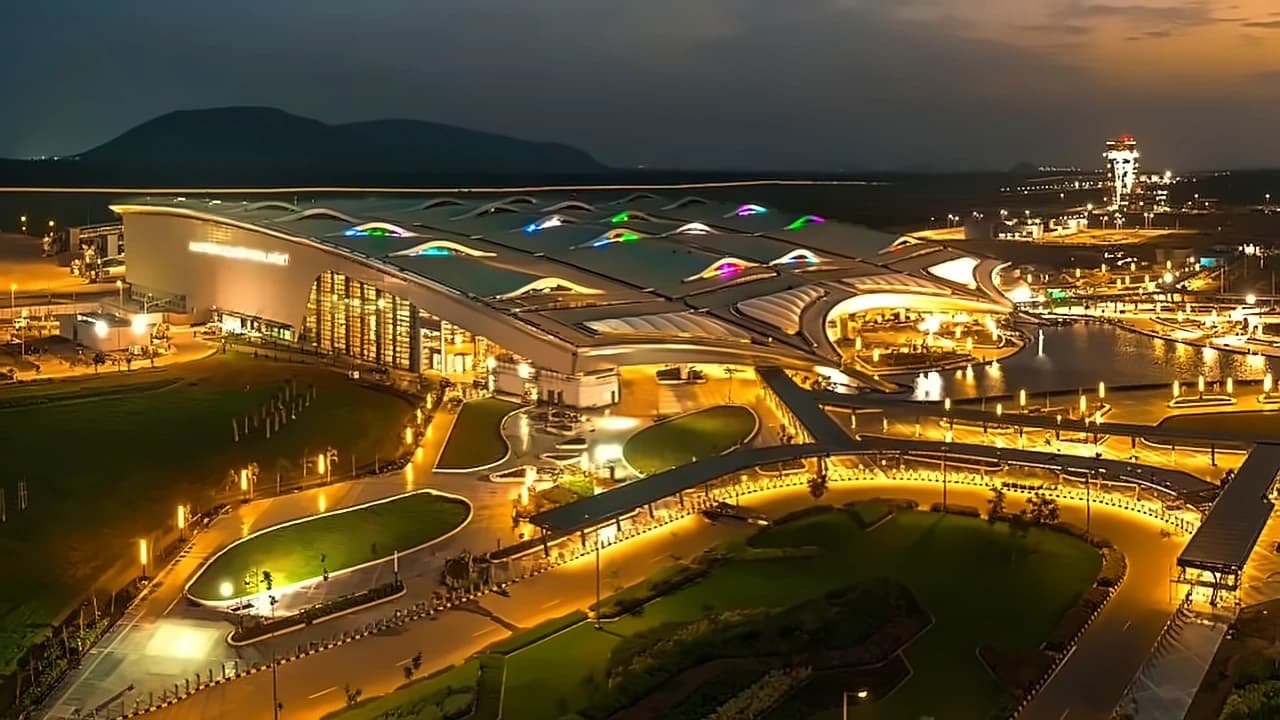
Prime Minister Narendra Modi inaugurated the Alluri Sitarama Raju International Airport at Bhogapuram in Vizianagaram district on August 1, 2026. According to the latest official schedule, PM Modi arrived from Delhi on a special aircraft at 10.45 am and was received by Governor S Abdul Nazeer and Chief Minister N Chandrababu Naidu. The ₹5,000 crore Greenfield airport has been developed by GMR Group under the Public-Private Partnership (PPP) model and is being positioned as a major growth engine for North Andhra through connectivity, cargo and jobs. The airport is designed to handle six million passengers annually in the first phase, with a master plan to expand capacity to 40 million passengers per annum in subsequent phases. At 10:58 am, the Prime Minister inaugurated the airport terminal building and subsequently inspected the facility along with the Chief Minister, Governor and other dignitaries. He then proceeded to a public meeting venue in an open-top vehicle, where more than 13,500 tribal women and students will greet him with a grand Dhimsa dance performance, with the Prime Minister addressing the public meeting from 11:30 am to 12:55 pm. Commercial operations of the airport would begin from August 17.
The inauguration comes as India's aviation sector achieves a significant milestone, with Minister of State for Civil Aviation Murlidhar Mohol announcing that total annual passenger handling capacity at airports has increased to more than 580 million. As per the latest government data, passenger traffic handled during 2025-26 was about 420 million, representing substantial growth in air travel demand. Currently, there are 166 airports in the country, with the ministry having given 'In-Principle' approval for setting up 25 greenfield airports, and out of them, 14 airports have been operationalised. The capacity augmentation and modernisation projects undertaken by the Airports Authority of India (AAI) and other airport operators are based on traffic growth, operational requirements, airline demand, financial viability and techno-economic considerations.
The passenger terminal has been designed to provide a modern, seamless and efficient travel experience, combining advanced infrastructure, modern technologies and sustainability measures. The airport features energy-efficient heating, ventilation and air conditioning (HVAC) systems, energy-efficient lighting, a 5 MW solar power plant, rainwater harvesting, smart building management systems, waste management initiatives, electric vehicle charging infrastructure and environmental monitoring measures. The terminal has been designed in accordance with Green Building Standards and is registered with the US Green Building Council (USGBC), achieving LEED Platinum standards. The terminal's design reflects the state's cultural identity, with an architectural form inspired by a flying fish to represent the Bay of Bengal and North Andhra's maritime heritage, while traditional Rangoli motifs have been used in the roof and ceiling design. The airport is among the 'fastest-completed greenfield international airports in India... nearly five months ahead of schedule' and has already received the Directorate General of Civil Aviation aerodrome licence along with required safety, fire and environmental clearances. The airport incorporates advanced passenger processing technologies including contact boarding bridges, Common Use Passenger Processing System (CUPPS), self-baggage drop, self-service passenger processing, smart surveillance, access control systems, security management systems and an Integrated Operational Control and Monitoring Centre.
During his visit to Andhra Pradesh, PM Modi will lay foundation stones and dedicate projects of the Ministries of Petroleum, Surface Transport and other departments worth a cumulative ₹18,000 crore. The Prime Minister will also inaugurate renewable energy transmission projects worth nearly ₹10,000 crore and dedicate National Highway projects worth over ₹1,880 crore. The Andhra Pradesh government invested ₹1,583 crore in infrastructure, including land acquisition (₹944 crore), water supply (₹75 crore), power supply (₹97 crore), funded works (₹134 crore), connectivity roads (₹301 crore), road connectivity (₹3.25 crore) and canal works (₹27 crore). The integrated project covers 2,703.26 acres, including the airport over 2,203.32 acres, an aviation hub over 500 acres, and an aviation university and EduCity over 136.63 acres, along with airside infrastructure, commercial development, residential zones and approach roads. The approach roads and supporting infrastructure connecting the airport will significantly improve air connectivity across North Andhra, coastal Andhra and neighbouring states.
The airport is expected to significantly strengthen North Andhra's export ecosystem through a 25,000 metric tonne annual capacity cargo terminal with temperature-controlled cold chain facilities for transporting pharmaceuticals, marine products and other high-value perishable goods. The government said integration with Visakhapatnam Port, industrial corridors and logistics networks is expected to help develop Bhogapuram into a major air cargo and logistics hub on India's east coast. The Union government had approved the Bhogapuram airport proposal on the condition that commercial operations are stopped for 30 years at the existing Visakhapatnam airport about 60 km away, which has been operating as a civil enclave at a naval airbase. The Communist Party of India (Marxist) has demanded that the Visakhapatnam airport be retained as a domestic airport even after the Bhogapuram International Airport commences operations. The project is expected to unlock new opportunities in tourism, hospitality, logistics, warehousing, exports, pharmaceuticals, marine products, IT, aerospace, defence and manufacturing. Tourist destinations such as Araku, Lambasingi, Visakhapatnam, Vizianagaram and Srikakulam are expected to benefit substantially. The Andhra Pradesh government views the nearly ₹5,000 crore Bhogapuram Airport not merely as an infrastructure project, but as a transformational asset for the entire North Andhra region, conceived as a catalyst for industrial growth, employment generation, exports, skill development and research.