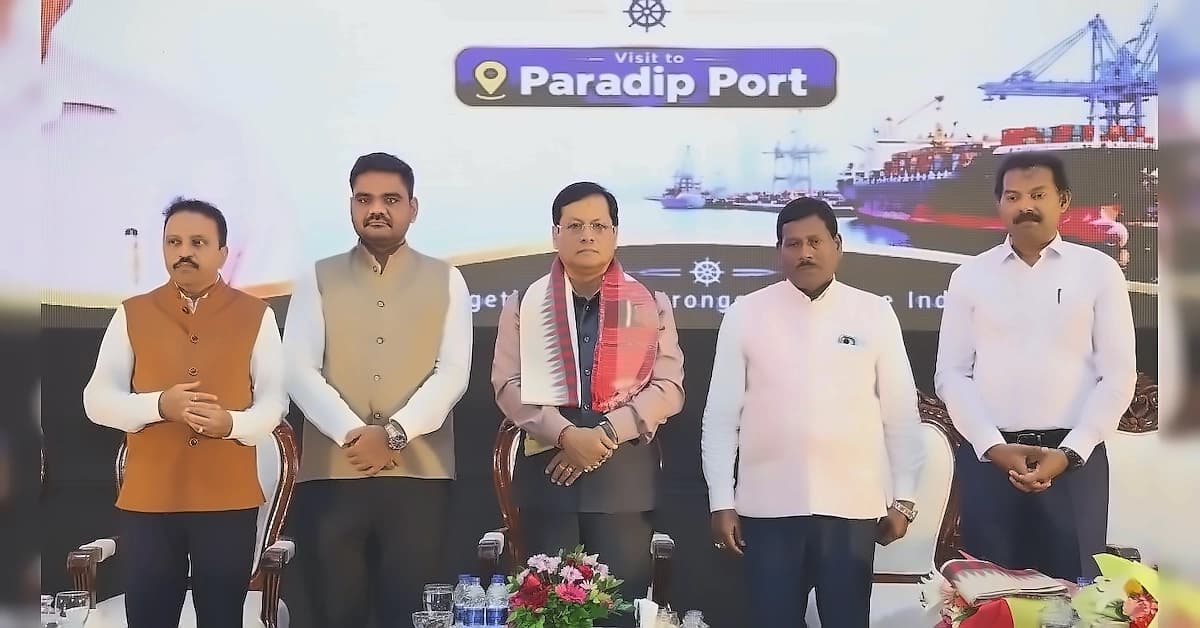
Paradip has been selected as one of four locations for critical mineral processing parks under the National Critical Minerals Mission (NCMM), as announced by Union Minister of State for Coal and Mines Satish Chandra Dubey in Parliament. The other selected states include Andhra Pradesh, Gujarat and Maharashtra. According to reports from Business Standard, the park in Odisha will be established inside the Petroleum, Chemicals and Petrochemicals Investment Region (PCPIR) in Paradip, leveraging the region's existing industrial infrastructure. The Paradip CMPP functions as the processing and value-addition node within Odisha's rare earth corridor architecture, serving as a component within a deliberate national system designed to intercept supply chains at the refining stage before manufactured goods are imported.
The critical mineral processing parks are backed by a ₹500 crore allocation under the mission, as reported by Business Standard. The parks are expected to strengthen domestic value chains for electric vehicles (EVs), semiconductors, renewable energy equipment, aerospace and defence manufacturing. The NCMM has allocated a total budget of ₹500 crore to develop four Critical Mineral Processing Parks across geographically and industrially strategic locations in India. Each facility is conceived as a shared-infrastructure platform where multiple processors, refiners, and downstream manufacturers can access purpose-built industrial capacity without individually bearing the capital burden of constructing it. The processing capacity addresses the structural vulnerability where India currently relies heavily on imported refined critical minerals and rare earth compounds, particularly acute in EV battery production where cathode active materials are overwhelmingly sourced from abroad.
The government has recognised nine premier institutes as Centres of Excellence (CoEs) under the NCMM for research and development in the critical mineral value chain, according to Business Standard. These CoEs include the Council of Scientific and Industrial Research-Institute of Minerals and Materials Technology (CSIR-IMMT) in Bhubaneswar. The proposed parks envisage facilitating critical mineral processing and value addition by providing common infrastructure for industries engaged in the processing of critical minerals and supporting downstream industries that use critical minerals as inputs. The geographic proximity between the CSIR-IMMT in Bhubaneswar and the Paradip CMPP creates a direct research-to-commercialisation pipeline that is genuinely rare in industrial development contexts, where laboratory-scale innovations in mineral processing techniques, hydrometallurgical methods, and refining efficiency can be translated into industrial applications without logistical friction that typically delays technology transfer.
According to industry experts cited by Business Standard, Paradip offers significant natural advantages for critical mineral processing. The location allows efficient transportation of imported concentrates as well as domestically mined ores through the deep-water port, while processed materials can be exported or supplied to manufacturing clusters across the country. The Paradip CMPP is positioned within the Petroleum, Chemicals and Petrochemicals Investment Region (PCPIR), an integrated industrial zone covering approximately 284 square kilometres across the Jagatsinghpur and Kendrapara districts of Odisha. This co-location compresses development timelines significantly, as the PCPIR already hosts operational anchor tenants, most significantly the Indian Oil Corporation (IOCL) refinery, along with fertilizer manufacturing operations. The IOCL petrochemical complex represents the company's largest single-location capital commitment in its corporate history at ₹61,077 crore, driving a compounding cluster effect that benefits the CMPP in ways that are easy to underestimate. The sector is projected to hit $18–20 billion by 2032, with the processing and manufacturing share set to quadruple, creating substantial employment opportunities across the development and operational lifecycle.
As reported by Business Standard, the processing park is expected to attract investments in refining, separation and advanced material manufacturing. Companies engaged in battery materials, permanent magnets, electronic components and speciality chemicals are likely to benefit from shared infrastructure, common utilities, logistics support and policy incentives envisaged under the mission. The CMPP serves as the processing infrastructure node within Odisha's rare earth corridor, one of four corridors announced in the Union Budget 2026-27 covering Odisha, Kerala, Andhra Pradesh, and Tamil Nadu. Primary beneficiaries include steel manufacturers, EV battery producers, clean energy equipment manufacturers, and defence sector suppliers that depend on processed critical mineral compounds as production inputs. The Ministry of Coal and Mines has confirmed that detailed investment requirements and employment generation projections are currently being developed as part of the formal Detailed Project Report (DPR) for the Paradip CMPP. The strategic ceiling for the Odisha critical mineral processing park extends well beyond meeting India's domestic demand, with its combination of port access, existing industrial infrastructure, and proximity to mineral-rich regions potentially attracting processing contracts from mineral-rich but processing-deficient nations in South Asia, Southeast Asia, and Africa.