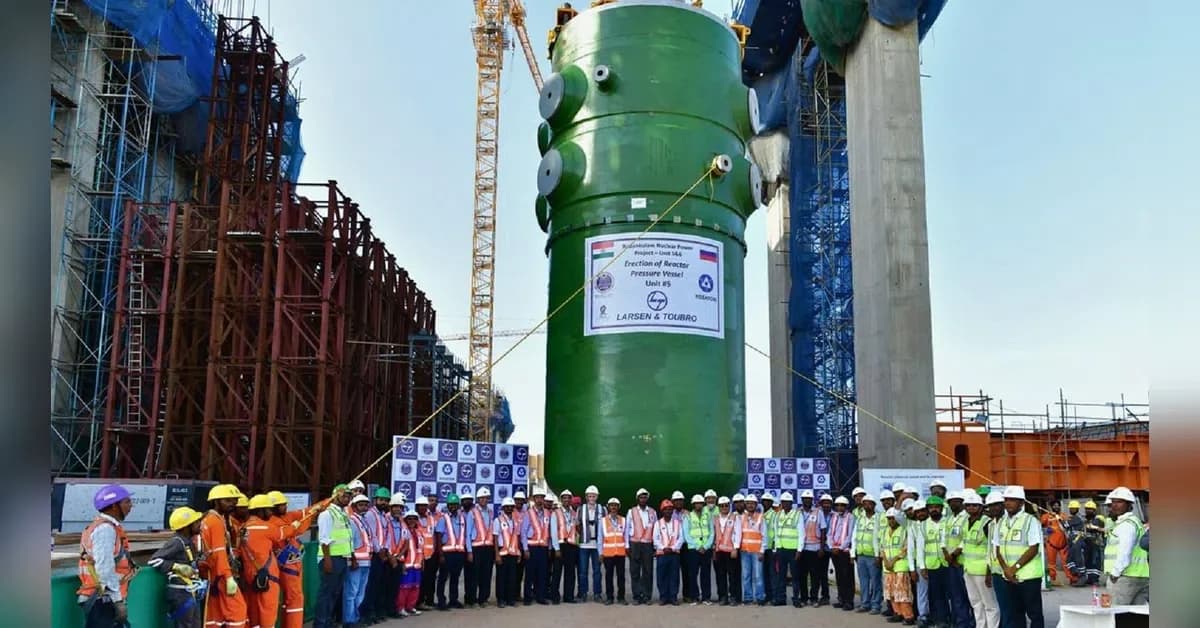
The Nuclear Power Corporation of India Limited (NPCIL) has achieved a significant milestone in India's largest nuclear power project with the successful installation of the reactor pressure vessel at Unit-5 of the Kudankulam Nuclear Power Project (KKNPP) in Tamil Nadu. According to Rosatom State Corporation, the 320 tonne Reactor Pressure Vessel (RPV) was installed using the 'open top' method, in which heavy equipment is lowered into the reactor building before the containment dome is erected. The precision-engineered vessel, manufactured at Volgodonsk in Russia and delivered to the Kudankulam site in 2025, houses the reactor core where nuclear fission takes place and is designed to withstand extreme temperatures and pressure environments. The operation was carried out after receiving Major Equipment Erection clearance from the Atomic Energy Regulatory Board on May 2, with the vessel lifted and positioned using specialised heavy-lift cranes while adhering to prescribed safety and quality protocols. Current indications suggest that the fifth unit is slated to become operational towards the end of this year. As per NPCIL, the reactor pressure vessel is considered the heart of a nuclear power plant, and this achievement signifies the beginning of the erection of Nuclear Steam Supply System (NSSS) equipment.
The Kudankulam project, conceived under an intergovernmental agreement in 1988, comprises six units, each of 1,000 megawatt electric (MWe) capacity. As reported by NPCIL, KKNPP Units 1 and 2 (2 x 1,000 MWe) are already operational and were connected to the Indian national grid in 2013 and 2016 respectively. These operational units have cumulatively generated about 130 billion units of electricity, averting the release of about 112 million tonnes of CO2 equivalent into the environment. KKNPP Units 3 and 4 (2 x 1,000 MWe) are at an advanced stage of construction, while Units 5 and 6 (2 x 1,000 MWe) are at different stages of construction and planned for commissioning at the earliest. According to NPCIL, as Units 3, 4, 5, and 6 progress through advanced and ongoing stages of construction, the Kudankulam site is steadily moving towards its full potential of 6,000 MWe installed capacity, reinforcing India's long-term commitment to reliable, clean, and sustainable energy. Once all six reactors become operational, the plant will have a total installed capacity of 6,000 MWe, making it one of the country's largest nuclear power facilities.
The installation of the fifth unit assumes particular significance amid India's ambitious expansion of nuclear energy under the Centre's vision of a developed nation by 2047. The 1,000 MW Unit-5 reactor will add reliable, round-the-clock electricity to India's power grid, helping meet growing demand from homes, industries and infrastructure. Unlike solar and wind power, nuclear energy can generate electricity continuously, strengthening energy security and reducing dependence on coal. The project will also support India's clean-energy transition by lowering carbon emissions while contributing to economic growth, job creation and long-term energy self-reliance. Nuclear power has emerged as a key component of the Centre's long-term strategy to achieve energy security and support its net-zero ambitions, with policymakers increasingly highlighting the role of nuclear power as a reliable source of round-the-clock, low-carbon electricity that can complement renewable energy sources such as solar and wind. The completed site will significantly contribute to India's clean-energy goals while providing reliable electricity with the highest standards of nuclear safety, quality and environmental protection in line with the Nuclear Energy Mission for Viksit Bharat. India aims to increase its nuclear power generation capacity to 100 gigawatts by 2047, with Kudankulam expected to play a major role in achieving that target.
The Russian partner Rosatom State Corporation collaborated on the installation through the 'open top' method, in which heavy equipment is lowered into the reactor building before the containment dome is erected. As reported by NPCIL, the equipment was manufactured at the Atommash plant in Russia and delivered to the Kudankulam site in 2025. Following the installation, work will now begin on placing other major reactor components, including steam generators, main circulation pumps, pipelines, pressure compensators and emergency core cooling system equipment. The development comes amid growing India-Russia cooperation in the nuclear energy sector, with Russian President Vladimir Putin expressing confidence that bilateral trade between India and Russia could reach USD 100 billion in the coming years during the St Petersburg International Economic Forum. Referring to cooperation in the nuclear sector, Putin said, "We are not only talking about our plans in energy, including nuclear energy. Kudankulam Nuclear Power Plant (KKNPP) is now being constructed." External Affairs Minister S Jaishankar had also highlighted the importance of the project earlier this year, saying, "Russia is our foremost partner in civil nuclear energy and the Kudankulam nuclear project is a stellar example." The milestone reflects close cooperation between NPCIL and Russia's Atomstroyexport (ASE), highlighting the importance of international collaboration in India's nuclear energy programme.