
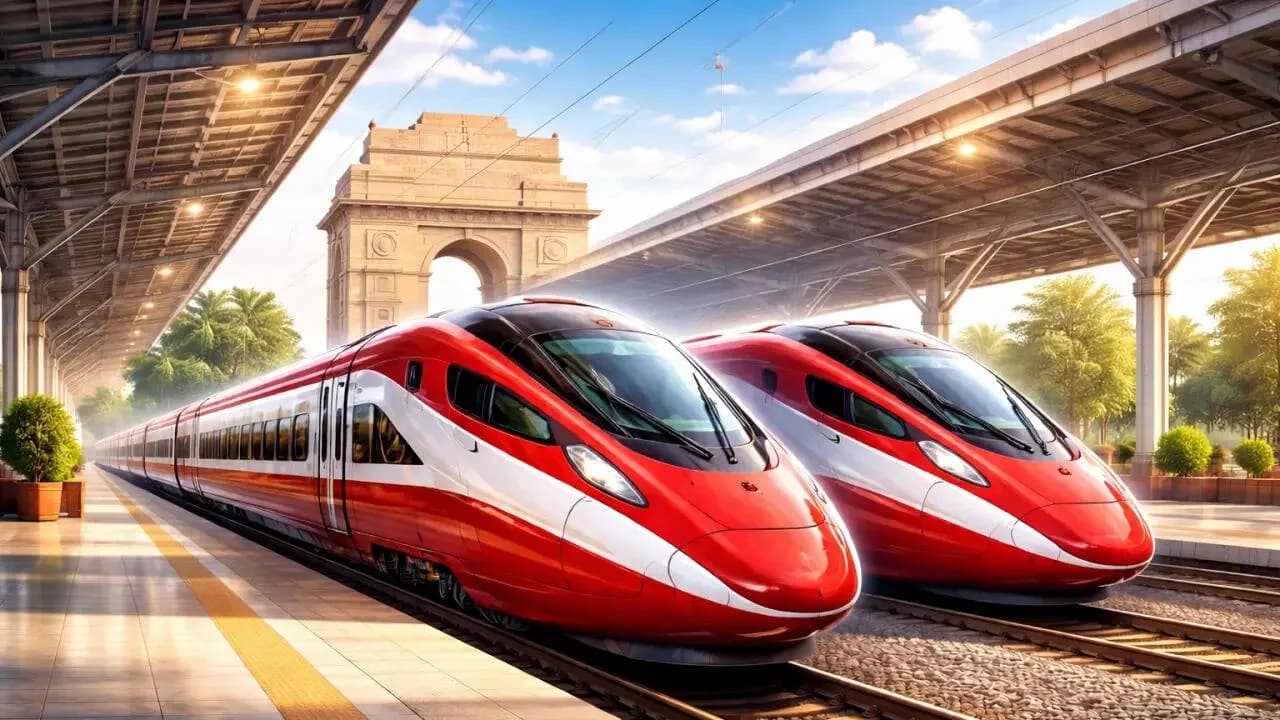
Finance Minister Nirmala Sitharaman announced seven new high-speed rail corridors in her Union Budget speech, marking a significant expansion of India's rail infrastructure. According to reports from The Times of India, these corridors will be developed as 'growth connectors' to promote environmentally sustainable passenger systems. The corridors will cover nearly 4,000 km with an estimated investment of ₹16–20 lakh crore, as highlighted by Deloitte India's Anurag Gupta. This announcement comes as Indian Railways is already working to upgrade overnight train travel with the launch of Vande Bharat sleeper trains and Amrit Bharat trains. Minister of State Harsh Malhotra emphasized that infrastructure serves as the backbone of this budget, with ₹3 lakh crore allocated for road infrastructure and seven high-speed rail corridors planned, setting India up for unprecedented connectivity.
The Mumbai–Pune corridor will be the western region's flagship project, cutting travel time to just 48 minutes. The Pune–Hyderabad route will enable travel in approximately 1 hour 55 minutes, creating a continuous high-speed spine across western and southern India. The Hyderabad–Bengaluru corridor will reduce travel time to about 2 hours, while the Hyderabad–Chennai route will take around 2 hours 55 minutes. The Delhi–Varanasi corridor will enable travel in around 3 hours 50 minutes, and the Varanasi–Siliguri route will take about 2 hours 55 minutes via Patna. As reported by The Times of India, these corridors will significantly transform inter-city passenger movement and act as key economic multipliers.
A landmark project, the Delhi–Mumbai Expressway is scheduled for completion by 2027, which will reduce travel time from 33 hours to just 12 hours—dramatically enhancing logistics efficiency and economic integration. The Delhi Decongestion Plan has been announced with an outlay of approximately ₹24,000 crore to ease traffic, reduce vehicular pollution, and improve urban mobility. Key road stretches including Ashram to Badarpur, Punjabi Bagh to Tikri Border, and the Mehrauli-Gurugram stretch have been taken over by NHAI to significantly enhance traffic flow. The plan focuses on extension of Delhi-Amritsar-Katra Expressway and construction of a road tunnel from Dwarka Expressway to Nelson Mandela Marg, Vasant Kunj, demonstrating comprehensive urban infrastructure development.
The budget allocates a record ₹1 lakh crore for healthcare, with ₹10,000 crore earmarked for the Biopharma Shakti initiative to strengthen innovation and self-reliance in medical technologies. Additionally, 1,00,000 allied health professionals will be trained and three AIIMS-Ayurveda institutions and five integrated medical hubs announced, reflecting a holistic approach. Flagship schemes like Ayushman Bharat continue to expand, benefitting lakhs of families in Delhi, while PM Vaya Vandana Yojna underscores the government's commitment to senior citizens. This healthcare focus represents a significant investment in India's medical infrastructure and medical technology development.
Jagannarayan Padmanabhan from Crisil Intelligence believes the seven high-speed rail corridors respond directly to rising commuter demand for faster, reliable and energy-efficient travel. According to The Times of India, he notes that such systems can substantially cut journey times between high-density city pairs, expand passenger capacity and enable a shift away from road and short-haul aviation. G Raghuram from The Infravision Foundation emphasizes that high-speed rail travel will have positive externalities in construction management, better concrete technology, and precision engineering. However, he raises concerns about funding, noting that ₹16 trillion for seven corridors may require significant bandwidth in execution.
Indian Railways is launching Vande Bharat sleeper trains with fixed fares of ₹2.4, ₹3.1 and ₹3.8 per km for third, second and first AC classes respectively. As reported by The Times of India, Railway Minister Ashwini Vaishnaw has announced plans to launch 260 such train sets. The Amrit Bharat trains feature improved interiors and are designed for the common man, with plans for 4,500 trainsets by 2047 and 800 trainsets operational by 2030. These initiatives represent a fundamental upgrade across passenger services, safety, comfort and amenities, bringing quality on par with global standards.
The Mumbai-Ahmedabad bullet train project is expected to be operational in the coming years, with the first stretch already under development. According to The Times of India, bullet trains run at 300 kmph, while high-speed rail includes travel at 220-250 kmph. The Mumbai-Ahmedabad project is estimated at ₹2 trillion over 11 years, meaning approximately ₹2 trillion per annum investment. With current railway spending at ₹0.5 trillion per year, experts suggest it could take 32 years to complete all seven corridors, or 25 years if allocations are increased significantly. The budget allocates ₹2,700 crore for railway infrastructure in the capital, reflecting the government's commitment to comprehensive rail development.