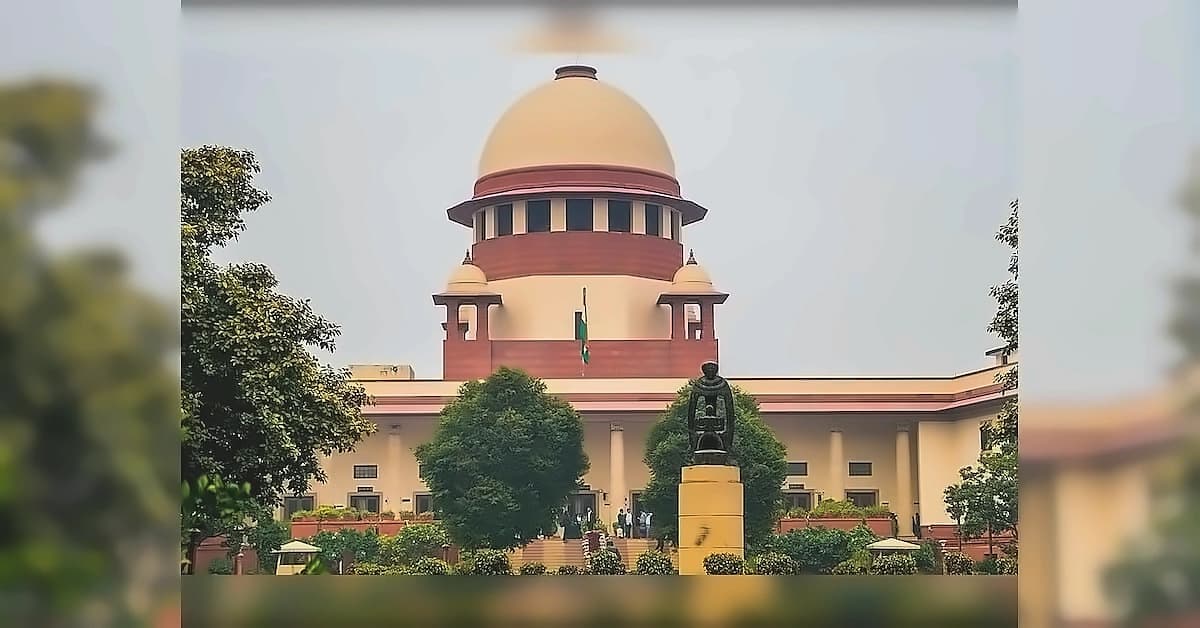
A three-judge Bench of the Supreme Court headed by Chief Justice of India Justice Surya Kant will hear review petitions challenging the Court's landmark July 2022 judgment that upheld the constitutional validity of several provisions of the Prevention of Money Laundering Act (PMLA). The new Bench will comprise CJI Surya Kant and Justices Joymalya Bagchi and V Mohana. According to reports from Business Standard, the decision to reconstitute the Bench was taken on Thursday after all parties consented to the new composition. The review petitions were earlier listed before a Bench comprising CJI Surya Kant and Justices Ujjal Bhuyan and N K Singh, but the CJI said the matter could not be heard by the original Bench as Justices Bhuyan and Singh are now part of other Benches. Solicitor General Tushar Mehta, appearing for the Enforcement Directorate, and Senior Advocate Kapil Sibal, representing the petitioners, agreed to the new arrangement. The Court said the matter would be heard by the new Bench owing to its urgency and that a date would be fixed separately.
The review petitions seek reconsideration of the judgment in Vijay Madanlal Choudhary v Union of India, in which a three-judge Bench had upheld the validity of several key PMLA provisions. As reported by Business Standard, the 2022 ruling came on a batch of 241 petitions challenging the anti-money laundering law. The judgment upheld provisions dealing with the definition of money laundering, attachment of property, search and seizure, arrest, the reverse burden of proof, trial of offences and the stringent twin conditions for bail. The Court had further held that an Enforcement Case Information Report (ECIR) need not be furnished to an accused as a matter of right, ruling that the ECIR is an internal document of the ED and cannot be treated as equivalent to an FIR. The Supreme Court had on July 31 last year said it would first examine whether the review petitions were maintainable before considering the substantive issues raised by the petitioners. The bench had noted that the ED had identified three preliminary issues concerning maintainability, while the review petitioners had proposed 13 questions for consideration.
The judgment had overturned the 2017 ruling in Nikesh Tarachand Shah v Union of India, in which the Supreme Court had struck down the twin conditions for bail under Section 45(1) of the PMLA. According to Business Standard, Section 45(1) of the Prevention of Money Laundering Act (PMLA), 2002, establishes that all offences under the Act are cognisable and non-bailable. To secure bail, an accused must fulfil strict 'twin conditions': the court must allow the public prosecutor to oppose the release, and be satisfied there are reasonable grounds that the accused is not guilty and will not re-offend**. The review petitioners have questioned several aspects of the 2022 verdict, including the validity of the reverse burden of proof under Section 24, the refusal to treat the ECIR on the same footing as an FIR and the stringent bail requirements under Section 45. The Supreme Court had also upheld Section 45 of the PMLA, which makes certain offences cognisable and non-bailable and imposes twin conditions for bail, holding that the provision was reasonable and did not suffer from arbitrariness or unreasonableness.

The Enforcement Directorate has raised preliminary objections to the maintainability of the review petitions, questioning whether the petitioners have demonstrated an 'error apparent on the face of the record', or whether the review pleas effectively seek a rehearing of the case in the guise of a review. As reported by Business Standard, the agency has also relied on the Supreme Court's August 25, 2022, order to contend that the scope of the review should be confined to two issues: whether an accused is entitled to a copy of the ECIR and the constitutional validity of the reverse burden of proof under Section 24. Solicitor General Tushar Mehta had said the bench that considered the review petitions for admission had issued notices only on two aspects: whether an accused is entitled to a copy of the Enforcement Case Information Report (ECIR), and the reversal of the burden of proof under Section 24 of the PMLA. The new Bench will now consider these issues and determine the scope of the review proceedings.
The 2022 judgment was delivered on a batch of more than 200 petitions challenging various provisions of the PMLA, with opposition parties frequently alleging that the law and its enforcement have been used by the government to target political opponents. The Supreme Court had described money laundering as a 'threat' to the proper functioning of financial systems worldwide and held that it was not an 'ordinary offence'. The Court had also held that authorities under the PMLA are 'not police officers as such' and that an ECIR cannot be equated with an FIR under the Code of Criminal Procedure. The next date of hearing will be notified later, as the bench comprising CJI Surya Kant and Justices Bagchi and Mohana will hear the matter. The Centre opposes a wider review beyond specific issues, while the petitioners seek a comprehensive reconsideration of the 2022 verdict.