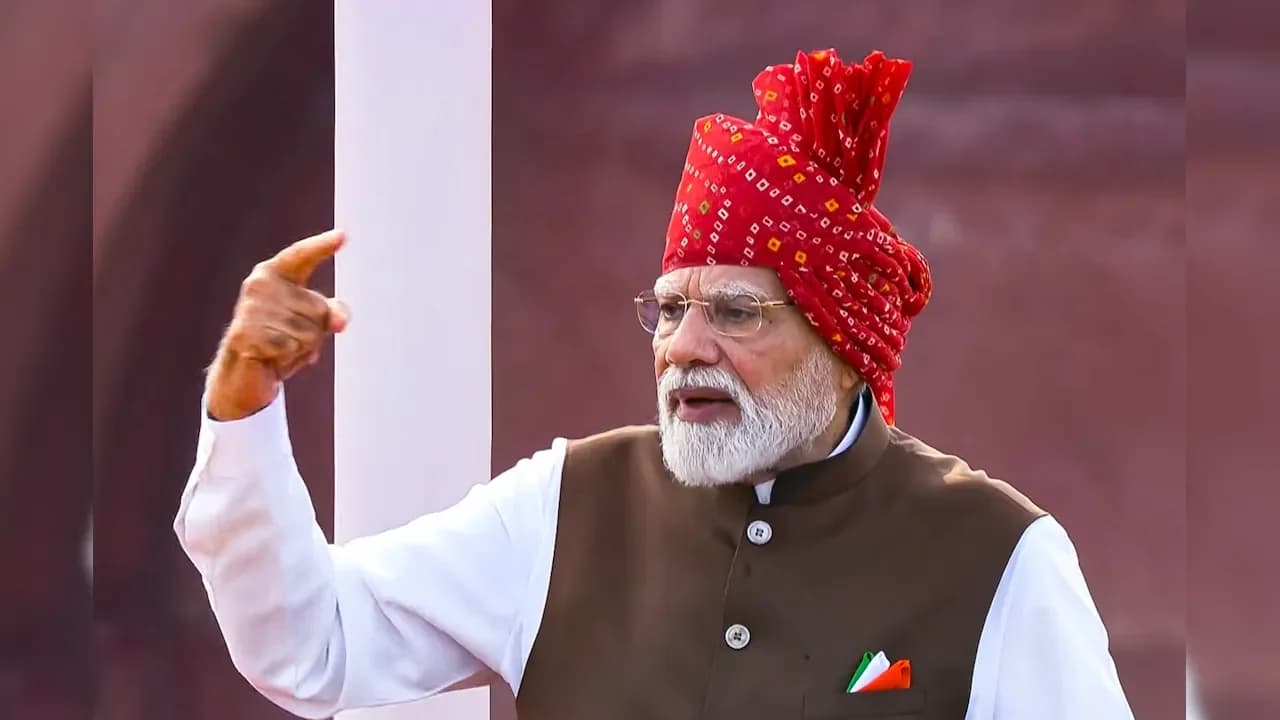
Prime Minister Narendra Modi announced a significant AI skill training initiative targeting one crore youth within the next year. According to reports from NDTV, Modi made this announcement during his 80th Independence Day address from the Red Fort, stating that the government has resolved to work towards providing AI skill training to 1 crore youth to build a workforce capable of competing and leading globally in artificial intelligence. The Prime Minister emphasized that this initiative follows recent AI Summit discussions and represents a strategic move to position Indian youth as global leaders in AI technology. As per PIB India, Modi stated that "In recent days, we organised the AI Impact Summit. The expansion of AI is happening very rapidly." He added that "From the Red Fort, I want to make an announcement for the youth of our country. We have decided that, over the coming year, we will work towards providing AI skills training to 1 crore youth so that the youth of our country have the capability to lead in the world of AI as well." Modi placed this initiative within his broader 'Shakti Ki Saptadhara' framework, under which technology and innovation form the third stream of India's development strategy, stating that "This is the era of robotics, AI, quantum technology, space and data centres. Emerging technologies are presenting new challenges, and we must become a global hub of innovation."
Alongside AI training, Modi announced the establishment of a free online coaching network for competitive examinations that could help families save thousands of crores of rupees in household expenditure. As reported by NDTV, the Prime Minister stated that coaching classes burden the poor and middle class, and the government will provide free online coaching for various exams using teachers, educational resources and Digital Public Infrastructure to reduce the financial burden on these families. According to PIB India, Modi explained that "The competition surrounding coaching classes has become a huge burden for middle-class families. Many parents now feel that if they do not send their children to coaching centres, they are somehow falling behind or do not belong to a respectable family." He added that "Keeping the concerns of poor and middle-class families in mind, we want to help save them the thousands of crores of rupees they spend on coaching." The Prime Minister noted that India already has the digital public infrastructure, teachers, and talent needed to make this initiative possible, by bringing these resources together to create a network through which young people across the country can access free coaching. Modi emphasized that "Our young people should be able to stay close to their families, receive their care, and avoid placing an additional financial burden on them."
The announcements also included a modern Civil Defence volunteer network that will train citizens in contemporary systems to respond to emergencies and security challenges. According to NDTV, this initiative is intended to strengthen community-level preparedness and resilience. Additionally, Modi announced a nationwide talent identification programme that will search for promising athletes among children aged 5 to 15 years in villages, towns and schools. Selected youngsters will receive specialised training, with the larger objective of developing world-class athletes and expanding India's participation across 40 Olympic disciplines ahead of the 2036 Olympics. As per PIB India, Modi emphasized that "India is making space for itself in the world of sports. We hear our national anthem frequently and see our tri-colour going up very often." He noted that while India's performance in international sports is improving, the country still does not participate in many Olympic events, stating "It is sad that we are not even able to compete in at least two-thirds of these events because we are not even able to qualify." The Prime Minister announced that "We have decided that in 2036, we should have participation in at least three fourth events." Modi also referred to the growing role of women in sports, STEM education, aviation and the armed forces during his address.
Highlighting the importance of semiconductor technology in the digital economy, the Prime Minister said India is moving towards self-reliance in the sector. He said "In today's digital world and technological landscape, we understand the immense importance of chips. Whether it is electronic goods, medical equipment, or transportation systems, chips are indispensable; without them, the world would come to a standstill." He said India has already established three major semiconductor facilities, and "I have been informed that production from these facilities has already begun for export." The Prime Minister added that "In the coming 7-8 years, five to eight additional semiconductor plants are set to commence operations very soon." This represents a significant expansion of India's semiconductor manufacturing capabilities as part of the broader Atmanirbhar Bharat initiative. Modi also called for India to take the lead in next-generation communication technology, including 6G, stating that "We have already demonstrated our strength through UPI and Digital Public Infrastructure. Now, we must take the next leap in next-generation communication technology."
Emphasising the role of nuclear power in ensuring long-term energy security, PM Modi announced ambitious targets for expanding the country's nuclear energy capacity. "Nuclear energy is a major means of energy security. We have paved the way towards a new goal by passing the 'Peace Act' in Parliament. By 2047, we are moving forward with the target of 100 GW of nuclear power." The Prime Minister said India plans to strengthen its nuclear power infrastructure in the coming years. "We aim to commission five new nuclear reactors within this decade alone. This year, India achieved a significant milestone by mastering fast breeder nuclear technology, marking a major stride toward self-reliance in nuclear fuel." These nuclear energy initiatives are part of India's broader strategy to achieve Atmanirbhar Bharat and reduce dependence on other nations for critical energy infrastructure.
All these initiatives have been linked to the broader goals of Atmanirbhar Bharat and Viksit Bharat (self-reliant and developed India). As reported by NDTV, Modi emphasized that these announcements are focused on preparing young Indians for emerging opportunities and strengthening youth capabilities. The Prime Minister positioned these announcements as part of India's broader strategy to advance self-reliance across multiple sectors including technology, education, defence, and sports, with the ultimate goal of building a globally competitive workforce across various domains. According to PIB India, Modi stated that "When I speak of a developed India, when I speak of propelling the nation forward at a rapid pace, the greatest beneficiary and the greatest enabler of this vision is the youth of my country, the youthful energy of my nation." He noted that "My dear fellow citizens, when I speak of a Viksit Bharat, when I speak of advancing the nation at high speed—who is the greatest beneficiary of this? Who is the greatest driving force behind all these efforts? If there is a driving force, it is the youth of our country." Beyond direct youth-focused announcements, PM Modi's seven-point roadmap placed manufacturing, agriculture, technology, infrastructure, defence, green and blue economy, and soft power at the centre of India's growth strategy. For Gen Z entering the workforce, manufacturing and MSMEs were among the sectors highlighted as areas with global opportunities, with Modi urging Indian businesses to use free trade agreements to take Indian products to international markets.