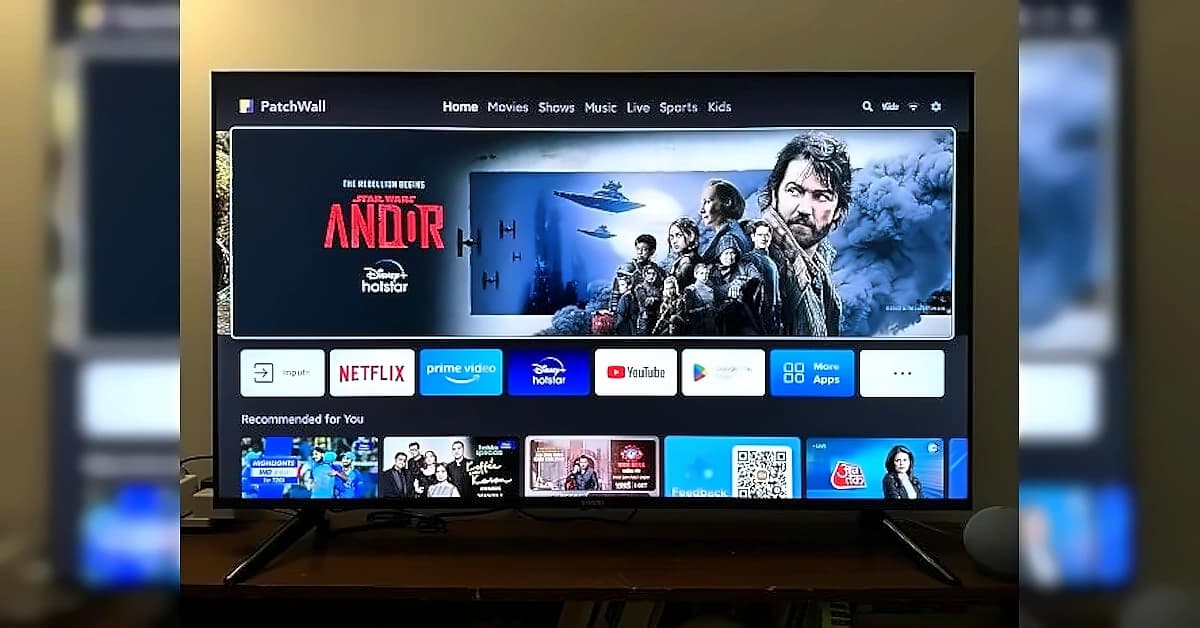
A Parliamentary Standing Committee has recommended that Prasar Bharati's WAVES OTT platform maintain free access to archival content even as the public broadcaster transitions to a structured pay-per-view (PPV) framework aimed at financial sustainability. According to the Thirtieth Action Taken Report of the Standing Committee on Communications and Information Technology, chaired by BJP MP Dr Nishikant Dubey, the committee urged the Ministry of Information and Broadcasting to ensure adequate safeguards to ensure affordability, accessibility and public interest orientation while implementing the PPV framework. The committee specifically recommended that archival content remain free of charge while the platform becomes financially sustainable without requiring greater budgetary support. WAVES OTT has recorded more than 11 million app downloads and over 7.3 million registered user accounts, currently hosting around 18,000 audio-visual titles comprising more than 12,000 hours of video and audio content in over 12 Indian languages.
A parliamentary committee has recommended establishing an independent post-release review panel for content on over-the-top (OTT) platforms. According to reports from Business Standard, the Parliamentary Standing Committee on Home Affairs, headed by BJP's Radha Mohan Das Agarwal, suggested creating a panel comprising experts from child development, education, law, social sciences and civil society to review flagged content and recommend appropriate corrective measures. The committee emphasized that the existing framework continues to rely largely on self-regulation by platforms and recommended incorporating robust technology-enabled age-verification mechanisms, effective parental controls and suitable penalties for non-compliance in the proposed comprehensive statutory framework. The committee has now expeditiously examined the feasibility of establishing this independent review mechanism to address growing concerns about content regulation on digital platforms.
The committee has recommended that the Union Ministry of Home Affairs (MHA) develop a standardised, multilingual grievance-redressal system across intermediaries defined under the Information Technology Rules, 2021. As reported by Business Standard, the proposed system should include unique complaint numbers, tracking facilities, defined timelines, reasoned disposal and automatic escalation of unresolved complaints. The committee emphasized that such a system should have an effective monitoring framework and be accessible across all intermediaries to address grievance-redressal obligations under Rules 3(2) and 3A of the Information Technology (Intermediary Guidelines and Digital Media Ethics Code) Rules, 2021. The system should be standardised, accessible and multilingual to ensure comprehensive coverage across all intermediaries.
The government has implemented comprehensive regulations for OTT platforms through the Information Technology (Intermediary Guidelines and Digital Media Ethics Code) Rules, 2021, notified on February 25, 2021. According to Union Minister of State L Murugan's written reply to the Rajya Sabha, complaints relating to violation of the Code of Ethics are addressed under the provisions of the three-tier grievance redressal mechanism. The Code of Ethics requires OTT platforms to not transmit any content which is prohibited by law, exercise due caution and discretion, and undertake classification of content based on themes and messages; violence; nudity; sex; language; drug and substance abuse; and horror. Part-II of the Schedule to the IT Rules, 2021 prescribes guidelines for content classification, including content involving psychotropic substances, liquor, smoking and tobacco, and imitable behaviour. The government issued an advisory on November 26, 2024, to publishers of online curated content on streaming content related to narcotic drugs and psychotropic substances.
The committee highlighted that withdrawal of general consent by certain states for Central Bureau of Investigation investigations continues to impede seamless and time-bound investigations into inter-state and transnational cybercrime. According to Business Standard, the committee asked the MHA to engage with state governments to evolve a durable mechanism for facilitating CBI investigations into cybercrime cases and suitably amend the Delhi Special Police Establishment Act, 1946, to enable the agency to effectively investigate cases of national and inter-state significance. The committee noted that this withdrawal of consent continues to create barriers in investigating cybercrime cases that require coordinated inter-state and transnational efforts.
The committee expressed concern about secondary-level dropout rates increasing to 12.6% in 2024-25 and noted sharp declines in gross enrolment ratios from 114.2 at primary level to 77 at upper-primary level, 65.4 at secondary level and 53.7 at higher-secondary level. As reported by Business Standard, it recommended integrating cybercrime prevention and cyber-hygiene education into school curricula and establishing a mechanism for periodically reviewing and updating the cybercrime legal framework. The committee also suggested setting up a specialised Integrated Cybercrime Task Force with nationwide jurisdiction to investigate complex and transnational cybercrime. These figures indicate continuing weaknesses in student retention and transition, particularly after the elementary stage, requiring urgent attention to educational policies.