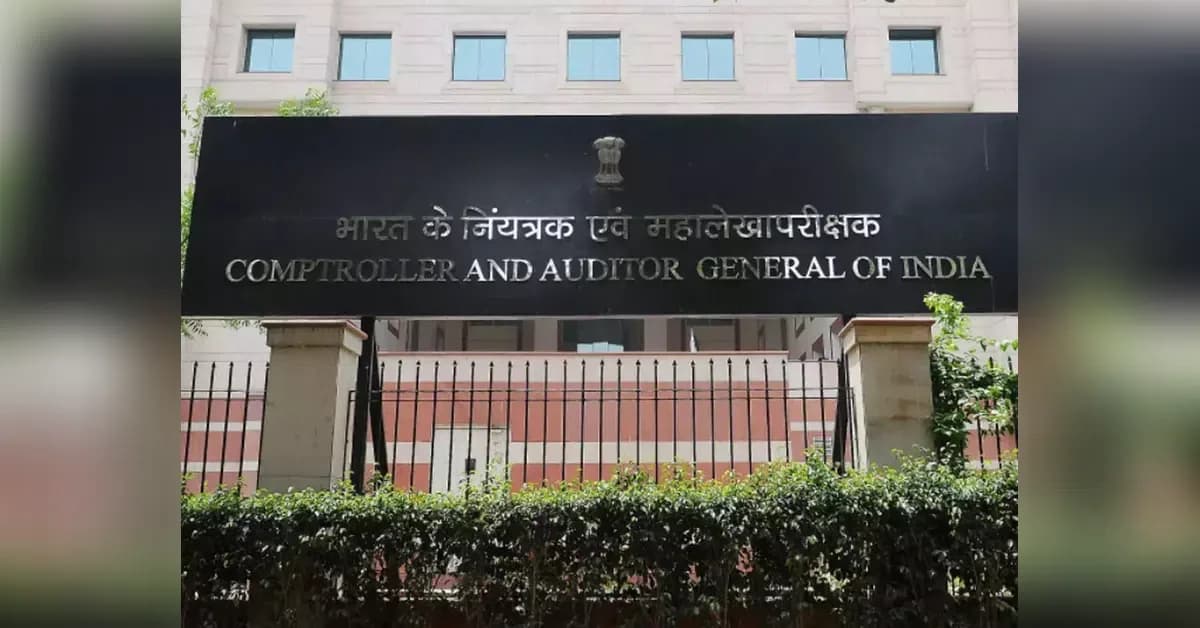
The Comptroller and Auditor General (CAG) has identified ₹3,541.16 crore in excess spending as well as significant shortcomings in financial management, budget estimation, and expenditure control in Maharashtra government's flagship Ladki Bahin Yojana. According to the CAG State Finances Audit Report 2024–25 tabled in the Maharashtra legislature on Friday, July 10, 2026, the Women and Child Development Department spent ₹33,237.24 crore on the initiative compared to an authorised budget of ₹29,693.09 crore. The department had not provided a precise explanation for the overspending, the auditor noted. The CAG termed the practice of parking funds in VPDAs without immediate requirements as a violation of financial discipline, stating that funds should not be drawn from the treasury unless there is an immediate expenditure requirement. As per PTI, the audit highlighted that this withdrawal and parking of funds in VPDAs without immediate requirements represents a serious financial irregularity, contrary to the principles of budgetary discipline and financial propriety.
The CAG found that ₹15,586 crore, withdrawn between January and March 2025, was transferred to Virtual Personal Deposit Accounts (VPDAs) despite no immediate requirement for the funds. According to the CAG, such withdrawals were contrary to the principles of budgetary discipline and financial propriety, and weakened legislative oversight of public finances. The audit observed 'significant deficiencies' in budget estimation, expenditure control and financial management, and recommended that the government make a more realistic assessment of beneficiary numbers and funding requirements while preparing budgets for large welfare schemes. The CAG advised the government to ensure that treasury withdrawals are directly linked to actual and immediate requirements, warning that parking public money in deposit accounts undermines legislative control and oversight. As per PTI, the CAG emphasized that the government should focus more diligently on its financial management and ensure transparency, given that the scheme continues to provide much-needed financial assistance to lakhs of women across Maharashtra.
The Maharashtra government has removed more than 9.2 million beneficiaries from the scheme following a state-wide verification exercise, according to The Indian Express. The exercise reduced the number of beneficiaries to over 15 million from a peak of around 24.3 million, meaning nearly four in every 10 beneficiaries were removed. Officials estimated that those whose payments were discontinued had collectively received around ₹14,000 crore before the benefits were stopped, with average assistance of about 10 months.
According to The Indian Express, the largest share of deletions, around 6.2 million beneficiaries or about 67%, was due to failure to complete mandatory electronic Know Your Customer (eKYC) verification. Another 1.6 million beneficiaries were found to belong to families with annual incomes above the scheme's ₹2.5 lakh eligibility limit. Around 442,000 were removed because they or a family member were government employees, while 360,000 were already receiving assistance under the Sanjay Gandhi Niradhar Yojana. The verification also identified cases where more than two members of the same family were drawing benefits, beneficiaries above the upper age limit of 65 years, and applicants flagged during district-level checks.
Launched in June 2024, the Mukhyamantri Majhi Ladki Bahin Yojana provides ₹1,500 a month through DBT to eligible women aged 21 to 65 years from families with an annual income of up to ₹2.5 lakh. According to the CAG, the state initially provided ₹26,200 crore for the scheme through supplementary demands, while another ₹3,490.75 crore was re-appropriated from the Lek Ladki Yojana, taking the total available grant to ₹29,693.09 crore. However, actual expenditure reached ₹33,237.24 crore, resulting in excess expenditure of ₹3,541.16 crore. The CAG noted that expenditure on women's welfare increased sharply from ₹261.78 crore in the previous year to more than ₹33,500 crore, reflecting a significant shift toward welfare-oriented transfers rather than capital asset formation. For the current financial year, the Maharashtra government has earmarked ₹26,500 crore for the scheme, down from ₹36,000 crore in 2025–26. The Mahayuti government's promise to raise the monthly assistance from ₹1,500 to ₹2,100 is yet to be implemented.