Eminent public interest lawyer and activist Prashant Bhushan has sparked a debate over administrative transparency and ethics, questioning the rapid transition of former top government officials, regulators and judges into corporate boardrooms shortly after retirement. According to reports from ZeeBiz, Bhushan took to microblogging platform X (formerly Twitter) to highlight what is widely described as the 'revolving door' phenomenon' -- where former custodians of public trust take up influential roles in the very corporate houses they were tasked with overseeing or regulating while in office. The activist-lawyer wrote on X: 'Shouldn't there be a ban on such post retirement jobs which create conflicts of interest while in position?'
As reported by ZeeBiz, Bhushan explicitly cited instances involving prominent corporate conglomerates, pointing out that former chiefs of the Central Vigilance Commission (CVC), the Comptroller and Auditor General (CAG), public sector banks and other state-owned enterprises, and even retired Supreme Court judges have taken up positions on corporate boards. The activist-lawyer wrote on X: 'Former CVC chief, CAG chief, Bank chiefs, PSU chiefs, even Supreme Court judge joined Reliance, the company that they should have dealt with in some capacity as Regulators, after retirement. Shouldn't there be a ban on such post retirement jobs which create conflicts of interest?' The graphic highlights a consistent pattern where former government heavyweights transitioned swiftly into lucrative advisory and board positions post-retirement. According to latest reports, Bhushan has specifically named prominent officials including former Chairman of State Bank of India Arundhati Bhattacharya, former CVC KV Chaudhary, former Chairman BPCL Sarthak Behuria, former Chairman of Indian Oil Corporation Sanjiv Singh, former Director General of GAIL Prabhat Singh, former Chairman and MD of State Bank of India KK Purwar, former Supreme Court Justice Krishna Murari, former CAG Rajiv Maharishi, Finance Secretary RS Gujral, Deputy Governor of Reserve Bank of India MK Jain, and former head of ICICI Bank KV Kamath who have joined Reliance after retirement.
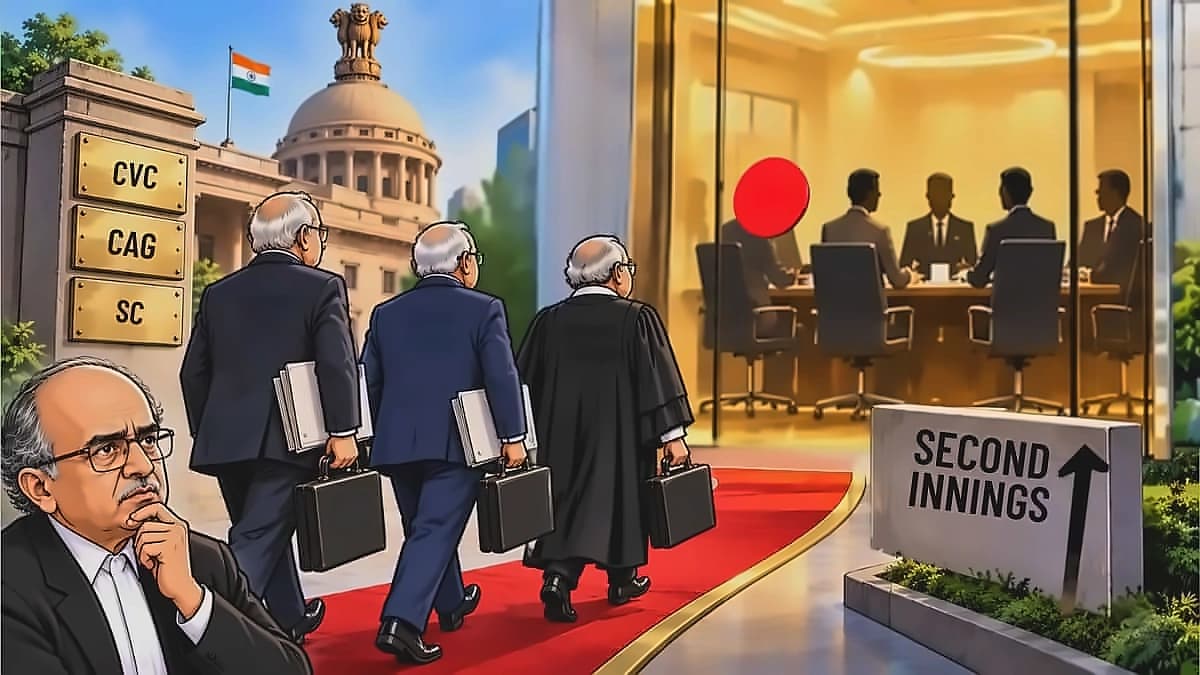
According to ZeeBiz reports, the very core of the debate centers on whether the prospect of lucrative post-retirement corporate appointments compromises the neutrality and independence of public servants while they hold office. Bhushan's remarks and data come at a time when several critics have argued whether it creates a potential conflict of interest when regulators, key policy decisions-makers, or judicial officers anticipate post-retirement directorships or advisory roles. While these appointments are undertaken under the gamit of existing corporate laws—provided cooling-off periods are observed or waived—the sheer volume of top-tier public officials migrating to a single conglomerate has sparked debate on neutrality and independence of public servants while they hold office. As reported by India.com, these officers are decision-makers in all matters, whether it's spectrum allocation, environmental clearances, tax concessions, loan restructuring, or legal disputes, making their impartiality while in office questionable when they anticipate multi-million dollar packages or prestigious board positions at major corporate houses.
As the debate triggered by Bhushan gains momentum, experts advocate for a balanced approach that enforces stringent ethical frameworks and clear cooling-off guidelines for retiring public officials, while safeguarding corporate pioneers who operate with transparency from unfair media narrative construction, as reported by ZeeBiz. Whether through stricter administrative rules or legislative action, addressing the 'revolving door' remains paramount to ensuring that public institutions remain impartial, transparent and entirely free from perceived conflicts of interest. The list spans decades of public service, cutting across financial regulation, oil and gas monitoring, tax administration, and the apex judiciary. Following Bhushan's post, the debate over this nexus between corporate and bureaucracy has intensified, with critics calling for strict cooling-off periods or a complete ban on joining private companies after retirement to maintain administrative transparency and public trust.