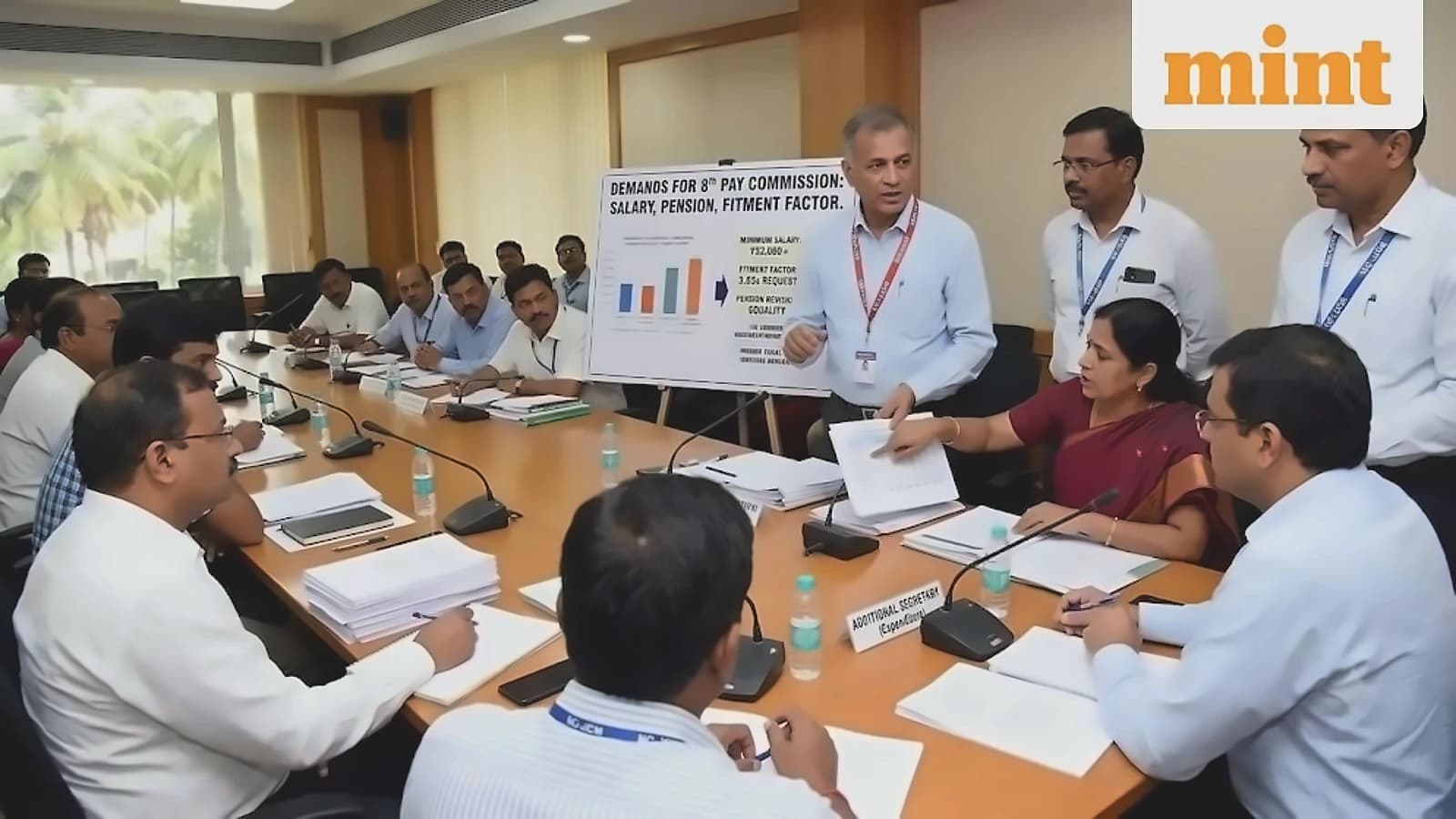
The Centre has clarified that the 8th Pay Commission is not required to keep the government informed about its deliberations, including proposals on the fitment factor. According to Minister of State for Finance Pankaj Chaudhary's reply in the Rajya Sabha, the Commission is empowered to devise its own procedure and functions independently under its notified Terms of Reference (ToR). The government specifically declined to comment on employee demands, stating that the Commission will determine its own procedure and that its Terms of Reference do not require it to keep the government informed about the recommendations it is examining or its consultation process while carrying out its deliberations. The clarification came in response to questions about employee demands, with the government neither confirming nor denying whether any such proposals had been received.
The 8th Pay Commission has significantly expanded its nationwide consultation process, with meetings now scheduled across four major cities - Delhi, Chennai, Puducherry, and newly added Chandigarh. According to the latest official notices, these meetings form part of the commission's comprehensive consultation process, giving eligible organisations, associations, unions and pensioners an opportunity to share their suggestions before the Commission prepares its recommendations on salaries, pensions, allowances and other service-related matters. Fresh meetings have been scheduled in Delhi on August 7 and August 10 for Central Government and Union Territory employee associations and federations that have already submitted their memorandums but are yet to present their views before the Commission. Eligible organisations have been asked to seek appointments by July 31 using the unique Memorandum ID generated during the submission process. Stakeholder interactions are now scheduled in Chennai on September 7-8, followed by Puducherry on September 9, with Chandigarh consultations set for September 16-18, 2026. Employee associations, institutions and organisations from Tamil Nadu and Puducherry have been asked to submit appointment requests by August 18, while Chandigarh consultation appointments must be requested by August 25. The 8th CPC will hold three-day meetings in Chandigarh from September 16-18, 2026, with applications invited from stakeholders in Punjab, Haryana, Himachal Pradesh and Chandigarh UT.
The 8th Pay Commission may consider higher annual increments for central government employees as proposed by several prominent unions, with employee unions demanding to increase the annual increment from the current 3% to at least 6% under the 8th Pay Commission. According to recent calculations, if the annual increment were increased from 3% to 6%, an employee could get a significant boost in basic pay over ten years. As per online reports, Level 1 basic pay of ₹18,000 could reach ₹37,800 after a 2.1 fitment factor, with total pay reaching ₹52,00,016 at 3% increment versus ₹59,78,809 at 6% increment over 10 years. Level 4 employees (₹25,500 basic) could see total pay of ₹73,66,689 at 3% versus ₹84,69,979 at 6% over ten years, with extra pay of ₹11,03,290. Level 6 employees (₹35,400 basic) could benefit from total pay of ₹1,02,26,697 at 3% versus ₹1,17,58,324 at 6%, with extra pay of ₹15,31,626. Level 8 employees (₹47,600 basic) could see total pay of ₹1,37,51,153 at 3% versus ₹1,58,10,627 at 6%, with extra pay of ₹20,59,475. The National Council of the Joint Consultative Machinery, All India Defence Employees' Federation, and Federation of National Postal Organisations have all suggested increasing the annual increment to 6%, while the Indian Railways Supervisors' Association demands 5% and the All India New Pension Scheme Employees Federation seeks 7%.
The 8th CPC benefits approximately 1.19 crore beneficiaries, including nearly 50 lakh central government employees and about 69 lakh pensioners, including defence sector personnel and retirees. As reported by officials, the 8th CPC, constituted in November 2025, is expected to submit its report to the government within 18 months, with May-June 2027 being the earliest possible announcement date. However, neither the government nor the 8th Pay Commission has announced a fitment factor, revised minimum basic pay, or a new salary structure. Similarly, no recommendations relating to Dearness Allowance (DA), House Rent Allowance (HRA), pensions or other allowances have been made public. The commission is expected to study employees' pay matrix, fitment factor, financial burden on the government, and how to implement the new pay structure before submitting its recommendations to the government. With nearly half of its 18-month tenure completed, expectations among over 1.1 crore serving government employees and pensioners remain high. While speculation over the fitment factor and salary revisions continues, with several unions such as BPMS, NCJCM, AIDEF, among others pushing for a fitment multiplier of 3.8x to 4x, there are no official updates on the same as of now.
The 8th Pay Commission's higher fitment factor announcement may hinge on a significant revision in family unit calculations, with employee unions demanding to increase the number of family units from 3 to 5 to calculate fitment factor. This issue gained prominence during the Rajya Sabha session on July 28, 2025, when member Javed Ali Khan questioned whether employees' unions have demanded to increase family units from 3 to 5 including parents of employees for 8th CPC calculations. While the government didn't directly answer this query, stating the 8th CPC is not required to provide updates on its progress, employees' unions have strongly suggested this change. The Staff Side of NC-JCM has proposed treating a family as 5 units: employee (1 unit), spouse (1 unit with no gender discrimination), 2 children (0.8 units each), and 0.8 units each for parents, totaling 5.2 units rounded to 5 units.