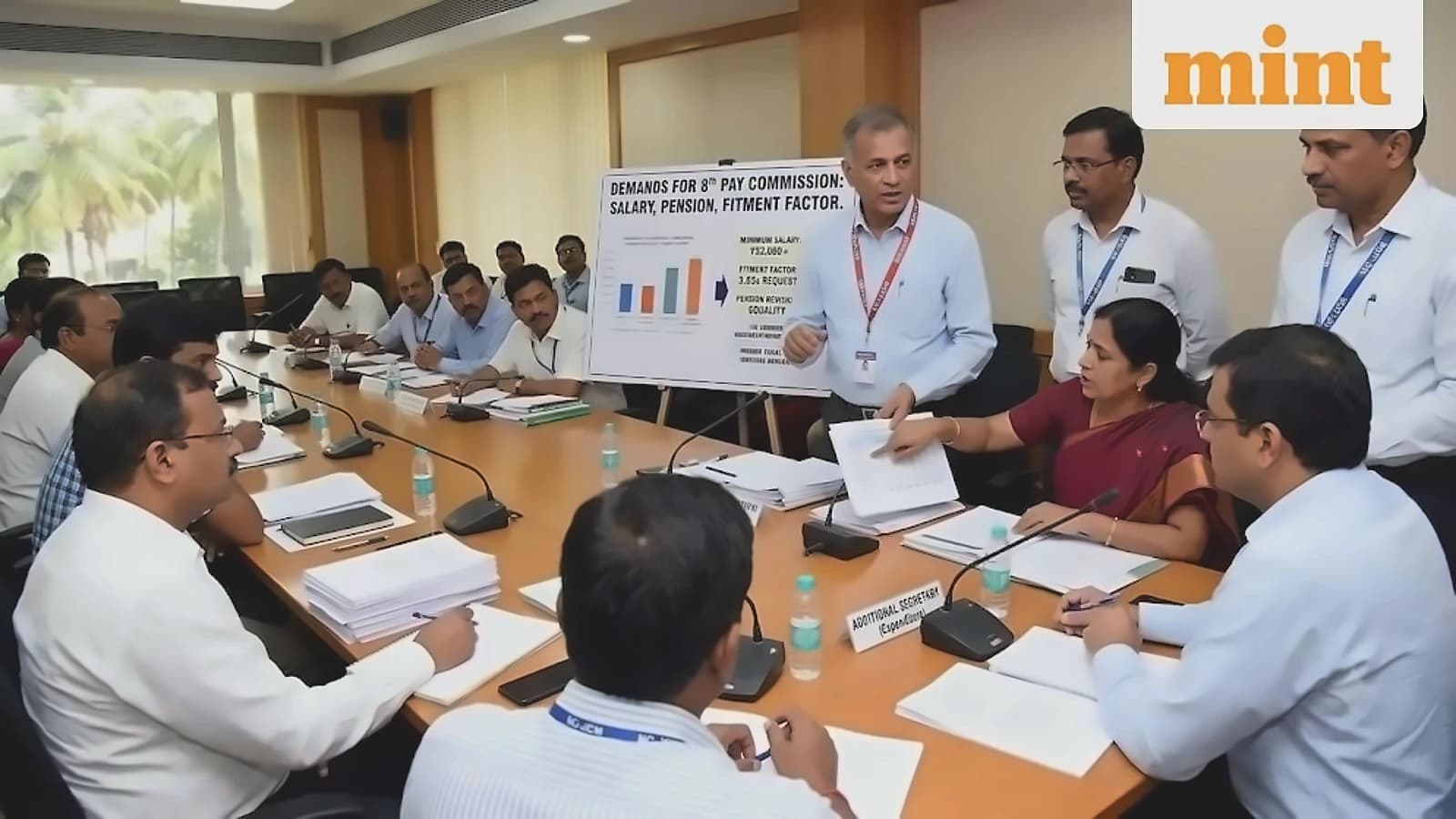
Central government employees awaiting the 8th Pay Commission's recommendations on fitment factor and revised pay may face an extended wait, potentially stretching well into 2027 and possibly beyond. According to reports from Mint, the 8th Pay Commission was constituted on November 3, 2025, and has been given an 18-month deadline to submit its report, placing the tentative deadline at May 3, 2027. However, historical precedent from the 7th Pay Commission offers a concerning timeline reference. The 7th Pay Commission, constituted on February 28, 2014, took nearly 21 months to submit its report, eventually presenting its recommendations on November 19, 2015. Applying this same timeline to the 8th Commission projects a report submission date of around July 25, 2027, more than two months past the formal deadline. Commissions have historically been granted extensions, and the 8th Pay Commission may yet submit its report ahead of schedule or seek additional time, though no official indication has emerged so far.
With the tenure of the 7th Pay Commission ending on December 31, 2025, employees are keen to understand how much additional income they could receive once the new recommendations are implemented. Reports suggest that while the revised pay structure could become effective from January 1, 2026, the actual implementation may occur in late 2027. If this happens, employees could be entitled to arrears for approximately 15 to 24 months depending on the final implementation date. Under earlier pay commissions, employees received arrears whenever implementation occurred after the notified effective date, with amounts varying depending on salary level, grade pay, and revision formulas adopted by the government. The government has not yet officially announced the implementation timeline, fitment factor, or arrears formula, making all current calculations speculative. If the government implements the report in the second half of 2027, employees may get arrears for 20-24 months, though this will be confirmed only when the government notifies the 8th Pay Commission report implementation.
The fitment factor is a mathematical multiplier used by the Central Pay Commission to convert an employee's pre-revised basic salary into the new, revised basic salary structure. As per Mint, the primary formula used is: Current basic pay x fitment factor = New basic pay. For instance, the 7th Central Pay Commission implemented a fitment factor of 2.57, which raised the minimum basic salary of central government employees from ₹7,000 under the 6th Pay Commission to ₹18,000. The fitment factor for the 8th Pay Commission has not been officially finalised but, various reports project the multiplier to land somewhere between 2.28 and 3.83. While this rise in basic pay may appear substantial, it is important to remember that such revisions for Central government employees and pensioners generally take place only once every decade. The concept of the fitment factor became a talking point during the 6th and 7th Pay Commissions, as earlier pay panels followed more complex approaches to revise salaries, including pay rationalisation, dearness allowance mergers, and need-based wage calculations.
Employee unions have reportedly demanded a fitment factor of 3.83, which could significantly impact salary revisions if accepted by the commission. Under this scenario, the current minimum basic pay of ₹18,000 could be revised to approximately ₹69,000, representing a monthly increase of around ₹51,000. However, the actual amount received by employees will depend on several variables including the final fitment factor recommended by the commission, current pay level and basic salary, Dearness Allowance merger formula, effective date of revised pay, and actual implementation date. Consultations with employee bodies are already underway, and the demands on fitment factor vary significantly across unions. Under the 7th Pay Commission, a uniform fitment factor of 2.57 was broadly applied across categories, though the current commission's approach to fitment factor determination remains to be seen. To be clear, the commission has not taken any decision on the fitment factor yet, while employee bodies have been demanding a fitment factor of 3 or above, the final decision may be more modest.

The 8th Pay Commission is expected to bring significant changes to the salary and pension structure of central government employees and pensioners, with key focus areas including Dearness Allowance (DA), Dearness Relief (DR), and the fitment factor. The commission is currently holding meetings with employee unions, representative bodies, and other stakeholders to gather inputs before finalising its recommendations. Around one crore beneficiaries, including nearly 50 lakh central government employees and about 65 lakh pensioners, are awaiting clarity on potential revisions. Dearness Allowance (DA) and Dearness Relief (DR) are inflation-linked components provided to serve employees and pensioners, respectively, calculated as a percentage of basic pay and revised twice a year based on movements in the All-India Consumer Price Index (AICPI). The Centre revised both DA and DR by two percentage points in April this year, raising them from 58% to 60% of basic pay with effect from January 1, 2026. Government data shows retail inflation stood at 3.93% in May 2026, while food inflation touched 4.78%, making DA and DR revisions crucial for burdened middle-class households and common salaried individuals.
In a significant development, the NC-JCM Staff Side has proposed the restoration of commuted pension of central government pensioners after 11 years instead of the present 15 years. According to Zee News, the Staff Side argues that the rules regarding the restoration of the commutation of pension were framed 39 years ago based on the Financial and Actuarial Parameters prevailing at that time, but a lot of changes have taken place in this 39 years which includes interest rates, life expectancy, mortality rates, death rates, and actuarial risk factors which necessitate a fresh values of the restoration period. The Staff Side shared calculations showing that the entire commuted value is recovered within about 10 years and recovery beyond this period results in excess recovery from pensioners. For a pensioner aged 61 years with a commutation factor of 8.194, the amount recovered in 10 years is ₹12,000 and in 15 years is ₹18,000. The Staff Side emphasized that although commutation is optional but the government as a Model Employer considers this matter from a welfare perspective of the senior citizens who have served the country rather than a revenue perspective. They noted that many expert bodies have also recommended the restoration of commuted pension in a shorter period, including the 5th CPC which recommended 12 years restoration and the 2nd National Judicial Commission which recommended 12 years restoration. The Staff Side proposed to the 8th CPC to recommend for restoration of Pension after 11 years or at the age of 71 years whichever is earlier, with many state governments having already reduced the period to 12-13 years.