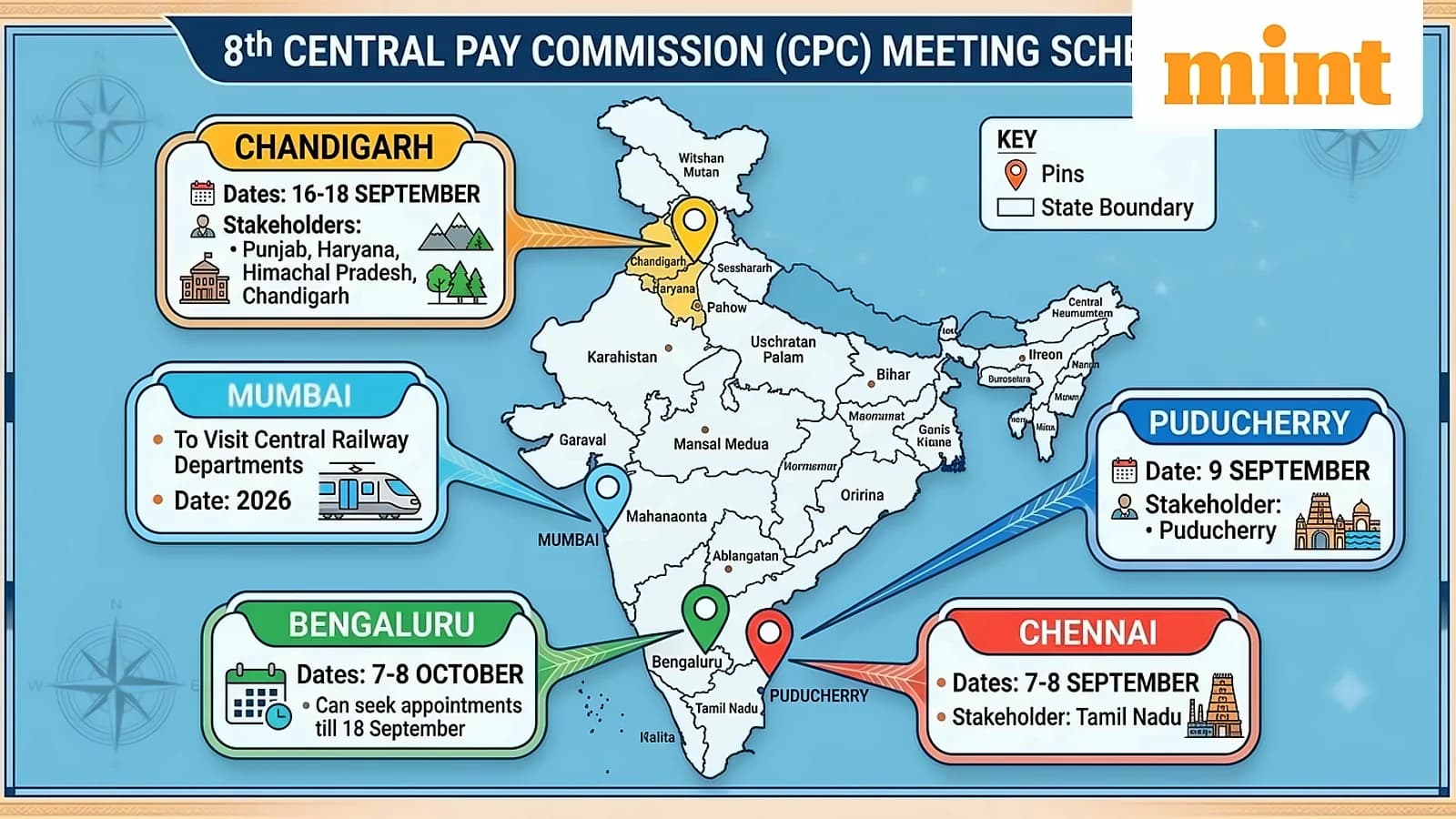
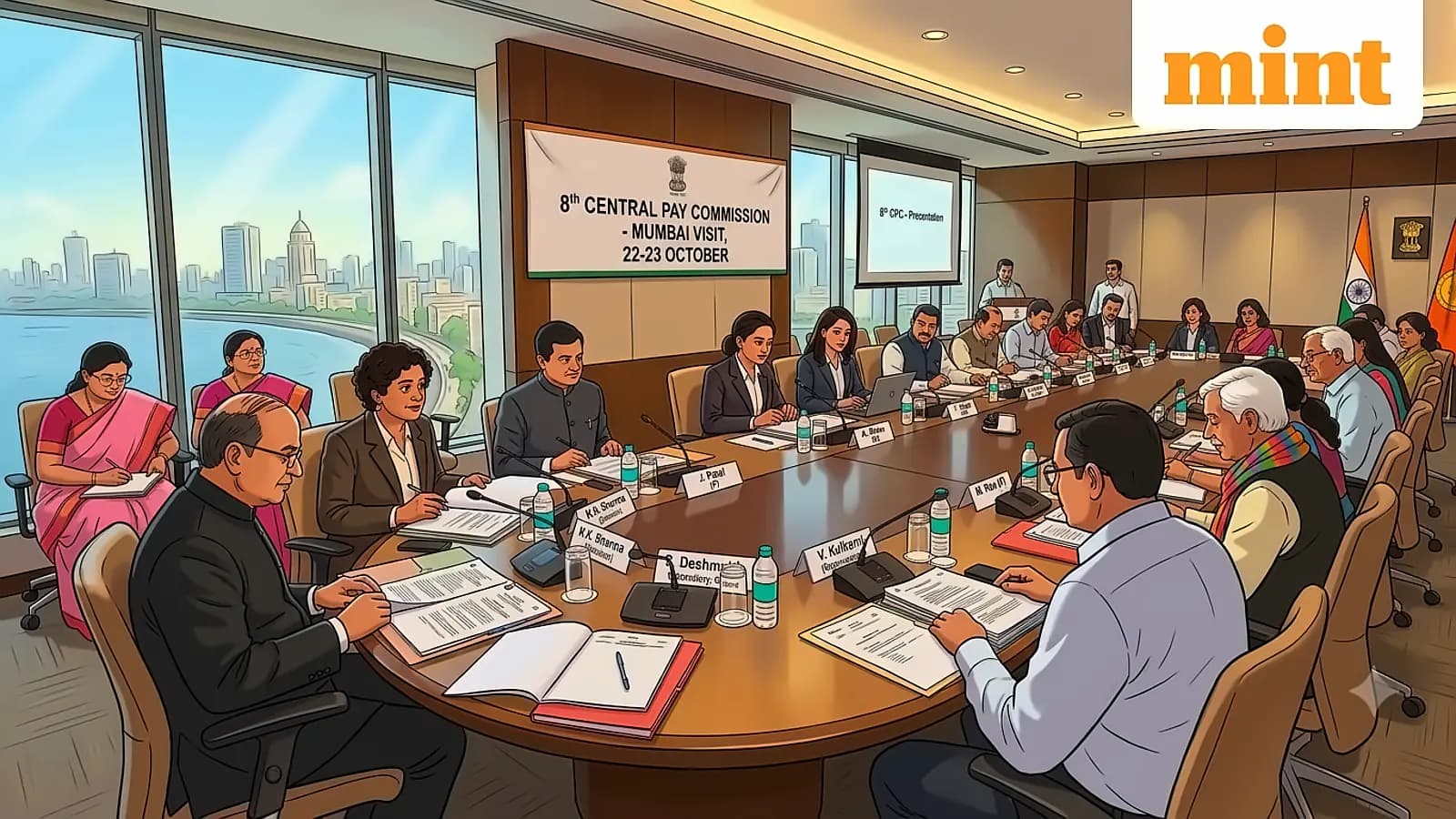
The 8th Central Pay Commission (CPC) has announced its Mumbai visit scheduled for October 22-23, 2026, with applications closing on October 10, 2026. According to the latest notices, eligible employee unions, representative groups, pensioner associations, federations and other stakeholders can submit appointment requests for interactions with the Commission. The Bengaluru visit is scheduled for October 7-8, 2026, with applications having closed on September 18, 2026. The commission has completed its September discussions in Chennai, Puducherry, and Chandigarh and is scheduled to hold discussions with employee and pensioner groups in Bengaluru on October 7 and 8, 2026, and in Mumbai on October 22 and 23, 2026. The Railway Ministry has indicated the commission will visit railway departments under the Central Railway Zone in Mumbai to gain firsthand experience of working conditions.
The 8th Central Pay Commission (CPC) faces potential arrears of nearly ₹18 lakh for Level 8 employees if implementation is delayed by 24 months. According to latest calculations, a Level 8 employee with current basic pay of ₹47,600 could see revised basic pay of ₹1,22,332 at a 2.57 fitment factor. If implementation is delayed by 24 months, the estimated arrears would be approximately ₹17,93,568 - calculated by multiplying the difference between current and revised basic pay by 24 months. The actual arrears will depend on the final fitment factor, implementation date, and other components of the revised pay structure.
For Level 6 employees currently drawing ₹35,400 basic pay, the estimated arrears range from ₹8,14,200 to ₹13,33,872 depending on fitment factors. Using a 2.10 fitment factor and 18-month delay, the estimated increase in basic pay would be ₹38,940, resulting in arrears of approximately ₹7,00,920 over 18 months. Level 7 employees with ₹44,900 basic pay could see arrears ranging from ₹10,32,700 to ₹16,91,832 under different fitment scenarios. The calculations consider implementation delays of 20 and 24 months and fitment factors of 2.15, 2.28 and 2.57 for Levels 6, 7 and 8 respectively.
Two central government employees could retire from the same post after serving for an identical number of years, yet receive different pension amounts because they retired under different pay structures. This disparity is at the heart of demands being raised by employee organisations before the 8th Pay Commission. The organisations want the government to extend the One Rank, One Pension (OROP) principle to civilian central government employees, bringing pension calculations closer to a common framework across retirement years. Manjeet Singh Patel, president of the All India New Pension Scheme Employees Federation, told ET Wealth Online that substantial differences persist in pension amounts among central government retirees, with previous Pay Commission revisions not eliminating these disparities. C Srikumar, general secretary of the All India Defence Employees Federation (AIDEF), said extending OROP could help remove pension differences between employees retiring from the same post at different points in time.
Since March, the commission has conducted multiple state visits to collect and analyze data before deciding on pay, allowances, and pension for employees and pensioners. According to the Terms of Reference, the 8th Pay Commission is expected to submit its recommendations within 18 months of its constitution in November 2025, which would place the expected timeline around May or June 2027. The commission can seek an extension if required. The current DA rate is 60% and could rise to around 66% if the recommendations are approved in the second half of 2027. Based on past trends, once the pay commission's recommendations are made, the rollout takes another two to three years to complete, meaning hikes announced in 2027 may only be fully implemented by 2029 or 2030. The commission's deadline to submit its report is May 2027, bringing its consultations into focus as central government employees await clarity on their revised salaries.