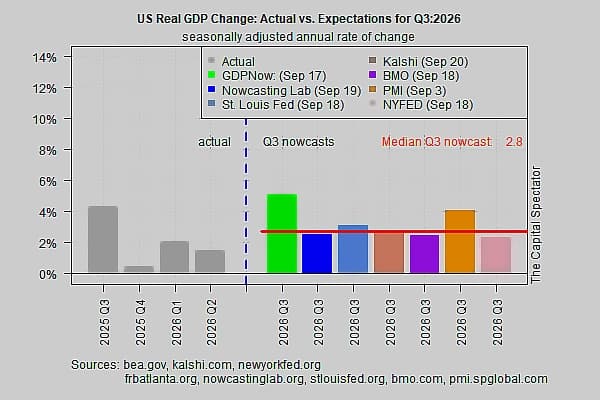
The US economy is showing strong signs of rebounding in the third quarter after a downshift in Q2, according to multiple GDP nowcasts. Economic growth is projected to rise 2.8% at an annualized rate, based on the median nowcast from The Capital Spectator's compilation of estimates. This represents a near doubling from Q2's 1.5% increase and would mark the strongest quarterly growth in a year. The government's official Q3 GDP data is scheduled for release on October 29. Several alternative measures of the US economy also reflect a pickup in growth recently, with the Dallas Fed's Weekly Economic Index (WEI) indicating year-over-year GDP growth at 3.1% through September 12, marking a solid strengthening versus the 2.1% increase reported in official GDP numbers through Q2.
Recent economic data has delivered a significant surprise with core durable goods orders surging 1.6% in August, according to the Commerce Department's Friday announcement. This performance was substantially better than economists' expectations of a 0.6% rise and represents a significant improvement from July's revised 0.6% increase. Including aircraft and military orders, durable goods remained unchanged in August, which was better than economists' consensus estimate of a 0.3% decline. The core durable goods report was particularly strong and did not put upward pressure on Treasury yields, probably because overall durable goods orders were unchanged. This robust performance adds to the growing evidence of economic momentum building in the third quarter.
Recent data highlights significant improvements in economic activity. Retail sales rebounded strongly in August with spending rising 1.2% versus July, nearly twice what economists expected and the strongest increase since March. The control group, which excludes certain categories and serves as a GDP proxy, also rebounded sharply with a 1.4% jump. Latest consumer spending data reinforces the positive momentum, with Synchrony Financial CFO Brian Wenzel reporting high-single-digit purchase-volume growth roughly 2.5 months into the third quarter, consistent with the approximately 8% growth reported during the second quarter. Speaking at an investor event, Wenzel noted that spending remained resilient across consumer credit cohorts despite affordability pressures and higher gasoline prices. Super-prime consumers continued to lead growth, while prime customers showed improved strength and non-prime customers trailed modestly but without presenting a concern, according to Wenzel's latest assessment.
Richmond Fed President Tom Barkin confirmed that the Federal Reserve's primary concern remains inflation rather than labor market weaknesses. Speaking on Tuesday, Barkin explained that the quarter-percentage-point rate increase to 3.75%-4.00% will help return inflation to the central bank's 2% target. When asked about future rate hikes, Barkin stated "Will additional hikes be required, and how many? We'll see," noting that he is not a voting member of the rate-setting Federal Open Market Committee this year. The Fed's decision to raise rates last week was driven by concerns that demand-driven inflation is becoming a significant factor affecting the economy, with much of the Personal Consumption Expenditures Price Index rising at an annual rate above 3%. Barkin noted that even temporary shocks have lasted longer than anticipated, creating more persistent price pressures across the economy.
Looking ahead to third-quarter earnings announcements, the S&P 500 is forecasted to post a 28.9% average annual increase, with October being a seasonally strong month. The AI revolution continues to drive significant growth, with data center order backlogs now extending out to 2032, indicating no stopping the data center boom. Major technology companies are expanding their AI capabilities, with Nvidia having alliances with companies like Apple, which reportedly wants to enter the server business with Nvidia's help by 2029. Taiwan Semiconductor recently reported 53% monthly sales growth compared to a year ago, demonstrating no slowdown in the AI revolution. After the Fed raised key interest rates, the US dollar strengthened and Treasury yields stabilized, with Treasury Secretary Bessent making it clear that the US intends to grow its way out of deficit problems.