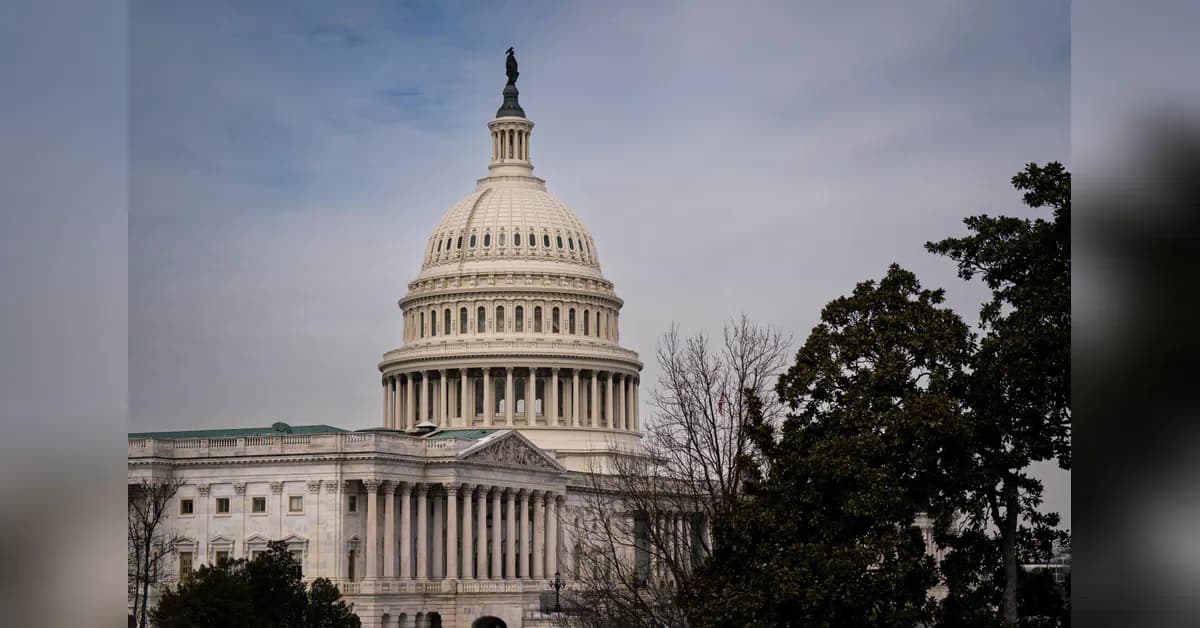
The Republican-controlled House passed a $95 billion budget proposal on Wednesday to fund the Iran war and other White House priorities, despite Democratic opposition and some Republican dissent. The vote tally was 216-214, with all Democrats opposed and several GOP holdouts joining the opposition. As reported by Business Standard, the package includes $60 billion for the Pentagon and $13 billion for other national security needs, along with $12 billion for farmers struggling under Trump's tariffs and $10 billion for voting law changes aligned with the SAVE America Act. The measure represents a lengthy reconciliation process that could take months to complete, with final voting potentially occurring after the August recess.
Republican leaders advanced the war funding legislation more than two months before the September 30 funding deadline, an unusually early move as Congress typically passes temporary funding measures only days or even hours before the fiscal year expires. House Speaker Mike Johnson challenged Democrats to support the bill, arguing that opposing it would leave them responsible for any government shutdown if funding lapses after September 30. House Appropriations Committee Chair Tom Cole emphasized that "Our conference refuses to let the obstruction and inaction of Senate Democrats trigger another manufactured shutdown at the end of September. That is why we are acting before a funding lapse crisis, not in response to it." The measure's passage was specifically designed to defuse a volatile issue in the run-up to the November midterm elections, where Democrats hope to retake control of the House and potentially the Senate.
Senate Majority Leader John Thune has been noncommittal on the House package that also divides his own GOP majority, with some Republican senators preferring more military funding while others demand cost offsets elsewhere. Thune's focus remains on avoiding another government shutdown before lawmakers leave for summer break. The Senate leader indicated he may hold onto the House's budget resolution and use it later in the fall to push the resolution through the Senate over objections, stating "It's a possibility that, if necessary, we could pull that budget resolution passed by the House and use it to fund government." This approach reflects the challenging political landscape where the House-passed war funding faces an uphill climb in the Senate.
Democratic leaders opposed the war funding, with House Democratic Leader Hakeem Jeffries stating that Republicans have "literally ripped food from the mouths of hungry children, seniors and veterans to sustain the Trump war machine." The opposition comes as Trump attended the dignified transfer of four service members killed in the Middle East, bringing the military death toll to 18. Defence Secretary Pete Hegseth told senators that the Pentagon is running short of cash despite a massive $150 billion one-time allotment in last year's budget bill. The Congressional standstill over the US war against Iran leaves the country unable to stop Trump's military strikes, but not having authorized the use of American military force, with most Americans disapproving of Trump's Iran strategy according to recent AP-NORC polls.
While the House has passed three appropriations measures for the 2027 fiscal year beginning October 1, the Senate has approved none, nor have any advanced through committees. Republican leaders in the chamber said they were negotiating with Senate Democrats on their own short-term funding bill. Without action by Congress, funding for most federal agency programs will expire at midnight on September 30, the end of the current fiscal year. The budget resolution sets out instructions for committees to draft legislation, with Johnson hoping the process could be completed this summer, though the lengthy reconciliation process faces significant challenges in the Senate.