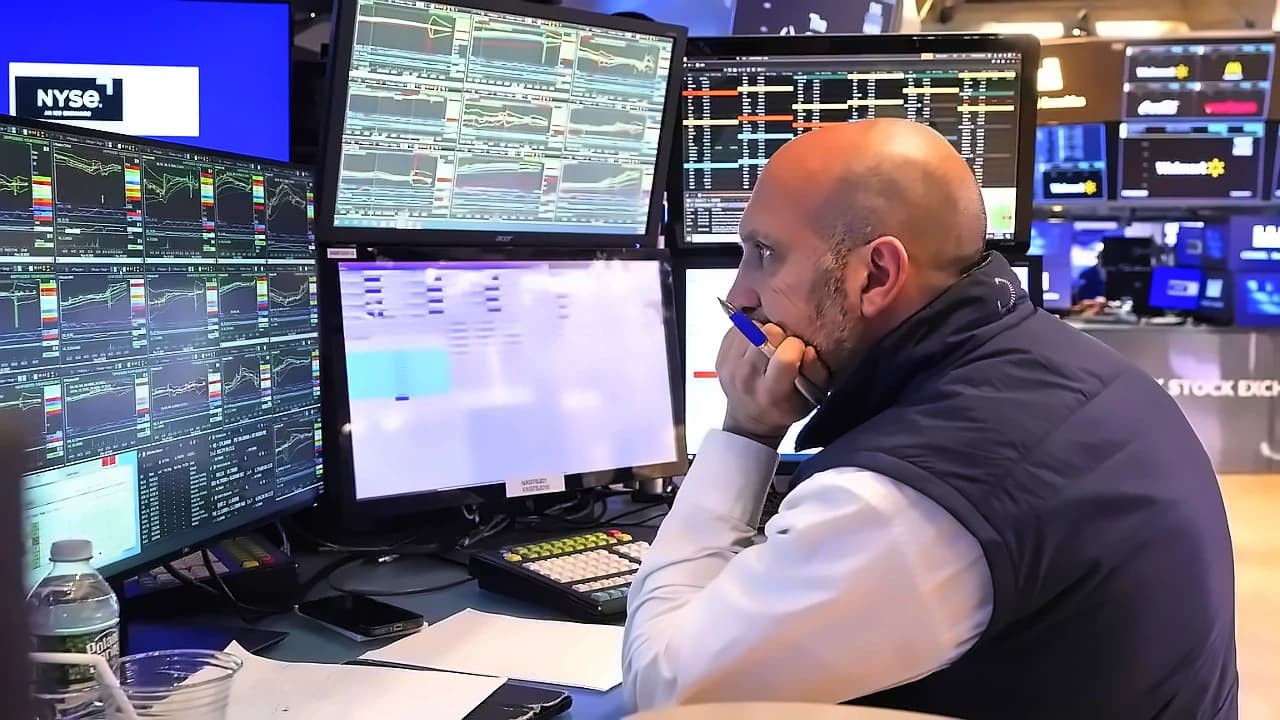
Wall Street's major market averages ended higher on Thursday, with the S&P 500 tagging 7,500 as investors looked ahead for updates on U.S.-China diplomatic talks. The Dow Jones Industrial Average closed +0.7%, while the S&P 500 gained 0.96%, or 71.35 points, to 7,515.60, marking a significant milestone as the index reached the 7,500 level. The Nasdaq Composite advanced 1.12%, or 294.47 points, to 26,696.82. Nvidia climbed 4.4% overnight after the United States approved sales of the company's H200 artificial intelligence chip to Chinese firms, pushing Nvidia's market valuation to a record $5.7 trillion. Among the 11 major S&P 500 sectors, seven traded in positive territory, with technology leading gains and rising 2.1%. The rally was further boosted by strong performance from semiconductor stocks, with Cisco Systems soaring 14.4% to an all-time high after beating quarterly earnings expectations and raising its annual revenue forecast after a surge in hyperscaler orders. Cerebras Systems made a powerful Nasdaq debut, surging above its IPO price after pricing its stock at $185 per share, giving the company an estimated valuation of roughly $40 billion.
U.S. President Donald Trump and Chinese President Xi Jinping met in Beijing on Thursday morning for a high-stakes summit that will continue until Friday. According to official broadcast reports, Trump promised Xi during his opening remarks that the two nations' relationship would be 'better than ever before.' The meeting is anticipated to address trade, tariffs, Taiwan, and Iran issues, with the two leaders having known each other longer than any other president of the United States or China. Trump had previously traveled to China during his first term in 2017. The summit featured a grand state ceremony at the Great Hall of the People, with military honors, a 21-gun salute, and schoolchildren chanting 'Welcome!' as Trump attended the official reception. Several leading American CEOs joined the US president on the trip, including Tesla's Elon Musk, Apple's Tim Cook, Boeing's Kelly Ortberg, and Nvidia's Jensen Huang, who joined as a last-minute addition. Xi reportedly told the business leaders that their companies could be 'deeply involved in China's reform and opening up' and that 'China's door will only open wider.'
Chinese President Xi Jinping told US President Donald Trump at the start of the two-day summit that trade negotiations were making progress but cautioned that tensions over Taiwan could place bilateral ties on a 'dangerous path' and potentially risk conflict. The summit represents a significant diplomatic effort to address global stability concerns and create a more cooperative relationship between the world's two largest economies. Xi delivered a stark warning regarding Taiwan, stating that 'If mishandled, the two nations could collide or even come into conflict, pushing the entire China-US relationship into a highly perilous situation,' according to Chinese state media. Trump said in an interview that China had agreed to purchase U.S. oil and buy more aircraft from Boeing, while China's foreign ministry said Trump and Xi had reached a consensus on several issues, although no further details were provided. However, beyond broad diplomatic statements, the first major sit-down between Trump and Xi appears to have yielded little progress on the war in Iran and no firm commitments from China, even as the White House had hoped to pressure Beijing into providing more aid. As Jorge León, head of geopolitical analysis at Rystad Energy, told Yahoo Finance, "Unless China sees a clear benefit in doing so — for example, avoiding a much more severe energy shock or securing concessions from Washington — I doubt Beijing will be eager to fully exercise that leverage."
According to a White House official, Xi indicated interest in purchasing more American oil to lessen China's reliance on the Strait in the future. The two sides agreed that the Strait of Hormuz must remain open to enable the free movement of energy. This cooperation addresses strategic energy security concerns for both nations, with the summit taking place against the backdrop of the Iran conflict and disruptions in global energy markets. Trump told Fox News that Xi had offered China's assistance in reopening the Hormuz Strait and had pledged not to provide military equipment to Iran. The war has led to global oil inventories shrinking at a record pace, and the market will remain 'severely undersupplied' until October even if the conflict ends next month, according to the International Energy Agency. Oil prices steadied ahead of the summit, with West Texas Intermediate trading near $101 a barrel after declining 1.1% in the previous session, while Brent crude closed below $106. The flow of crude and fuels through the crucial Strait of Hormuz fell by nearly 6 million barrels per day in the first quarter, following the start of hostilities at the end of February.
Asian stock markets slipped on Friday as optimism surrounding technology stocks faded, with investors turning their focus to inflation concerns that increased expectations of a U.S. interest rate hike later this year. MSCI's broadest index of Asia-Pacific shares outside Japan fell 2.2% on Friday, erasing more than this week's earlier gains. Japan's Nikkei 225 also declined 1.81% after data showed the country's wholesale inflation accelerated to 4.9% in April, marking the fastest pace in three years and reinforcing expectations that the Bank of Japan will continue raising interest rates. South Korea's KOSPI Composite Index briefly climbed above the 8,000-point mark for the first time, before profit-taking emerged and dragged the index down 5.48%. Meanwhile, China's CSI 300 Index slipped 0.55%, while Hong Kong's Hang Seng Index declined 1.34%. Asian chipmakers also declined, with Japan's Tokyo Electron and Advantest falling between 2% and 8%. U.S. Trade Representative Jamieson Greer said that chip export controls were not discussed during Thursday's U.S.-China talks, adding that it was up to Beijing to decide whether it wanted to purchase American chips. Rising inflation concerns, fueled by the sharp increase in oil prices, have dampened demand for U.S. Treasuries, with a series of weak auctions this week highlighting underlying fragility in the bond market.