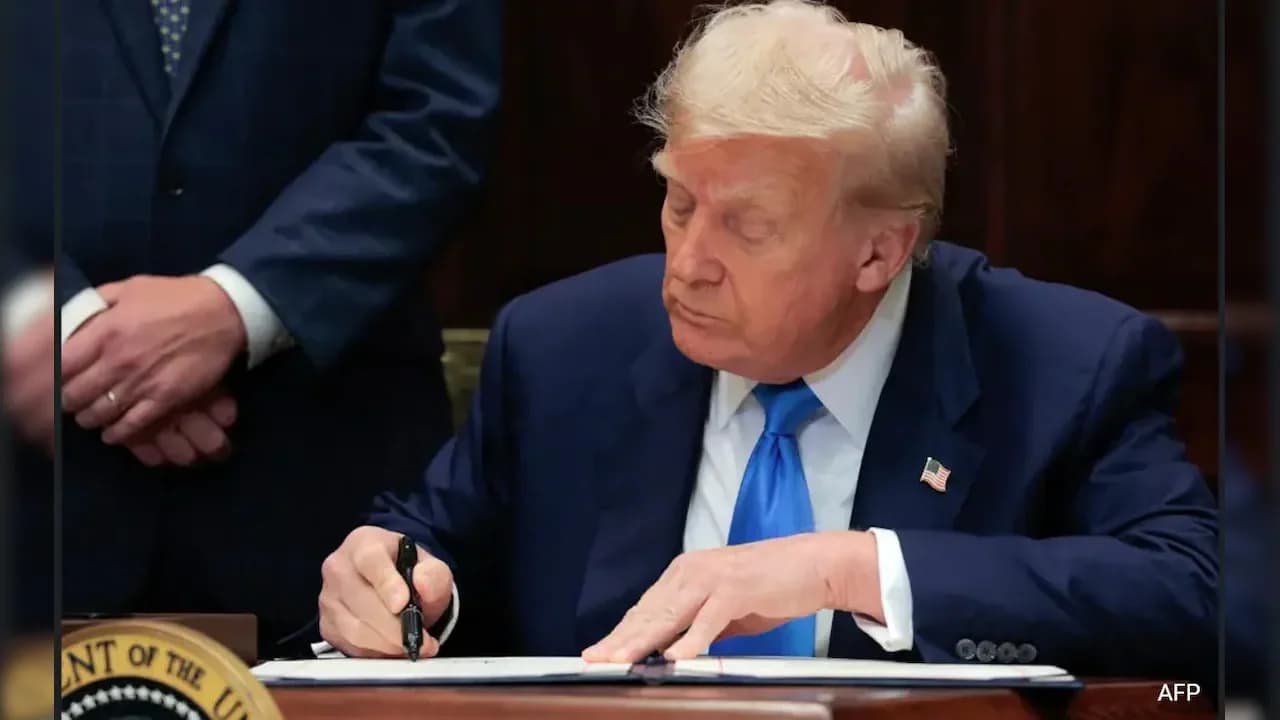
US President Donald Trump, his two oldest sons, and the Trump Organization have voluntarily withdrawn their $10 billion lawsuit against the Internal Revenue Service (IRS) while simultaneously announcing the creation of a $1.776 billion fund to compensate victims of so-called weaponization of the DOJ under the Biden and Obama administrations. According to a Miami federal court filing on Monday, the lawsuit was filed in January 2026 and claimed that the IRS had neglected to protect private tax information. The filing from Trump's attorneys did not explain the unexpected action, but it implied that it effectively prevented a judge from determining the legality of the president's civil claim. This comes amid reports that Trump's Department of Justice was considering settling the case in exchange for the creation of the $1.8 billion fund to compensate people Trump claims were wrongly targeted by the previous administration. The Justice Department confirmed that Trump himself will not receive any payments, but will receive a formal apology, as reported by the Justice Department. Acting Attorney General Todd Blanche stated that the settlement aims to 'make right the wrongs that were previously done while ensuring this never happens again,' with the fund being overseen by a five-member commission whose members have not yet been announced.
Congressmember Jamie Raskin of Maryland, the top Democrat on the House Judiciary Committee, has strongly criticized the proposed settlement as an illegal 'political slush fund.' Speaking with Democracy Now! shortly before news broke of Trump dropping the IRS lawsuit, Raskin called the proposal 'bogus' and 'vacuous,' stating that there's 'nothing to it' since the private contractor who leaked Trump's tax returns is already in prison. Raskin last week introduced the Protecting Our Democracy Act, which is geared toward curbing the president's profiteering from public office. The congressman characterized the corruption as 'the whole purpose of the Trump administration,' describing it as 'a vast money-making operation' rather than an eccentric peripheral issue. Raskin emphasized that there's 'no private right of action under the statute' and that similar situations have happened to 'lots of people,' making the $10 billion figure 'ridiculous' given the absence of actual IRS negligence. During an appearance on ABC's 'This Week,' Raskin called the plan 'unconstitutional' and argued that people with legitimate legal claims should seek relief through the courts rather than through a government-administered compensation fund.
The proposed settlement would involve Trump dropping his lawsuit in exchange for an agreement by the IRS to drop audits of the Trump family and their businesses, as well as the creation of the $1.776 billion fund to compensate people Trump claims were wrongly targeted by the Biden administration. According to reports, the fund would be called the President Donald J. Trump Truth and Justice Commission, would be led by a Trump-appointed commission, and would reportedly be $1.776 billion. Trump allies who could potentially file claims and be compensated include participants in the January 6, 2021, attack on the Capitol, with Raskin estimating $1 million per head for groups like the Proud Boys, Oath Keepers, and insurrectionists, with $100 million left over for other purposes. The deal follows several other settlements reached by Trump allies, including Michael Flynn who received over $1 million in March after suing for $50 million, and Carter Page who settled in April over surveillance issues. The settlement represents an unprecedented move that would allow the president's administration to pay his supporters from a government agency he controls with taxpayer money.
Trump, Donald Trump Jr., Eric Trump, and the Trump Organization voluntarily dismissed the lawsuit against the IRS 'with prejudice,' which prevents the plaintiffs from bringing identical allegations in a different civil lawsuit. Judge Kathleen Williams of the U.S. District Court had given the DOJ and Trump's lawyers two days to respond to the notice of dismissal over whether a 'case and controversy exists' to establish jurisdiction. The filing suggests that any subsequent order dismissing 'all claims' would be a 'nullity,' implying no judicial analysis is appropriate. The deal follows several other settlements reached by Trump allies, including Michael Flynn who received over $1 million in March after suing for $50 million, and Carter Page who settled in April over surveillance issues. Minutes after Trump's legal team notified the court he's dropping the case on Monday, nearly 100 House Democrats submitted a 'friend-of-the-court' brief accusing Trump of 'blatant self-dealing' and questioning the propriety of a president seeking monetary damages against a government agency within his executive branch. The federal judge presiding over the case in Florida expressed skepticism that it was the kind of legitimate legal dispute that belonged in her courthouse, asking outside lawyers to brief her on the question.
The lawsuit stems from Charles Littlejohn, an IRS employee, who disclosed Trump's tax information in 2019 and 2020 during Trump's first term as president. The leaked tax returns were published by ProPublica and The New York Times. According to the Monday filing, Trump sued the IRS in his capacity as a citizen, not as the president, and the dismissal implies that there could not be sufficient real hostility between the parties to meet constitutional requirements for federal court jurisdiction, as Trump is suing 'entities whose decisions are subject to his direction.' Raskin emphasized that there's 'no private right of action under the statute' and that similar situations have happened to 'lots of people,' making the $10 billion figure 'ridiculous' given the absence of actual IRS negligence. Littlejohn was sentenced to five years in prison for leaking Trump's tax records, along with the records of thousands of others. A 2020 New York Times investigation found Trump paid $750 in federal income taxes during his first year in the White House and paid no federal income taxes in several other years. Earlier this year, lawyers for Trump and the IRS jointly requested a 90-day pause in the lawsuit while settlement negotiations continued, with Trump suggesting that any damages awarded could ultimately be donated to charity.