Singapore's ambitious effort to boost US stock trading during Asian hours has made a slow start, with competing products and cautious investors keeping volumes subdued. According to Reuters calculations, only about $2.3 million worth of SpaceX SDRs had changed hands through September 18, compared with roughly S$2 billion in average daily turnover on SGX and about $336.6 billion of SpaceX shares traded on Nasdaq during the same period. Trading in SpaceX SDRs in Singapore represented just 0.0007% of the total trading volume of the company's shares in the US over the corresponding period. The Singapore Exchange launched its first three US stocks under its Singapore Depository Receipts (SDR) programme in July, covering Grab, Sea Ltd and SpaceX. Grab and Sea SDRs together recorded around $24 million in trading during the period, compared with about $26 billion worth of the stocks traded in the US.
The Singapore Exchange launched its first three US stocks under its Singapore Depository Receipts (SDR) programme in July, covering Grab, Sea Ltd and SpaceX. The shares were traded in Singapore dollars during local market hours. SGX has stated that its SDR listings are designed to give investors access to global companies during Asian trading hours rather than directly replicate the trading volumes of the stocks in their home markets. The SDR programme, first introduced by SGX in 2023, forms part of Singapore's broader efforts to deepen its equities market, which has historically lagged behind the city-state's prominence as a major Asian financial centre. The Singapore Exchange currently has 38 SDR listings, including companies from Thailand, Indonesia and Hong Kong, as part of its broader strategy to strengthen its equities market position in the competitive regional landscape.
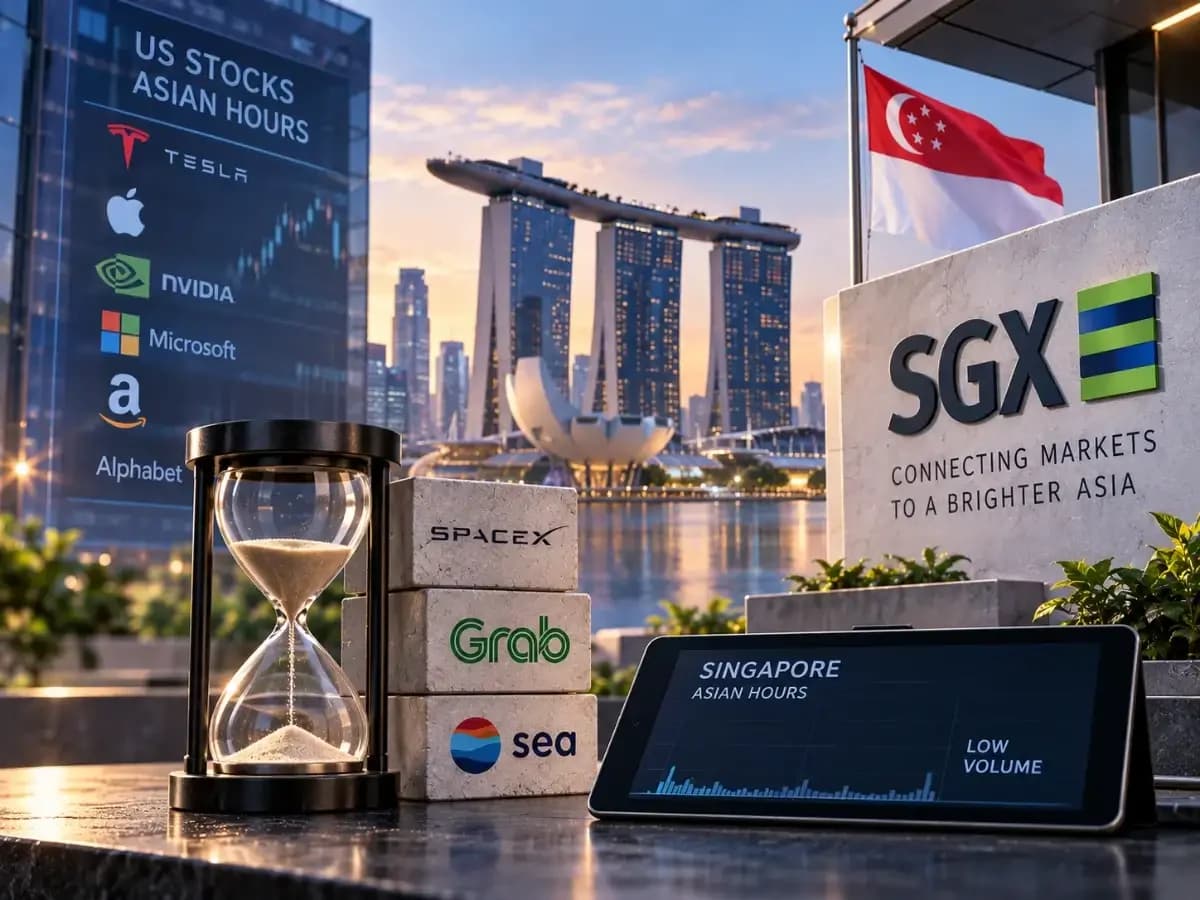
Chris Forbes, head of Asia and Middle East at CMC Markets in Singapore, described the initial rollout as disappointing and said investors already have access to alternative products. Strong global demand for US equities has prompted brokers, exchanges and cryptocurrency companies to develop derivatives and other products that provide exposure to US stocks outside traditional market hours. Nasdaq and NYSE Arca are preparing to launch a 24-hour trading programme on December 6, while the London Stock Exchange expects to introduce its own extended-hours offering in the first half of next year. The developments could increase competitive pressure on regional exchanges seeking to attract investors interested in trading US stocks during Asian hours.
Phillip Securities managing director Luke Lim, whose brokerage is the issuer designated by SGX to create SDRs by holding the underlying shares in trust and selling the local units to investors, expects to launch additional SDRs. Carmen Lee, head of equity research at OCBC, told Reuters that investors in Singapore tend to be more familiar with companies that are directly listed locally. She also noted that SDRs are not constituents of major benchmarks such as the Straits Times Index or MSCI indexes, which may limit their visibility among investors. Grab and Sea declined to comment on their SDRs, while SpaceX did not respond to requests for comment, as the companies were not directly involved in the SDR launches.
The early trading figures point to a key challenge for Singapore's SDR initiative: providing access to globally popular US stocks does not necessarily translate into significant local liquidity, particularly when investors can already obtain exposure through a growing range of alternative products and trading venues. The developments highlight the difficulty Singapore and other regional exchanges face as global financial markets move towards longer, and potentially around-the-clock trading. The Singapore Exchange's SDR strategy represents part of broader efforts to strengthen its equities market position in the competitive regional landscape, but the limited activity in recent US stock listings illustrates the ongoing challenges in capturing demand for round-the-clock US equity trading.