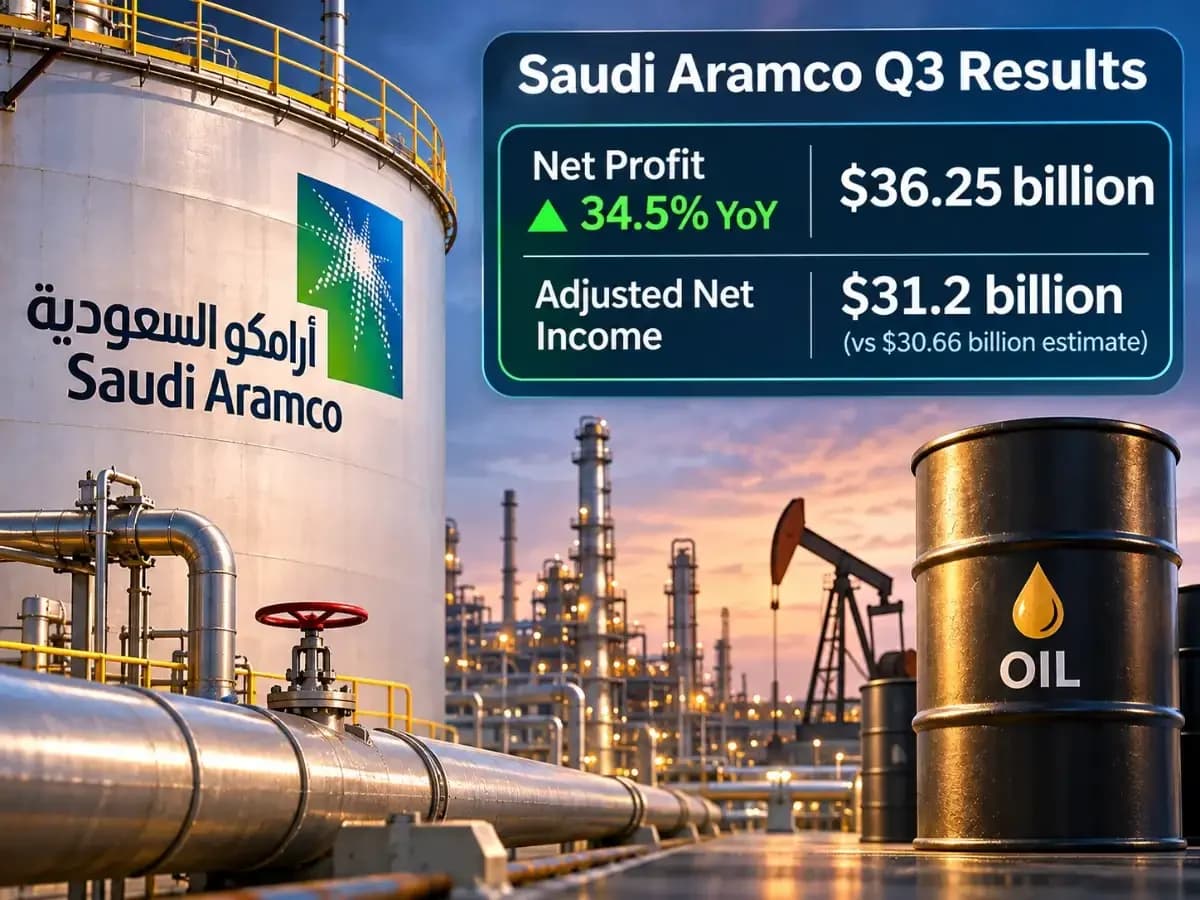
Saudi Aramco delivered exceptional third-quarter results with adjusted net income rising 9% year-on-year to $31.2 billion for the three months ended September 30, according to latest reports from CNBC TV18. This performance significantly exceeded analyst expectations, with the company beating estimates of $28.7 billion compiled by Bloomberg. The world's largest oil exporter demonstrated resilience despite ongoing geopolitical challenges, with the oil selling price jumping 35% to about $95.20 per barrel compared to $70.10 a year earlier. The company maintained its base dividend at $21.9 billion on a quarter-on-quarter basis, a payout that remains crucial for Saudi Arabia's public finances. The higher earnings are particularly beneficial for the kingdom as it faces waves of attacks from Yemen's Houthi militants that's pressuring the economy and putting increasing focus on the strength of its oil revenue.
The company's downstream earnings before interest and tax jumped more than three-fold to a record $10 billion, as reported by CNBC TV18. This surge in refinery profits, combined with higher oil prices, provided crucial support for Aramco's earnings. The company's total liquids production dropped about 10% to 8.7 million barrels per day, while natural gas output dipped 2.6%. Despite these production challenges, the company's gearing, a measure of indebtedness, eased to 5.5% at the end of September from 6.2% at the end of June, while free cash flow of $28.2 billion covered the dividend payout. The strong refining performance aligns with global oil majors from BP Plc to ExxonMobil Holdings Corp. and Chevron Corp. all benefiting from surging refining margins during the quarter.
Higher oil prices provided crucial support for Aramco's earnings, with Brent crude surging more than 40% during the quarter to average over $90 per barrel as reported by CNBC TV18. The ramp-up in Iranian attacks on shipping in the Strait of Hormuz raised supply concerns, with the global benchmark topping $100 per barrel by mid-September and rising further last month amid concern that fighting could break out again in the US-Iran war. Aramco increased crude shipments from its main export hub at Ras Tanura on the Persian Gulf in September to regain market share among buyers in Asia, pivoting to the Hormuz route after the alternative through the Red Sea was disrupted. The company has continued exporting crude through its eastern terminals in the Gulf and western terminals along the Red Sea, while increasingly relying on its East-West pipeline to transport crude from eastern oilfields to the Red Sea.
The US-Iran conflict has created significant operational disruptions for Aramco, with the company's energy infrastructure and headquarters coming under attack as fighting intensified in the wider regional conflict involving Yemen's Iran-aligned Houthi group. In recent weeks, Houthi attacks have targeted Aramco's energy infrastructure, including Yanbu, where the East-West pipeline terminates, refineries in western Saudi Arabia, a major oil field and even the company's headquarters. Despite these challenges, the kingdom has kept driving exports out to markets. The East-West pipeline, which Aramco CEO Amin Nasser described as a critical lifeline for maintaining the country's oil exports, ramped up flows after the conflict began in late February following US and Israeli strikes on Iran. The company has successfully adapted its export strategy, pivoting to alternative routes while maintaining its commitment to keeping exports flowing to markets.