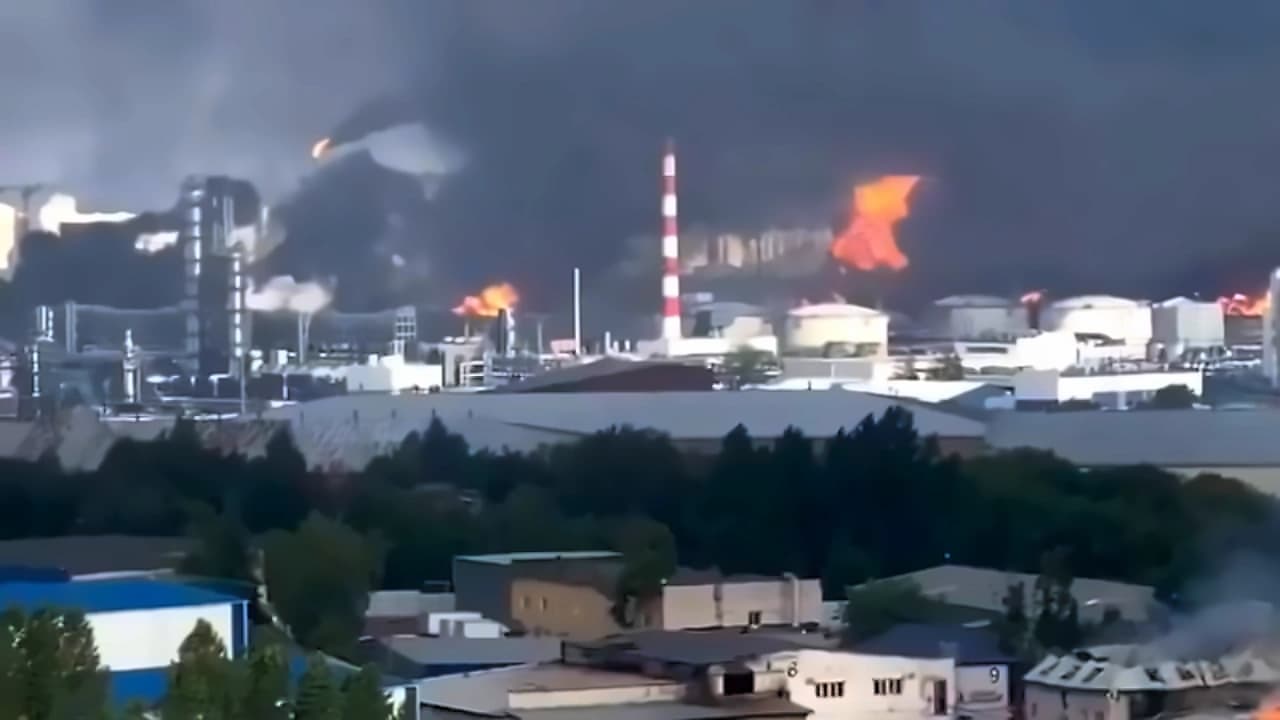
Russia suffered a significant blow when Ukrainian long-range drones struck an oil terminal in St. Petersburg and set it ablaze, as reported by President Volodymyr Zelenskyy on Wednesday. The drones flew more than 1,000 kilometres to hit the terminal, with clouds of black smoke rising over the city's port after the attack. St. Petersburg, Russia's second-largest city and where President Vladimir Putin was born, was hosting an annual international economic forum that is a prestigious event for the Kremlin. Russian authorities briefly suspended flights at St. Petersburg airport overnight and cut off mobile internet services due to the attack. This strike comes as Putin is set to speak at the economic forum, which has been Russia's leading event for attracting foreign capital for decades and is sometimes called Russia's Davos.
Russia is experiencing an unprecedented wave of attacks on critical energy infrastructure, with the latest strike targeting the Ilsky refinery in Krasnodar Krai on June 1-2. According to the Krasnodar Krai Operational Headquarters, drone strikes triggered a fire at one of southern Russia's largest oil-processing plants, which has an annual processing capacity of 6.6 million tonnes of crude oil. The facility plays a significant role in supplying petroleum products, including fuel for the Russian military. This marks at least the 16th attack on the facility since Russia launched its full-scale invasion of Ukraine in 2022, with the refinery previously targeted in February when a reported Ukrainian strike caused a major fire and temporarily disrupted operations. The latest incident highlights the growing vulnerability of Russia's energy sector amid escalating tensions.
Russia's intelligence agencies have grown more aggressive in their efforts to steal Western technology and defence secrets as sanctions squeeze the country's wartime economy, according to three senior European intelligence officials. Moscow's agents are building fake companies, recruiting middlemen and deploying cyber spies and hackers who are gathering information that could also be used to attack key infrastructure. As reported by The Associated Press, Christoffer Wedelin, deputy head of operations at the Swedish Security Service, stated that "they really know what they need" and are putting "serious effort" into acquiring advanced machine tools, factory equipment, research and dual-use technology. The situation has escalated recently with Anne Keast-Butler, director of Britain's signals intelligence agency, publicly accusing Russia of "relentlessly targeting" the U.K. and its European allies through technology theft, alongside orchestrating potential acts of sabotage and assassination.

Russia's refining sector is experiencing significant decline amid the ongoing attacks on energy infrastructure. Data from energy analytics firm OilX showed that Russian refineries processed 4.58 million barrels of oil per day in May, down 2.3% from April and 14.4% below levels recorded at the start of the year. The reduced refinery output has affected fuel markets, with supplies of AI-95 gasoline on commodity exchanges falling sharply in May, while wholesale gasoline prices have risen significantly since the beginning of 2025. The combination of infrastructure attacks and operational challenges is creating additional pressure on Russia's energy supply chain, which is already strained by sanctions and the war effort.
Four years of international sanctions have hampered Moscow's ability to procure machinery, technology and research from Europe, while the grinding war in Ukraine has taxed key industries and pushed the country toward a potential financial crisis. Kaupo Rosin, head of Estonia's Foreign Intelligence Service, reported that about a third of Russia's gross domestic product currently goes to the war effort. The war and ensuing sanctions have slowed growth and fueled stubborn inflation. Russian officials planned to have a budget deficit of 3.7 trillion rubles ($52.1 billion) for the whole of 2026 and had already reached about 3.4 trillion rubles ($47.9 billion) by the end of February, according to Rosin. However, recent geopolitical developments, including the Iran war that erupted on February 28 and caused oil prices to soar, have provided temporary relief to Russia's budget, though analysts caution that continued Western pressure could lead to an imminent financial crisis.