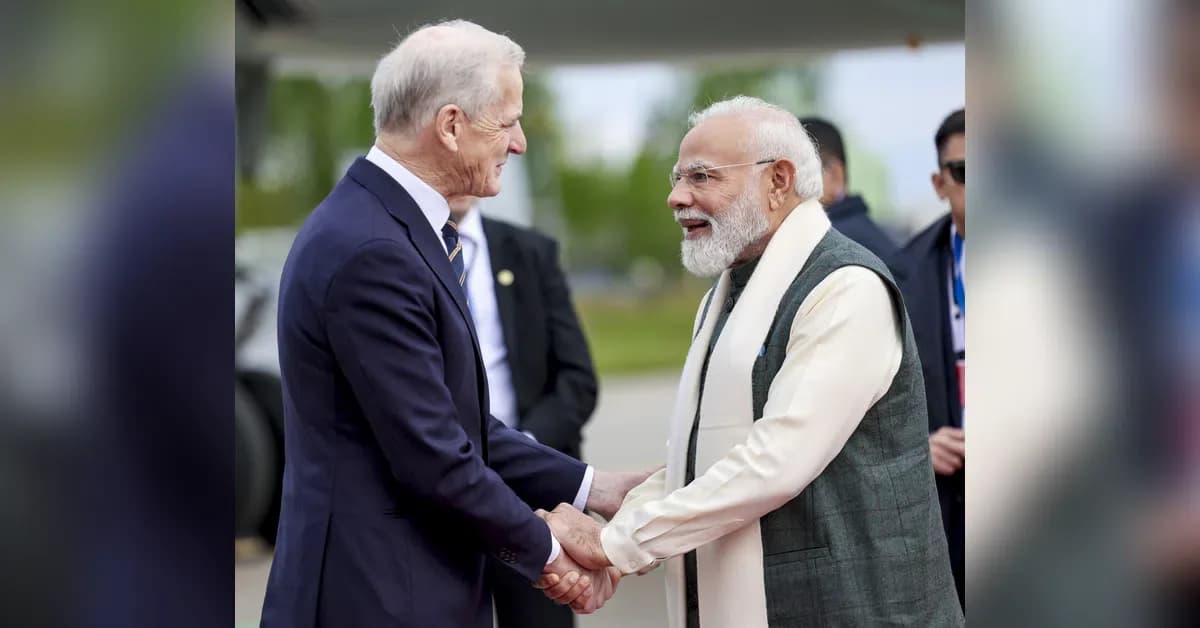
Prime Minister Narendra Modi arrived in Sweden on Sunday for a two-day visit focused on strengthening ties in trade, technology, defence and emerging sectors. As reported by multiple sources, Modi's aircraft was escorted by Swedish Air Force Gripen jets during landing in Gothenburg, where he was warmly received by Prime Minister Ulf Kristersson. The visit marks a significant diplomatic engagement between the two nations, with both leaders emphasizing the importance of deepening bilateral cooperation across multiple sectors. Modi thanked Kristersson for the special gesture of coming to receive him at Gothenburg airport, stating he was "grateful to Prime Minister Kristersson for the special gesture of coming to receive me at Gothenburg airport. Looking forward to boosting India-Sweden friendship in this important visit."
The India-Sweden relationship has reached unprecedented economic heights, with bilateral trade between India and Sweden reaching a record ₹62,000 crore (7.75 billion US dollars) in 2025. As reported by UNI, Swedish investments in India have also steadily expanded, totalling more than ₹2,25,000 crore (2.8 billion dollars) between 2000 and 2025. The visit comes at a time when India is intensifying engagement with European partners to diversify supply chains, accelerate clean energy collaboration and deepen technological partnerships. Modi's Sweden trip also assumes significance as it is his first visit to Europe since the India-European Union Free Trade Agreement came into effect in January 2026, opening new avenues for trade and investment cooperation between India and European economies.
Ahead of the India-Sweden engagements in Gothenburg, Prime Minister Narendra Modi and Prime Minister Ulf Kristersson have jointly articulated a shared vision for resilient growth, sustainable industrial transformation and stronger global cooperation. As reported by the Ministry of External Affairs, the leaders emphasized that "Cooperation, not fragmentation, will lead us towards shared prosperity and a sustainable future." This collaborative approach underscores the growing India-Sweden partnership in clean technology, innovation, green industry, energy transition and sustainable development. The discussions focused on creating future-ready economies through collaboration between governments, businesses, research institutions and financial systems to address global challenges.
During the visit, Modi and Kristersson are expected to hold wide-ranging bilateral discussions covering cooperation in defence manufacturing, artificial intelligence, resilient supply chains, startups, emerging technologies, climate action, space collaboration and people-to-people exchanges. As reported by UNI, the talks would also review progress in ongoing partnerships and explore fresh opportunities for collaboration in sectors critical to future economic growth and strategic resilience. The two leaders will also jointly address the European Round Table for Industry alongside European Commission President Ursula von der Leyen, with the forum expected to focus on industrial competitiveness, sustainable economic growth and emerging opportunities arising from stronger India-Europe economic integration following the implementation of the India-EU trade agreement. Modi reiterated India's vision of 'Design for India, Make in India and Export from India' and invited European companies to deepen their engagement with India as a trusted and reliable economic partner.
Swedish industry leaders have expressed strong optimism about the growing India-Sweden relationship ahead of PM Modi's visit to Gothenburg. Jens Holtinger, Chief Technology Officer of Volvo Group, described Modi's visit as "a great honour" and highlighted Volvo's 25-year presence in India with nearly 5,000 employees. As reported by ANI, Holtinger noted that India is "the second biggest R&D centre that we have in the world" and expressed confidence in India as "a very good platform for the future." Kamal Bali, President and Managing Director of Volvo Group India, termed the visit a "significant milestone" in India-Sweden relations, noting that "Swedish businesses remain optimistic about India's economic growth, domestic demand and skilled workforce, particularly in digital technologies and manufacturing sectors."
The discussions focused on expanding opportunities in clean energy, defence, semiconductors and advanced manufacturing, with particular emphasis on leadership and renewable energy cooperation. As reported by PTI, Modi invited Swedish companies to enhance their presence in India under initiatives such as 'Make In India', the National Green Hydrogen Mission, and the National Critical Mineral Mission. The collaboration extends to resilient supply chains, climate-smart industrial growth and sustainable mobility solutions. Vinay Dhar, Head of Digital Business at CONSAT Engineering, highlighted how industry collaboration has enabled growth and brought new technology to India, emphasizing the importance of "bringing those technologies into India, which is good for society, industry and good for driving the economic growth of India." The partnership continues to focus on strengthening cooperation in green transition, sustainable mobility, life sciences and digital technologies.