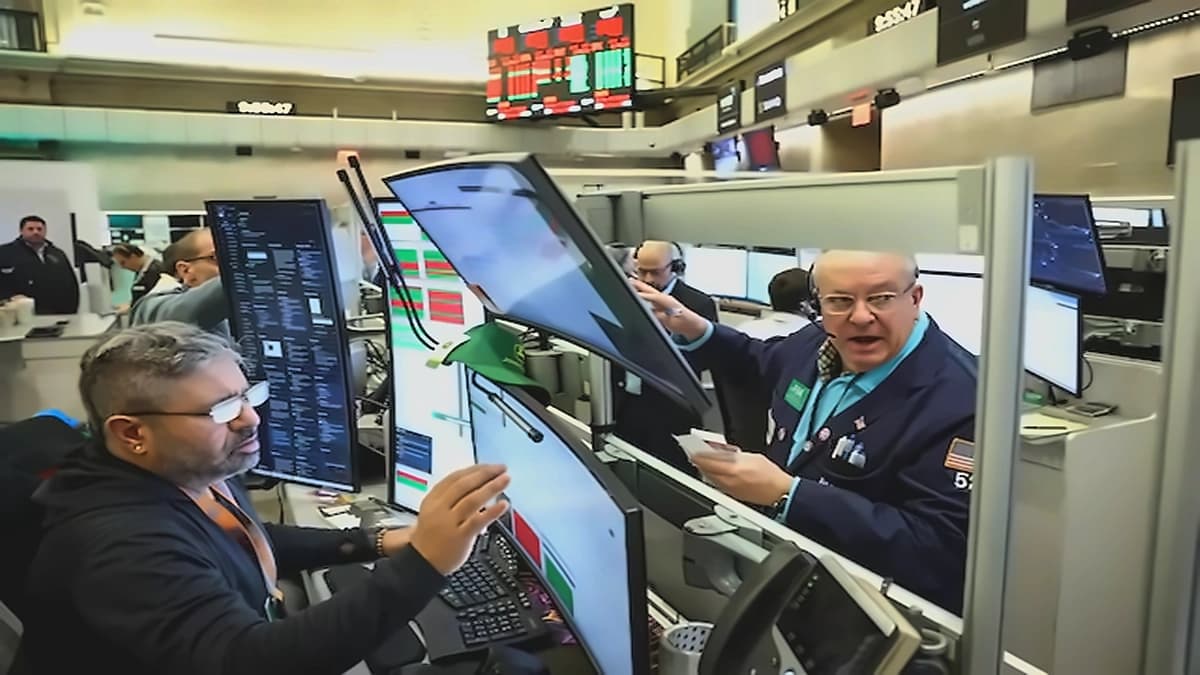
The S&P 500 is seeking a third consecutive year of double-digit gains and a sixth positive year out of the past seven, according to reports from Investing.com India. This performance naturally invites comparisons with the late 1990s technology boom, though it does not automatically constitute a bubble. The S&P 500 trades at roughly 20 times forward 12-month earnings, which is above both its five-year and 10-year averages, representing elevated but not full late-1990s valuations. The top ten names in the S&P 500 account for more than 40% of the index, with AI at the center of this concentration, creating a narrower foundation for market performance. Recent market action shows the S&P 500 gained 3.4% in its strongest rally of the year, breaking a five-week decline pattern, yet veteran macro investor Jordi Visser argues this bounce fits a regime shift rather than a return to bull market dynamics. Visser's analysis reveals that credit spreads are near all-time tights with HY OAS at record lows, while initial jobless claims show no uptrend and S&P 500 forward earnings revisions are strongly positive at nearly 2% above start-of-year consensus. However, the S&P 500 is below 50-day support with resistance levels at 6600-6670 near-term and 6750 for the 50-day moving average, while equal-weight S&P 500 and NYSE breadth are at all-time highs despite the index reaching record levels.
The largest technology companies are on course to spend roughly $700 billion to $725 billion on capex in 2026, representing approximately 75% above last year's already extraordinary $410 billion, as reported by Investing.com India. This represents an industrial buildout on a scale normally associated with power grids, railroads and wartime factories. The data-center buildout has expanded beyond semiconductors and hyperscalers to encompass power grids, cooling systems, turbines, cable, natural-gas infrastructure, industrial equipment, software and construction. This concentration of economic force is pulling demand through multiple sectors of the economy that had been starved of growth narratives for years. However, recent developments show memory shortages with all three major memory companies hitting a combined $1 trillion market cap, while Fujikura reported sharp guidance cuts due to production constraints and Modine Manufacturing cited supply constraints and bottleneck issues. Visser's analysis reveals that semiconductor test equipment is in a severe component shortage—the worst ever supply crunch—with equipment unable to be built due to semiconductor shortages. The memory sector faces particular challenges as Visser sold his Micron position (bought at $100, sold at ~$650), citing inherent cyclical nature and Chinese competition risks despite the current cycle being different.

FINRA customer margin debt reached a record $1.42 trillion in May, up 53.7% from a year earlier, while the S&P 500 rose 28.2% over the same May-to-May window, according to Investing.com India. This means leverage has been growing at nearly twice the pace of the market it finances. The first-quarter reporting was strong, with the proportion of S&P 500 companies beating earnings expectations comfortably above its normal mid-70% range, and analysts still expect S&P 500 earnings growth above 20% in the second quarter. However, the market is moving beyond the easy-money stage where everyone gets paid for owning the story. Recent technical analysis reveals that the S&P 500 is below 50-day support with resistance levels at 6600-6670 near-term and 6750 for the 50-day moving average, while equal-weight S&P 500 and NYSE breadth are at all-time highs despite the index reaching record levels. Visser's analysis shows that multi-week momentum readings in the S&P 500 exceeded 70—historically a zone that precedes either a top or a period of building a top—with momentum breaking sharply intraweek even though the index finished near highs. The bull/bear newsletter ratio has reached levels that historically precede unexpected bullish policy responses and sharp but short-lived rallies.
The Federal Reserve is no longer the soft mattress beneath equity valuations, as reported by Investing.com India. The old script that assumed easier policy would keep cushioning valuations is now curling at the edges. Thursday's June employment report matters significantly because it could determine whether the market gets another breath of air or another bucket of cold water. The analysis suggests the market has moved through the first five innings of a nine-stage cycle and is beginning to test the upper boundary of the sixth inning, where wealth spreading occurs and speculation increases. However, recent developments show the Fed remains paralyzed with negative job creation in multiple months and weakening quits rates, creating conditions where the Fed can't raise rates this time according to Visser's analysis. The CPI is forecast to hit 3.7% on the next print, which would push three-month Treasury yields below CPI, creating negative real yields for the first time since the inflation crisis began. Visser's analysis indicates that the CDX IG has not moved, so no bubble unwind is imminent, while gross leverage across hedge funds remains shockingly high despite net leverage reduction, suggesting deleveraging is incomplete and factor volatility will persist.
Veteran macro investor Jordi Visser argues that the current market selloff—the S&P 500's worst week since Liberation Day (down 2.6%) and Nasdaq's worst since then (down 4.5%)—is not the beginning of a bear market but a necessary rotation within an ongoing secular bull cycle driven by AI. He calls the past nine weeks of relentless gains the "fireworks show" climax; now the market enters a "digestion" phase where the easy trades are over and investors must pick specific winners. The S&P 500 closed at all-time highs for the ninth consecutive week, up 5% in the month, yet only 3 of 11 sectors participated, showing narrow leadership typical of late-cycle AI concentration. Visser maintains that the AI-driven expansion remains intact but has entered a midcycle slowdown—a pause where growth is still positive but the rate of change declines. His investment approach emphasizes rotating from hyperscaler spenders (Mag 7, Meta, etc.) toward application-layer companies (biotech, healthcare, agentic commerce) and value-oriented sectors, arguing that the next parabolic move will be in power and energy bottlenecks rather than traditional AI infrastructure. Visser's analysis shows that the tech short side of the momentum basket relative to the AI trade is about to break through the 50-day moving average, indicating a regime shift toward two-sided trading where "crappy beta is outperforming the stuff with great earnings." His concrete portfolio response includes exiting Micron near its peak (around $700), buying Marvell (called "the next trillion-dollar company" by Jensen Huang), adding Eli Lilly as the "most important AI company in the world," and nibbling Bitcoin at its 200-week moving average. He also bought Chevron and Exxon as hedges against rising oil prices from prolonged Strait of Hormuz closure.