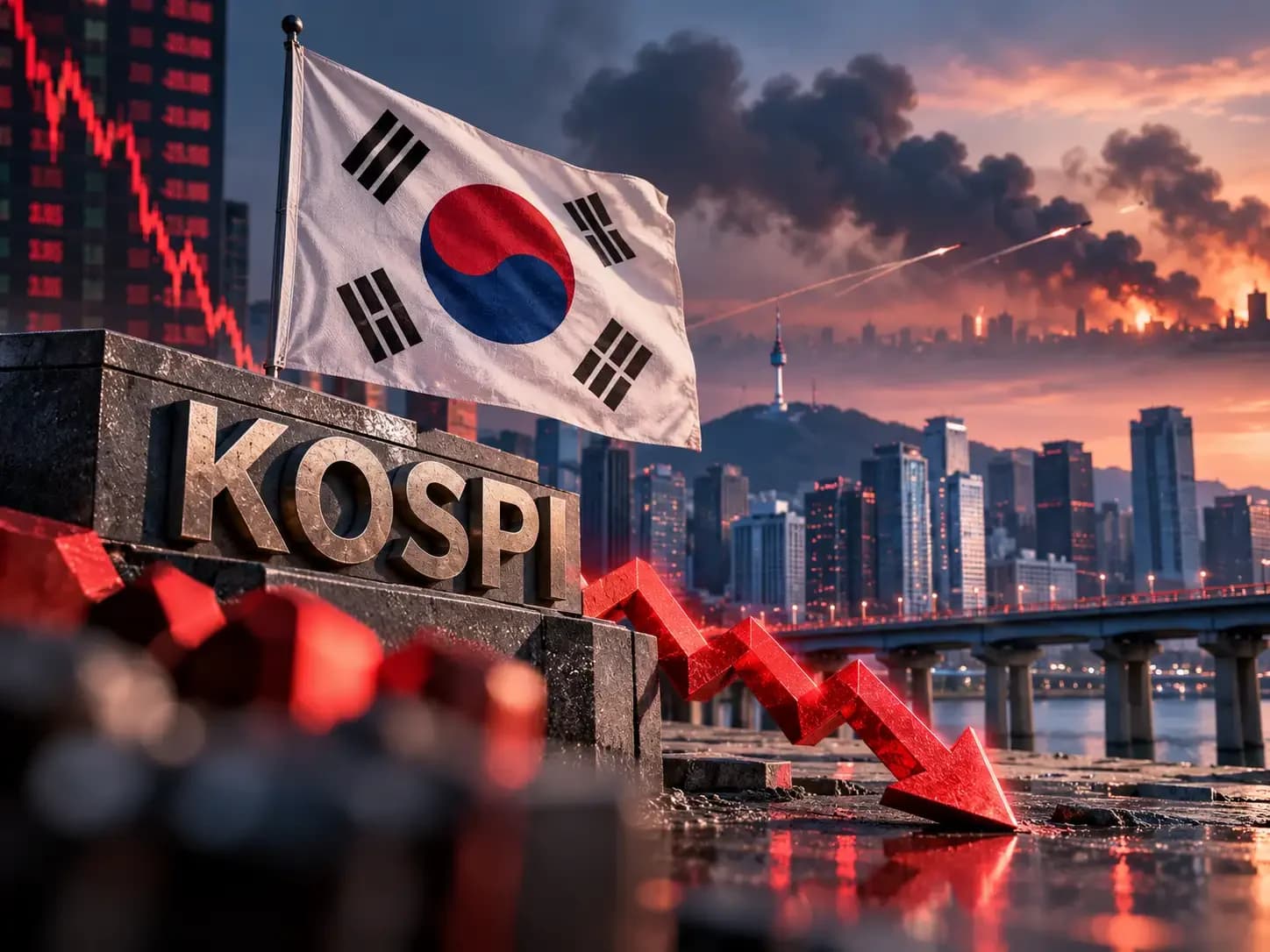
South Korean shares fell over 1% on Thursday as escalating Middle East tensions and attacks near the Strait of Hormuz weighed heavily on investor sentiment. According to Reuters, the KOSPI declined 96.61 points, or 1.37%, to 6,955.03 as of 0058 GMT. The decline came after Iran said on Wednesday that it had attacked 10 ships near the Strait of Hormuz after the United States sank five Iranian oil tankers, marking the biggest wave of attacks on shipping by both sides since the six-month-old war began. This represents a significant reversal from the previous session's recovery to 7,058.06.
The BOK's September credit report identified heavy semiconductor sector weighting as the primary driver of the KOSPI's dramatic decline from above 9,200 to the 6,200 range last month. As reported by Bloomberg, Samsung Electronics and SK Hynix make up 51.2% of the index and drove 69.3% of its decline during the selloff. Two-times leveraged exchange-traded funds tied to the chipmakers grew from $3.33 billion to $10.7 billion in a single month after their May listing, according to deputy governor Park Jong-woo. In Thursday's session, Samsung Electronics, SK Hynix, and Samsung BioLogics all traded lower, with Samsung BioLogics declining 1.72%. According to the central bank's September monetary policy report, the two chipmakers accounted for nearly half of the Kospi's market capitalization, with Hong Kong-listed leveraged products tied to the companies expanding more than twentyfold during the first half of 2026.
The selling pressure was broad-based across major sectors, with 197 stocks advancing and 666 declining out of 906 stocks traded on the South Korean exchange. According to Reuters, LG Energy Solution declined 0.81%, while Hyundai Motor and Kia Corp fell 0.77% and 0.39% respectively. POSCO Holdings slipped 0.30%, indicating widespread weakness across heavyweight stocks. Foreign investors were net sellers of South Korean shares worth 219.3 billion won ($163.94 million), continuing the trend of foreign outflows that has characterized recent sessions.
In offshore trading, the South Korean won was quoted at 1,337.8 per dollar, up 0.1% on the day, while its one-month non-deliverable forward contract was quoted at 1,337.4 per dollar. Despite Thursday's equity decline, the KOSPI has gained 65.04% so far this year, while the won has strengthened 7.5% against the U.S. dollar. In South Korea's debt market, September futures on three-year Treasury bonds fell 0.07 point to 102.97, while the yield on the most liquid three-year Korean Treasury bond rose 3.0 basis points to 3.936%. The benchmark 10-year yield increased 5.3 basis points to 4.443%. South Korea's strong economic fundamentals support this resilience, with stock market capitalization equal to 147.2% of GDP and gross savings at 35.6% of GDP, providing substantial household and business funds for potential financial asset investments.

The BOK recommended closer monitoring of leveraged ETFs, cautioning that their recent shrinkage does not remove the need for continued oversight. According to Bloomberg, retail margin loans also hit a record before unwinding sharply during the correction. South Korean authorities had already proposed restricting an individual investor's exposure to leveraged single-stock exchange-traded funds to 20% of investment assets following sharp price moves in technology shares. Kiwoom Securities analyst Han Ji-young still expects buybacks and returning foreign buyers to offer support for the market, despite the current volatility challenges and the impact of Middle East tensions on risk sentiment. The regulatory focus reflects concerns about daily rebalancing by leveraged funds adding to market swings, particularly given the concentration in semiconductor stocks.