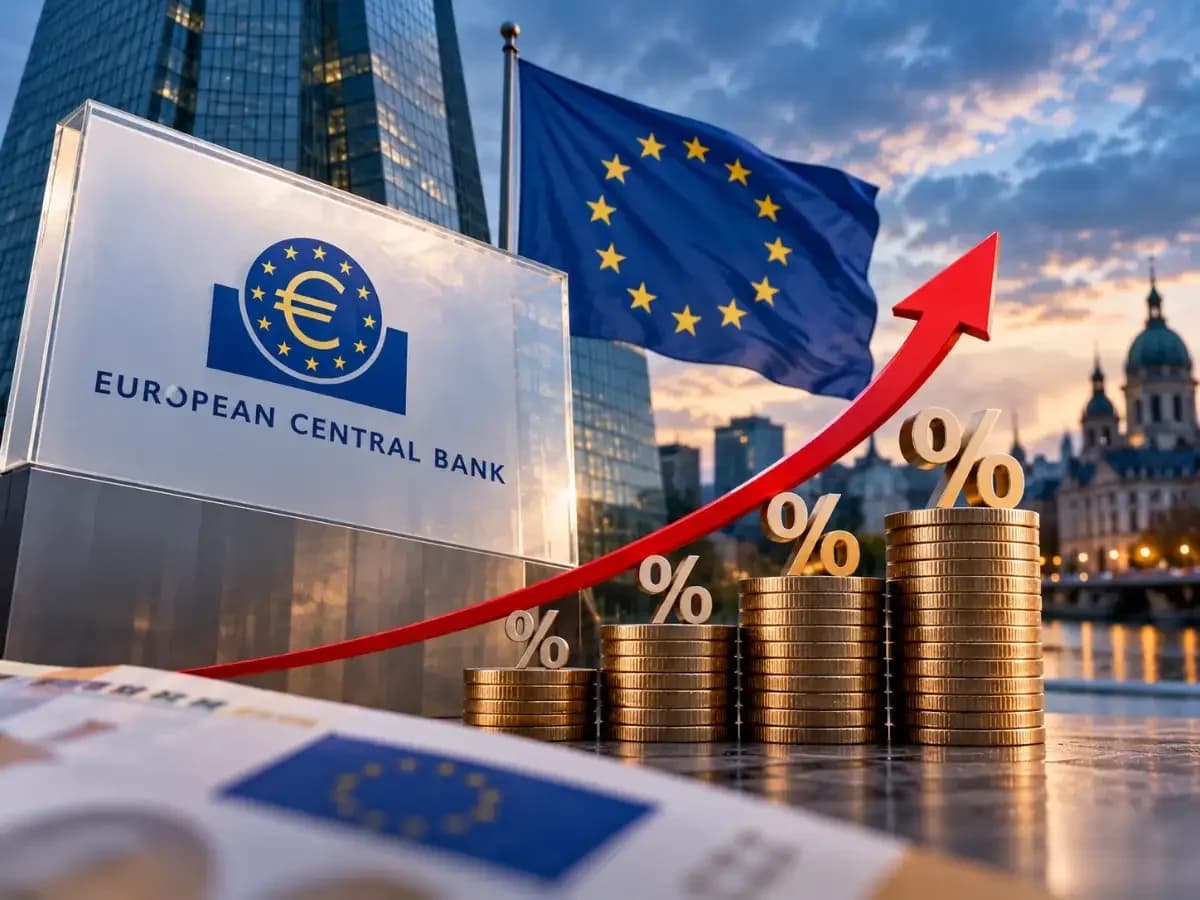
Major asset management firms are taking a contrarian position ahead of Thursday's European Central Bank meeting, arguing for a limited rate hiking cycle. According to reports from Bloomberg, JPMorgan Asset Management argues that lackluster economic growth on the continent will make the ECB's expected hike a case of 'one and done'. Pictet Asset Management and Carmignac say policymakers would be justified staying on hold altogether, representing a sharp divergence from market expectations. As Zara Nokes, global market analyst at JPMorgan AM, explains, the central bank is unlikely to pursue further cuts after Thursday if economic activity remains sluggish, even as the ECB underscores its commitment to returning inflation to target.
The market currently favors 75 basis points of increases by year-end due to inflation threats from the Iran war, as reported by Bloomberg. However, Luca Paolini, chief strategist at Pictet, expects the ECB to do only one quarter-point hike to demonstrate attention to inflation data, stating that 'The European economy is not picking up'. Guillaume Rigeade, co-head of fixed income at Carmignac, notes that 'The European economy can accept this 25 basis points higher — it's not a big danger'. Paolini adds that 'The market expects three — they'll probably do one, just to show 'we're looking at inflation data'.

Recent economic data shows euro area GDP fell in Q1 instead of climbing as economists forecast, due to a sharp downward restatement for Ireland, according to Bloomberg. Market gauges of inflation expectations rose sharply after the Iran war start, jumping from 1.75% at end-February to 2.40%, but have since retreated to 2.12%, only narrowly above the ECB's official target of 2%. The OECD warns of 'deteriorating sentiment' with the euro area expected to grow just 0.8% this year. David Zahn at Franklin Templeton expects more hikes if inflation doesn't decline, though he doesn't think rates will return to 4%.
Investment professionals are positioning accordingly based on their ECB outlook. Lauren van Biljon at Allspring Global Investments doesn't see Thursday's increase marking the start of a sustained rate-hiking cycle, using the bond selloff to add duration exposure by shifting from two-year to five-year maturities and from five-year to 10-year notes. Guillaume Rigeade is long German two-year bonds while negative on longer-dated European bonds due to heavy government borrowing expectations. Niall Scanlon at Mediolanum International Funds prefers short-dated government bonds, expecting front-end yields to decline if oil prices settle lower and peace talks materialize. Scanlon notes 'There's scope for front-end yields to come lower just based on that asymmetric move in the event of a peace deal'.
A Bloomberg survey of economists conducted May 29-June 3 indicated that all respondents but one anticipate a quarter-point hike at Thursday's meeting, which would be the central bank's first hike since 2023. Most economists then see another increase before year-end, with cuts only coming mid-next year. David Zahn at Franklin Templeton expects more hikes if inflation doesn't decline, though he doesn't think rates will return to 4%. The ultimate outcome depends on oil price settlements and their impact on inflation expectations, with ongoing US-Iran talks creating uncertainty. Rigeade warns that 'If we enter into a hiking cycle with back-to-back hikes, it could be different'.