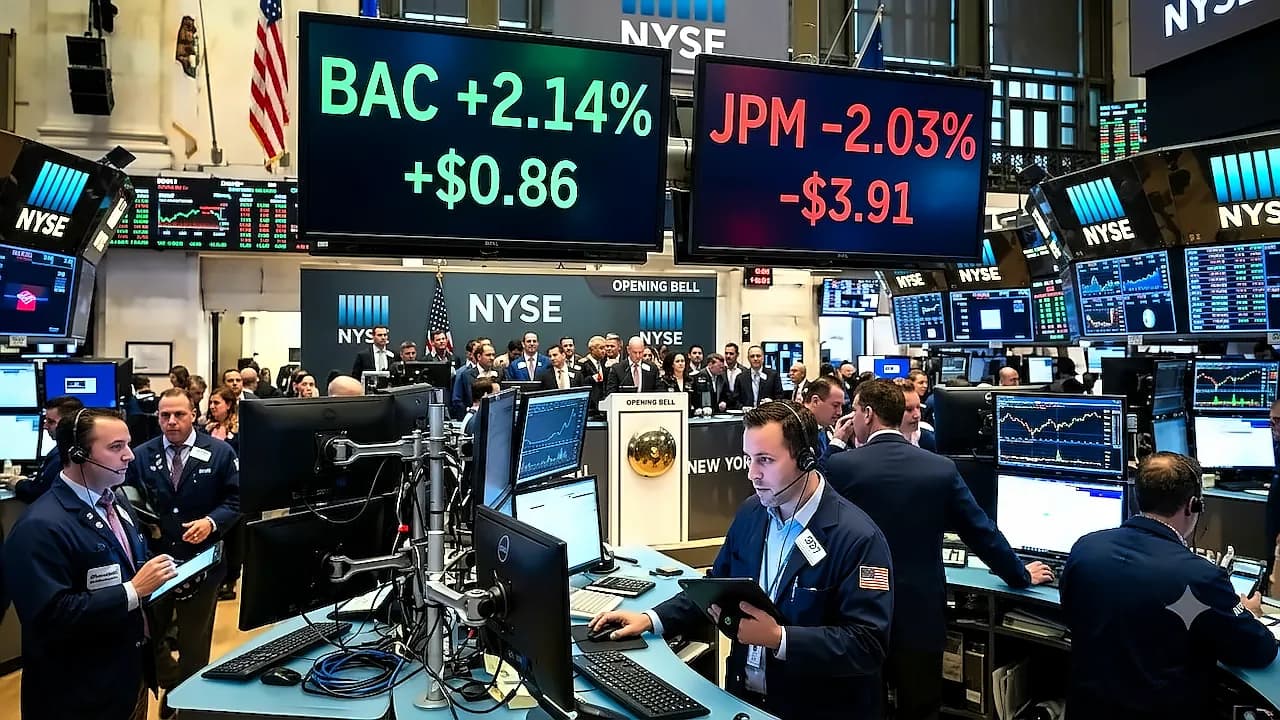
JPMorgan Chase expects investment banking fees and trading revenue to deliver robust growth in the third quarter, with co-President Doug Petno projecting mid-to-high teens percentage growth in both segments. This forecast stands in stark contrast to Bank of America's warning at the Barclays Global Financial Services Conference that Q3 investment banking fees are tracking $1.6B-$1.8B, representing a 10%+ decline from $2B in Q3 2025. As reported by Reuters, Petno's optimistic outlook is particularly notable given JPMorgan's already strong base, having posted $3.3 billion in investment banking fees in Q2 2026, a 30% jump compared to the same period a year earlier. The growth drivers include mergers and acquisitions, equity underwriting, fixed income trading, and equities activity, with executives pointing to strong deal flow and solid client engagement across all segments.

Bank of America's warning has revealed a broader industry-wide challenge, with Jefferies data showing investment banking proxy revenue for eight major global banks already down 15% year-over-year and 27% from Q2 as of September 3. According to Investing.com, the culprit includes a broad market-wide investment banking slowdown, slipping financing activity, and the effect of "higher-for-longer" rates on deal pipelines. Bank of America shares fell 5.14% to $59.47, dragging the S&P 500 Banks Index down 2.7% following Moynihan's disclosure. CEO Brian Moynihan explained that the broader investment banking market is also down around 10%, suggesting the softer quarter reflects cooling industry activity rather than company-specific breakdown. The market-wide stress was evident well before the disclosure, signaling that the investment banking sector faces significant headwinds beyond individual bank performance.
JPMorgan's investment banking division demonstrated exceptional performance in the second quarter, with investment banking fees jumping 30% year-over-year and markets revenue surging 35%. According to Reuters, Petno highlighted that deal activity remains robust and the bank is experiencing broad-based strength across both investment banking and markets businesses. He noted that the bank started the quarter with a strong pipeline that continues to drive activity, with management and board confidence driving tremendous M&A activity that is as high as seen in some time. The $3.3 billion investment banking fee base from Q2 2026 already represents a high starting point for the projected mid-to-high teens growth in Q3, even as broader market conditions present challenges. Bank of America's Q2 performance had shown even stronger momentum, with investment banking fees rising 50% year-over-year to $2.1 billion and sales and trading revenue reaching a record $7.1 billion.
Petno emphasized that clients are demonstrating remarkable resilience, seeing through market volatility and uncertainty which reflects the diversity and strength of the U.S. economy. As reported by Reuters, he noted that clients are incredibly resilient and seeing through the market volatility and the fog of uncertainty. This client strength is particularly notable given the current market conditions and the bank's ability to maintain robust business activity across its key segments. Executives pointed to strong deal flow and solid client engagement across investment banking and markets segments, with no meaningful economic deterioration flagged as a concern for the upcoming quarter. The client resilience becomes even more significant against the backdrop of broader market headwinds affecting the investment banking sector, with global M&A activity remaining substantial in the first half of 2026 with more than $3 trillion of announced transactions.
In June 2026, JPMorgan reorganized its top executive layer, with Doug Petno taking the role of sole CEO of the Commercial and Investment Banking division and Troy Rohrbaugh stepping in as co-president overseeing Consumer and Community Banking. According to Reuters, Petno confirmed that CEO Jamie Dimon is not stepping back and remains active as ever, out in the market all the time. He explained that the company is big and scaling rapidly, requiring significant executive coordination to give Dimon leverage and round out the executive team. The newly restructured leadership team is projecting straightforwardly bullish sentiment, with executives explicitly noting no significant economic concerns tied to their deal activity despite the broader market challenges facing the investment banking sector. Bank of America's diversified earnings base provides stability, with second-quarter net interest income increasing 9% to $16 billion and average loans and leases growing 8%, making it less dependent on any single capital-markets cycle.