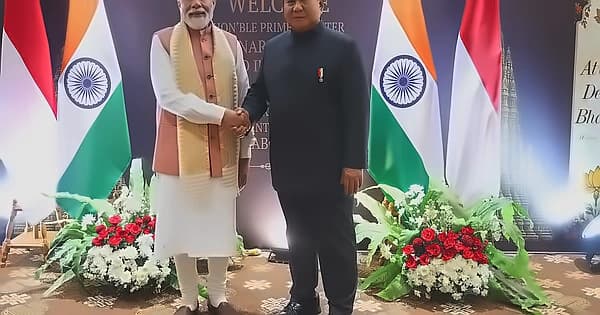
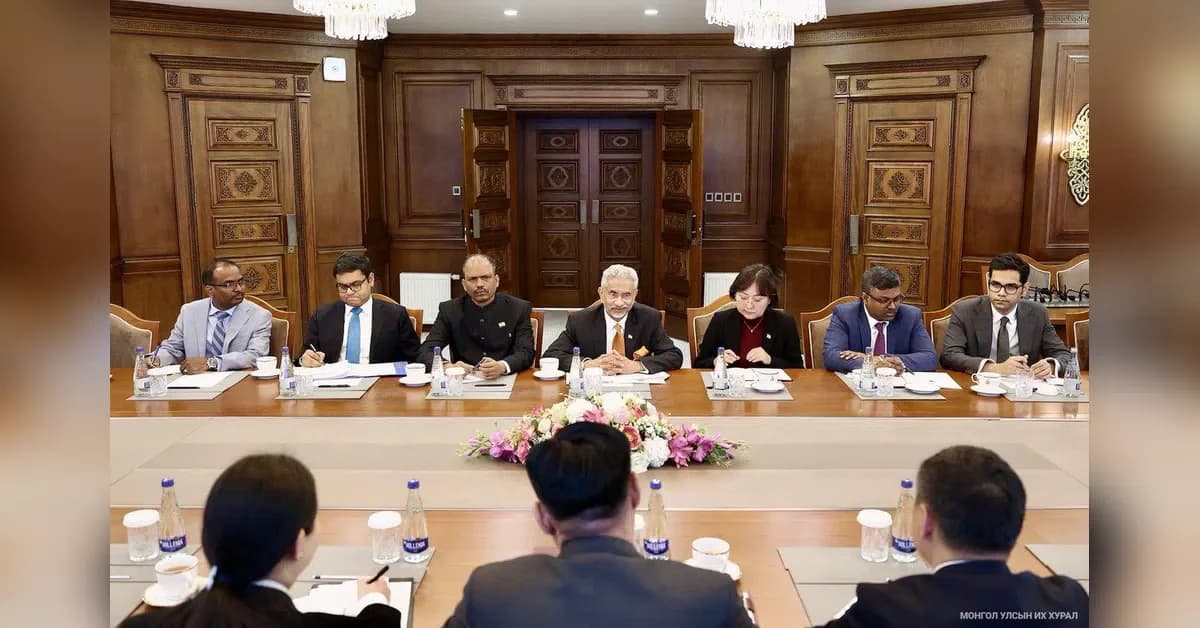
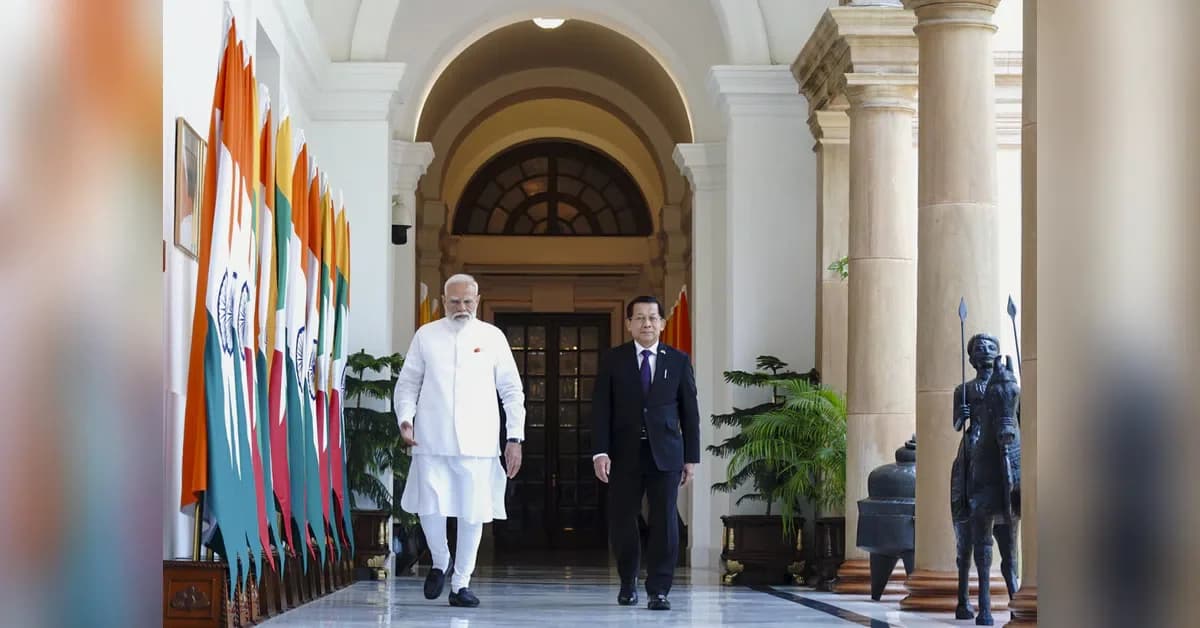
External Affairs Minister S Jaishankar hosted Indonesian Foreign Minister Sugiono for the eighth India-Indonesia Joint Commission meeting on Sunday, exploring expanded cooperation across multiple sectors. As reported by NDTV, the ministers held extensive discussions covering the full spectrum of bilateral cooperation from political to defence and security, maritime trade and investments, to healthcare, pharmaceuticals and food security. Jaishankar welcomed Sugiono and his delegation to New Delhi, noting that Indonesia is an important partner of India in the Southeast Asian region and that ties, including in trade and investment between the two sides, have been on an upswing in the last few years. The external affairs minister recalled the 'fruitful' talks between Prime Minister Narendra Modi and Indonesian President Prabowo Subianto during his visit to India in January last year, stating that 'the visit has certainly imparted fresh momentum to our comprehensive strategic partnership'. Sugiono also acknowledged that President Subianto's visit to India last year helped chart a new course in the India-Indonesia partnership. The India-Indonesia Comprehensive Strategic Partnership has witnessed a strong growth in recent years, with the two ministers discussing avenues for further strengthening cooperation in political, defence and security, maritime, trade and investment, pharma and healthcare, digital, energy, connectivity, space, education, consular and culture domains, and people-to-people exchanges.
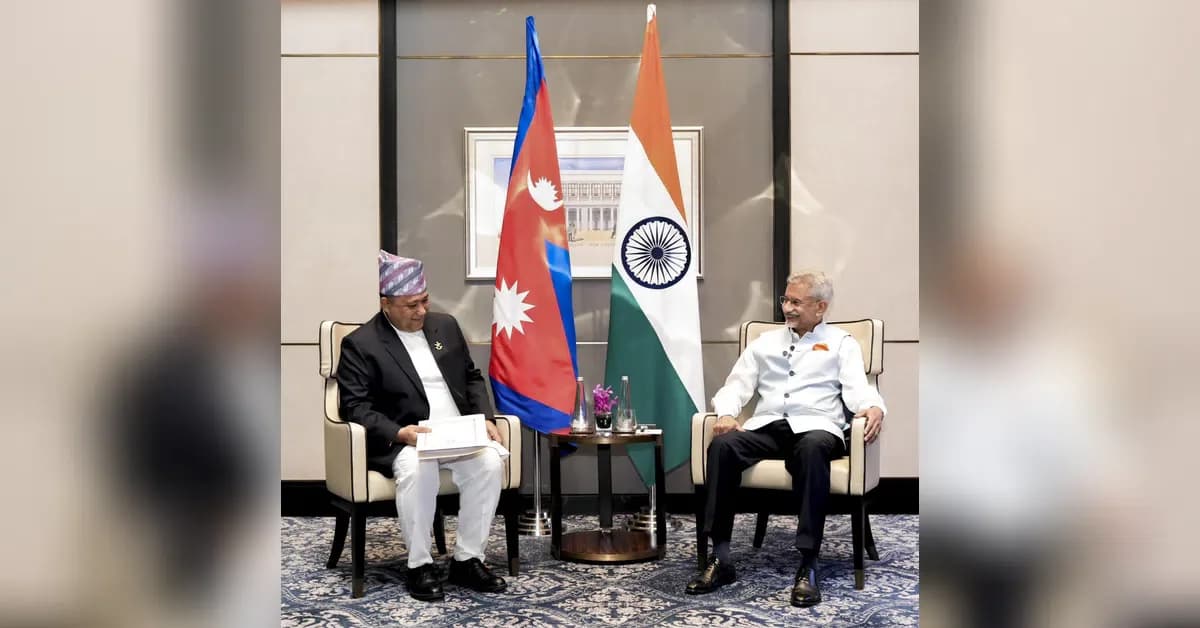
Nepalese Foreign Minister Shishir Khanal has made a significant diplomatic overture regarding the ongoing boundary dispute with India, effectively endorsing New Delhi's rejection of third-party involvement. Speaking at a media interaction on Sunday, Khanal stated that Nepal wants to resolve the border row with India through existing bilateral mechanisms as 'no problem is too large and complex' when both sides meet with 'open heart, rational mind and mutual respect'. According to Business Standard, Khanal emphasized that 'we look at India with an open heart, clear eyes, and with a single, transparent agenda: the economic transformation of Nepal'. The Nepalese minister noted that 'rather than engaging in hyper-nationalistic grandstanding, we are pursuing calm, data-driven and evidence-based discussions to resolve challenges in good faith' and expressed confidence that 'no boundary too complex when we sit down with an open heart'. These remarks came a day after Khanal's wide-ranging talks with External Affairs Minister S Jaishankar and mark a significant shift in Nepal's diplomatic approach to the boundary controversy.
External Affairs Minister S Jaishankar and his Nepalese counterpart Shishir Khanal emphasized the 'special' relationship between India and Nepal during their meeting on Saturday. According to reports from Business Standard, Jaishankar reiterated Prime Minister Narendra Modi's sentiment regarding India's commitment to working with Nepal for mutual prosperity, progress and well-being of both countries. Khanal responded by stating that Nepal accords 'highest priority' to its relationship with India and the current government is ready to engage 'substantively and purposefully' with New Delhi. The ministers' discussions were part of Khanal's three-day trip to New Delhi that began on Friday to strengthen bilateral ties, a visit that was overshadowed by controversy triggered by Nepalese Prime Minister Balendra Shah's recent remarks on the boundary row between the two sides. Khanal's recent remarks further emphasized this cooperation, stating that 'we carry no old baggage and have only firm resolve for a genuinely transformative relationship' with India.
The ministers discussed comprehensive cooperation across multiple sectors during their productive talks. As reported by Business Standard, the detailed discussions covered development cooperation, connectivity, energy, hydropower, education, health, capacity building, digital, culture and sports. Jaishankar described the partnership as 'unique' and noted there is an opportunity to advance ties in newer domains like startups, artificial intelligence, information technology and renewable energy. The external affairs minister highlighted that there are strong complementarities between the objectives outlined by Nepal's government and India's initiatives in the neighbourhood. Khanal's recent statements also highlighted India's technological advancement, noting that 'when we look across the border, we see a Rising India - an India that has fundamentally and beautifully redefined itself on the global stage as a dynamic, fast-growing tech and economic powerhouse'. The Nepalese minister emphasized that 'our primary responsibility is to close the gap between bold promises made on paper and the physical reality delivered on the ground, transitioning away from abstract political statements to deliver measurable, life-changing results'.
Following the meeting, the Indian side virtually handed over 72 health facilities and 12 cultural heritage projects to Nepal under the reconstruction programme launched after the 2015 earthquake. According to Business Standard, Jaishankar and Khanal jointly launched the linkage between India's UPI payment system and Kathmandu's National Payments Interface in Nepal to facilitate cross-border personal remittances. Additionally, an agreement was firmed up between Digital India Bhashini and Kathmandu University to co-create the National Digital Infrastructure for a 'Voice First' language translation platform for Nepal. Khanal's recent statements also highlighted India's technological advancement, noting that 'when we look across the border, we see a Rising India - an India that has fundamentally and beautifully redefined itself on the global stage as a dynamic, fast-growing tech and economic powerhouse'. The Nepalese minister expressed Nepal's desire to engage with this 'dynamic neighbour' by contributing its own aspiring energy to the partnership.
Jaishankar highlighted the strong security cooperation between the two countries, stating that both sides collaborate closely to maintain security along their long and uniquely open border. As reported by Business Standard, he noted that 'our two countries have always stood by each other in times of need' and mentioned that in the wake of the ongoing crisis in West Asia, India has ensured uninterrupted fuel supplies to Nepal. This cooperation comes amid ongoing controversy over Nepalese Prime Minister Balendra Shah's recent remarks on the boundary row between the two sides. Khanal's recent diplomatic approach suggests a 'calm, data-driven approach to resolve issues' and commitment to building 'mutually beneficial relationship for overall prosperity of both the nations'. Regarding the Kailash Mansarovar Yatra controversy, Khanal explained that 'our concerns are with the renewal of the agreement between India and China over the Kalapani and Lipulekh area, where we have said for a very long time that the land belongs to us, and without Nepal's consent, the two countries by themselves cannot make those agreements'. The ministers also discussed the economic fallout of the West Asia crisis during their deliberations.
The ministers expressed optimism about the future trajectory of bilateral relations, with Khanal describing 2026 as providing the 'most conducive, highly aligned window' for the two countries in decades to completely 'elevate and transform' their relations. According to Business Standard, Jaishankar said there is an opportunity to 'decisively shift the trajectory of India-Nepal relations' and to realise the full potential of their ties. Khanal emphasized that 'let us build a partnership that is not constrained by the anxieties of the past, but one that is fuelled by the high hopes and promising prospects of our shared future' and noted that 'true interdependence' means shared borders act as 'highly efficient bridges, not frustrating barriers'. The Nepalese minister's recent remarks further underscore this vision, stating that 'we refuse to look at India through the distorted, hyper-sensitive lens of 21st-century geopolitics' and instead want to build 'a genuinely transformative relationship' with India, describing it as the 'most important partner'. The India-Indonesia Comprehensive Strategic Partnership continues to grow from strength to strength across established and new areas of cooperation, with Indonesia being a key pillar of India's Act East Policy.